18 Best Things to Do in Uzbekistan (2026 Guide)
October 18, 2026 · Uzbekistan
This post contains affiliate links. We may earn a commission if you book through them, at no extra cost to you. Disclaimer.
The best things to do in Uzbekistan are to stand in Samarkand's Registan Square, walk Bukhara's living old town around the Kalyan Minaret, and spend a night inside the walls of Khiva, the most complete Silk Road town in Central Asia. Add Tashkent's chandeliered metro and Chorsu Bazaar, a night in a desert yurt camp, and, if you have time, the silk and ceramic workshops of the Fergana Valley.
Most first trips follow one line across the country, from Tashkent in the east to Khiva in the west, linked by fast trains. This guide covers the 18 things most worth your time along that route and a little beyond it, with 2026 ticket prices where we could confirm them, how long each one takes, and how to fit them into a trip.
Things to do in Uzbekistan: the quick list
| # | Thing to do | Where | Time needed |
|---|---|---|---|
| 1 | Stand in Registan Square | Samarkand | 2 to 3 hours, plus an evening visit |
| 2 | Walk the avenue of tombs at Shah-i-Zinda | Samarkand | 1 to 1.5 hours |
| 3 | See Timur's tomb at Gur-e-Amir | Samarkand | 45 minutes |
| 4 | Look up at the Kalyan Minaret | Bukhara | 1 hour |
| 5 | Spend an evening at Lyabi-Hauz | Bukhara | An evening |
| 6 | Explore the Ark fortress | Bukhara | 1 to 1.5 hours |
| 7 | Sleep inside Khiva's Itchan Kala | Khiva | 1 to 2 days |
| 8 | Climb a minaret and walk Khiva's walls at sunset | Khiva | 2 hours |
| 9 | Ride the Tashkent metro | Tashkent | 2 hours |
| 10 | Shop at Chorsu Bazaar and visit Hazrati Imam | Tashkent | Half a day |
| 11 | Eat plov from a giant cauldron | Anywhere, best in Tashkent | Lunch |
| 12 | Ride the Afrosiyob high-speed train | Tashkent to Bukhara | 2 to 4 hours |
| 13 | Take a day trip to Shahrisabz | From Samarkand | Full day |
| 14 | Sleep in a yurt camp in the Kyzylkum Desert | Near Lake Aydarkul | 1 night |
| 15 | Visit the desert fortresses of ancient Khorezm | Near Khiva | Half day |
| 16 | Watch silk and ceramics made in the Fergana Valley | Margilan and Rishtan | 2 days |
| 17 | See the avant-garde art of the Savitsky Museum | Nukus | Half day |
| 18 | Stand among the ships of the dried-up Aral Sea | Moynaq | Full day from Nukus |
If you only have a week, do numbers 1 to 6 and 9 to 12: Tashkent, Samarkand and Bukhara. With ten days, add Khiva (7, 8 and 15). With two weeks, add a yurt night or the Fergana Valley. Our Uzbekistan itinerary for 7, 10 and 14 days sets out each version day by day.
Samarkand
Samarkand was the capital of Timur (Tamerlane), the fourteenth-century conqueror who filled it with some of the most ambitious buildings in the Islamic world. It's the highlight of most trips. Our full guide to the 15 best things to do in Samarkand has every sight, ticket and tip.
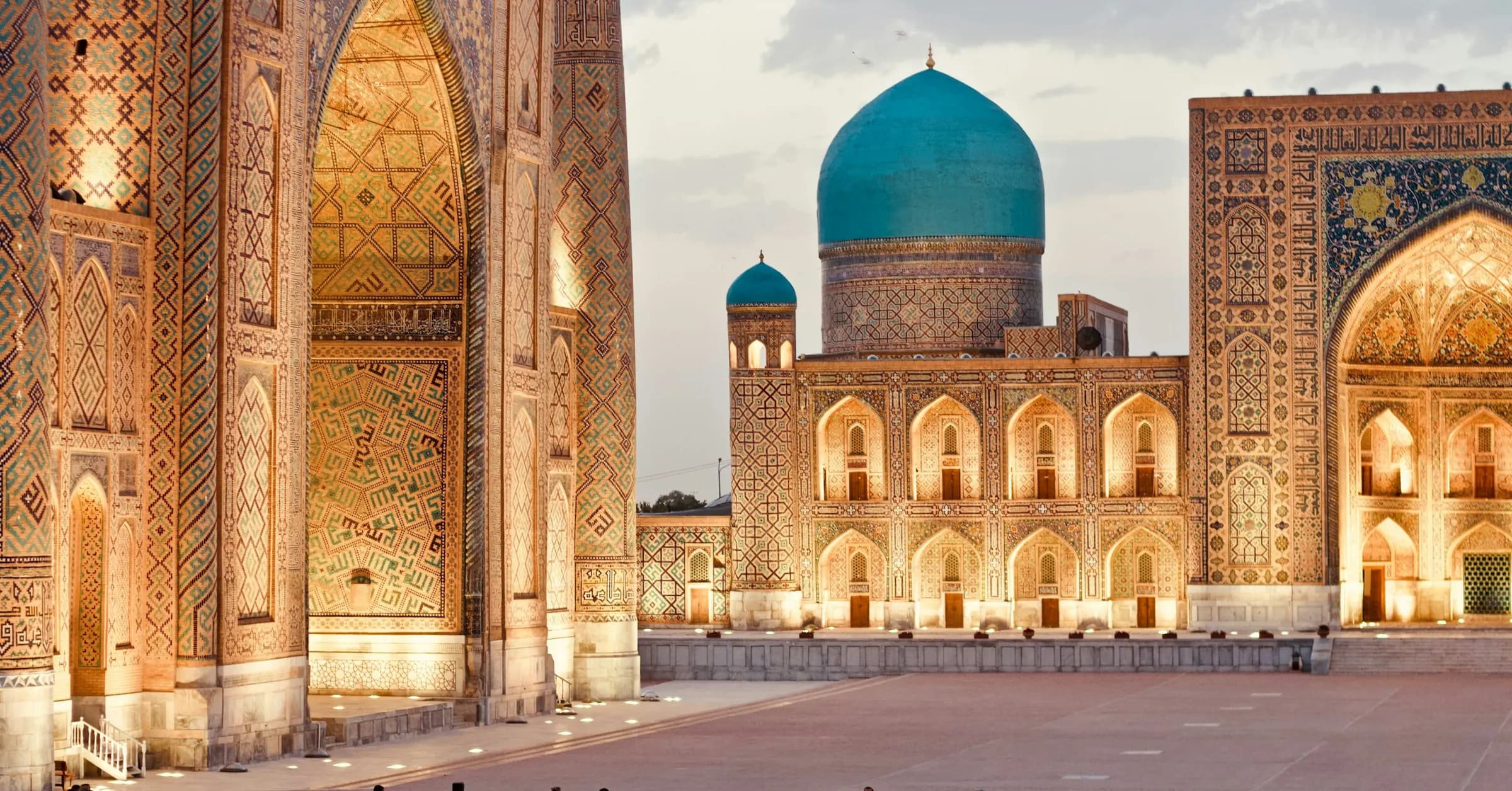
1. Stand in Registan Square
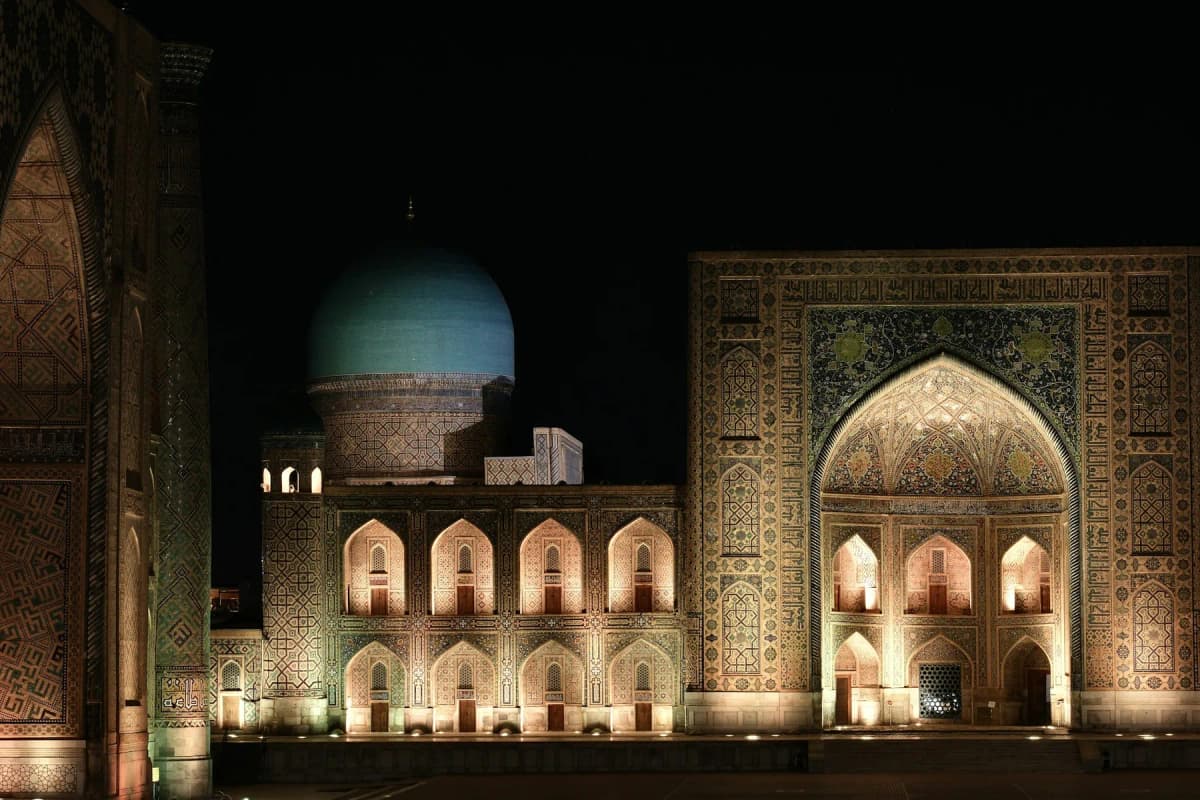 Photo: Alessio Roversi on Unsplash
Three huge madrasas, built between the fifteenth and seventeenth centuries, face each other across one square, every surface covered in blue, turquoise and gold tilework. The Registan is the single most famous sight in Central Asia, and it lives up to the photos. The ticket lets you walk into the square and the madrasa courtyards, where the old student cells are now craft shops.
- Ticket: 100,000 som for a foreign adult in 2026 (about $8).
- Tip: come back after dark, when the facades are lit and the square looks completely different. Watching from the steps outside is free.
2. Walk the avenue of tombs at Shah-i-Zinda
A narrow lane climbs a hill past a row of mausoleums, each one tiled more richly than the last. Shah-i-Zinda ("the living king") grew up around a shrine to Qusam ibn Abbas, a cousin of the Prophet Muhammad, and many of Timur's relatives are buried here. It's a working pilgrimage site, so dress modestly and keep your voice down. Go early in the morning for soft light and fewer people.
- Ticket: 80,000 som in 2026.
3. See Timur's tomb at Gur-e-Amir
Timur himself lies under a fluted turquoise dome a short walk from the Registan. The interior is gilded from floor to ceiling, and a dark green jade block marks his grave. It's small and quick to see, so it's easy to combine with an evening walk.
- Ticket: 75,000 som in 2026.
To understand who built what and why, a small-group Samarkand heritage tour covers the Registan, Shah-i-Zinda and Gur-e-Amir with a guide in a few hours.
Bukhara
Bukhara is the most atmospheric of the Silk Road cities: a lived-in old town of mud-brick lanes, trading domes, pools and madrasas, almost all of it walkable. See our guide to the 15 best things to do in Bukhara for the full list and 2026 ticket prices.
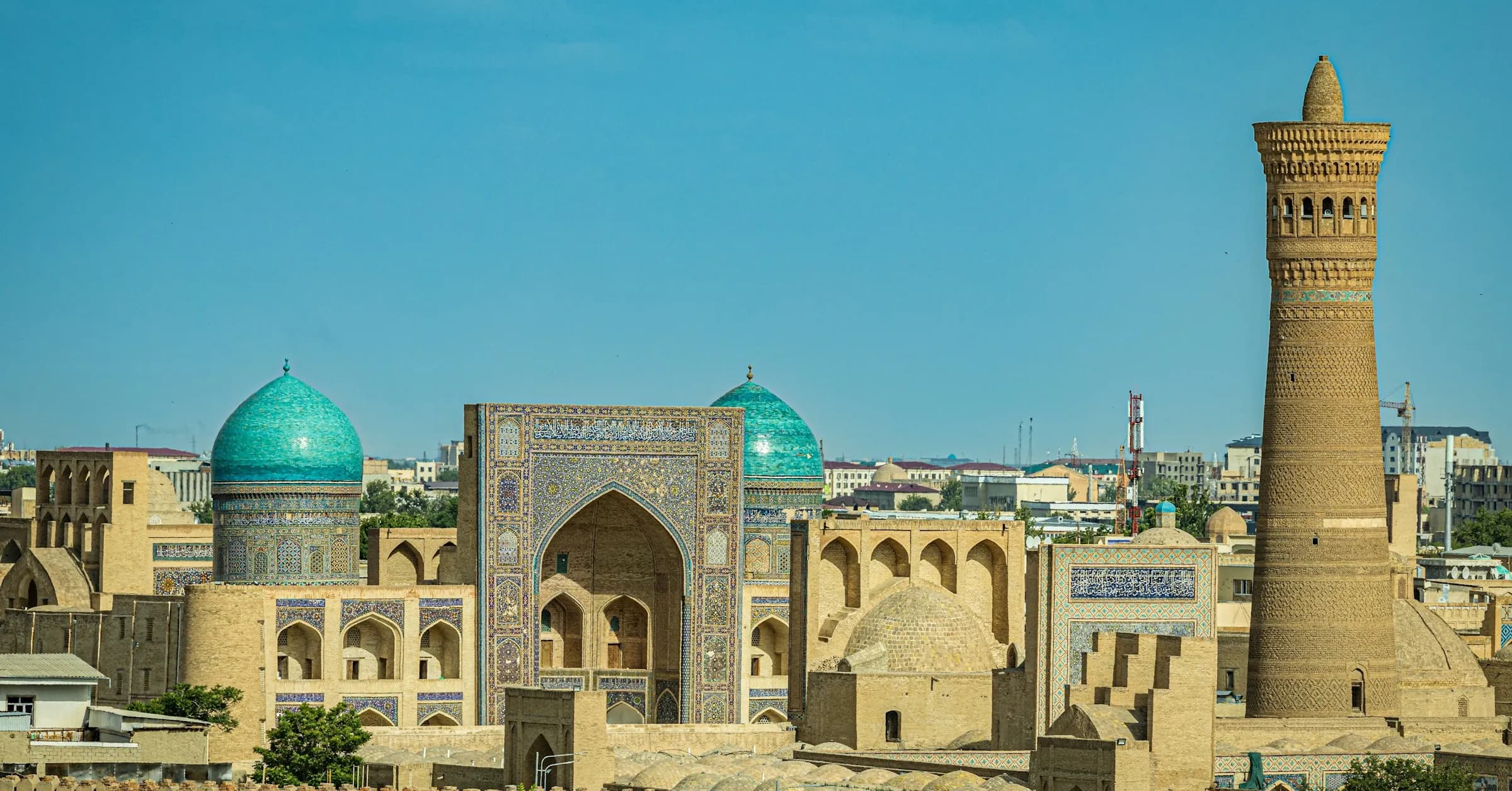
4. Look up at the Kalyan Minaret
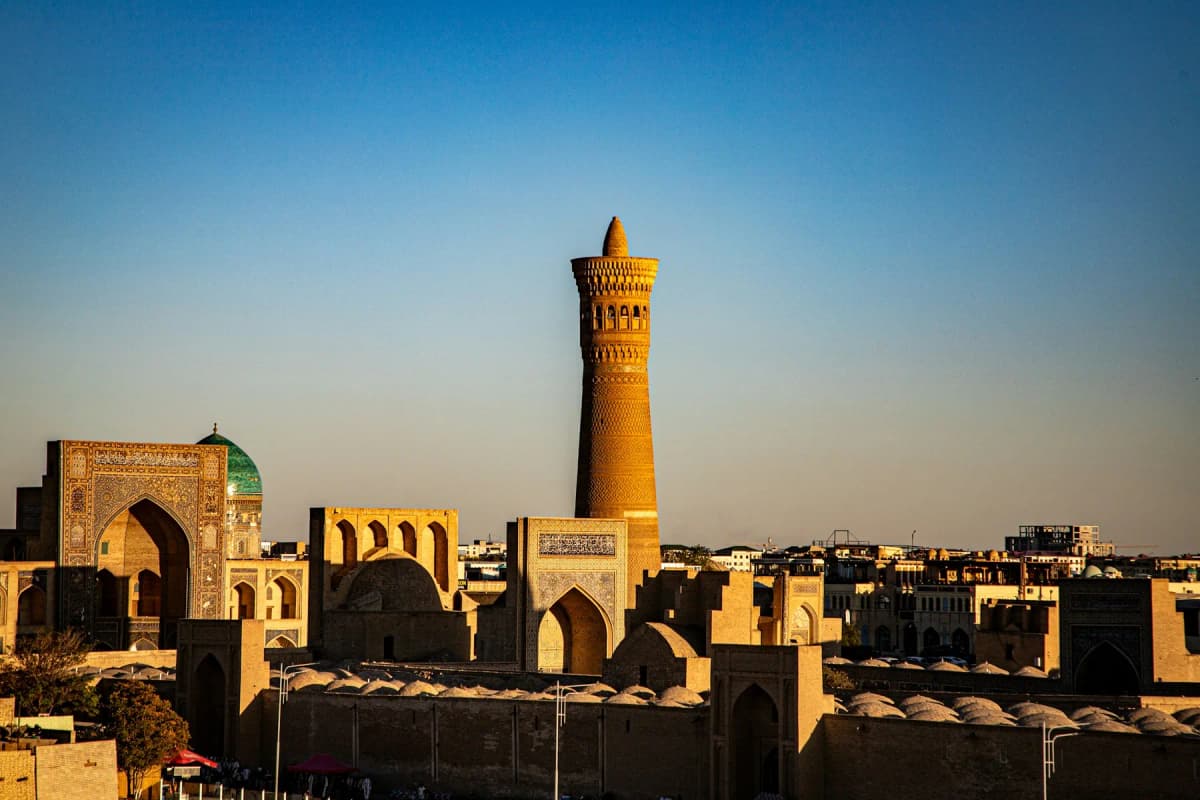 Photo: Bernd Dittrich on Unsplash
Built in 1127, the Kalyan Minaret (Po-i-Kalyan) is so well made that Genghis Khan is said to have spared it when he destroyed the rest of the city. It stands over a square with the Kalyan Mosque on one side and the working Mir-i-Arab Madrasa, with its two blue domes, on the other. The square itself is free, and it's at its best in the late afternoon.
5. Spend an evening at Lyabi-Hauz
Lyabi-Hauz is a stone-edged pool shaded by old mulberry trees, with teahouses around it and two madrasas facing it across the water. It's the social heart of the old town, and the natural place to end every day in Bukhara with a pot of green tea. It costs nothing to sit by the water.
6. Explore the Ark fortress
The Ark is the massive mud-brick citadel where the emirs of Bukhara lived and ruled until 1920. Inside are a mosque, a throne room and several small museums. The ramp up to the gate and the walls from outside are the most striking part.
- Ticket: 60,000 som in 2026.
If you'd like the stories behind the buildings, a small-group walking tour of Bukhara's old city is a good way to start your first day.
Khiva
Khiva's inner walled town, Itchan Kala, is a UNESCO World Heritage Site and the most complete old town in Uzbekistan. It's far from the other cities, which is exactly why it feels so different. Our guide to getting from Bukhara to Khiva covers the new fast train, sleepers and private transfers.
7. Sleep inside Khiva's Itchan Kala
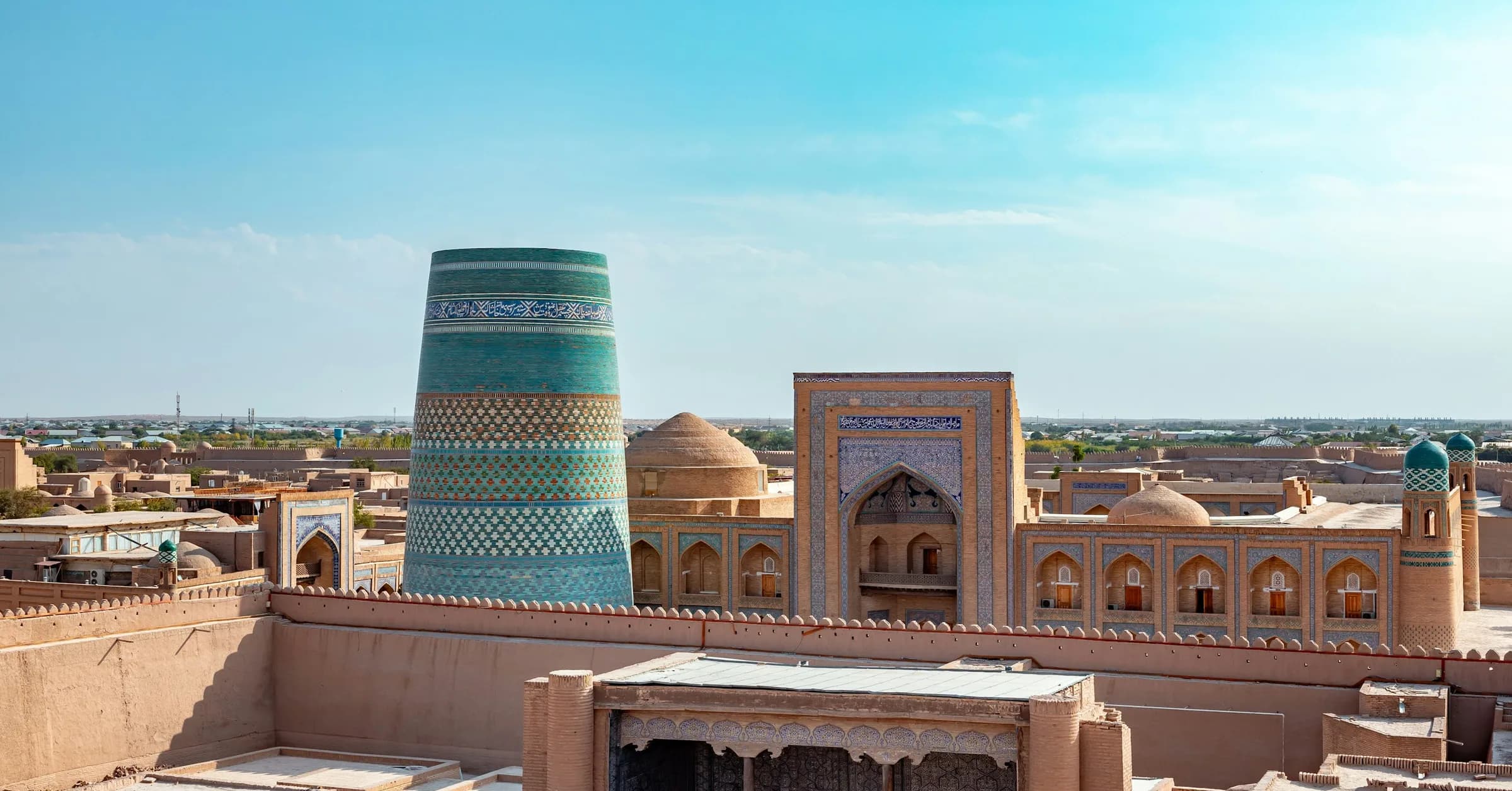
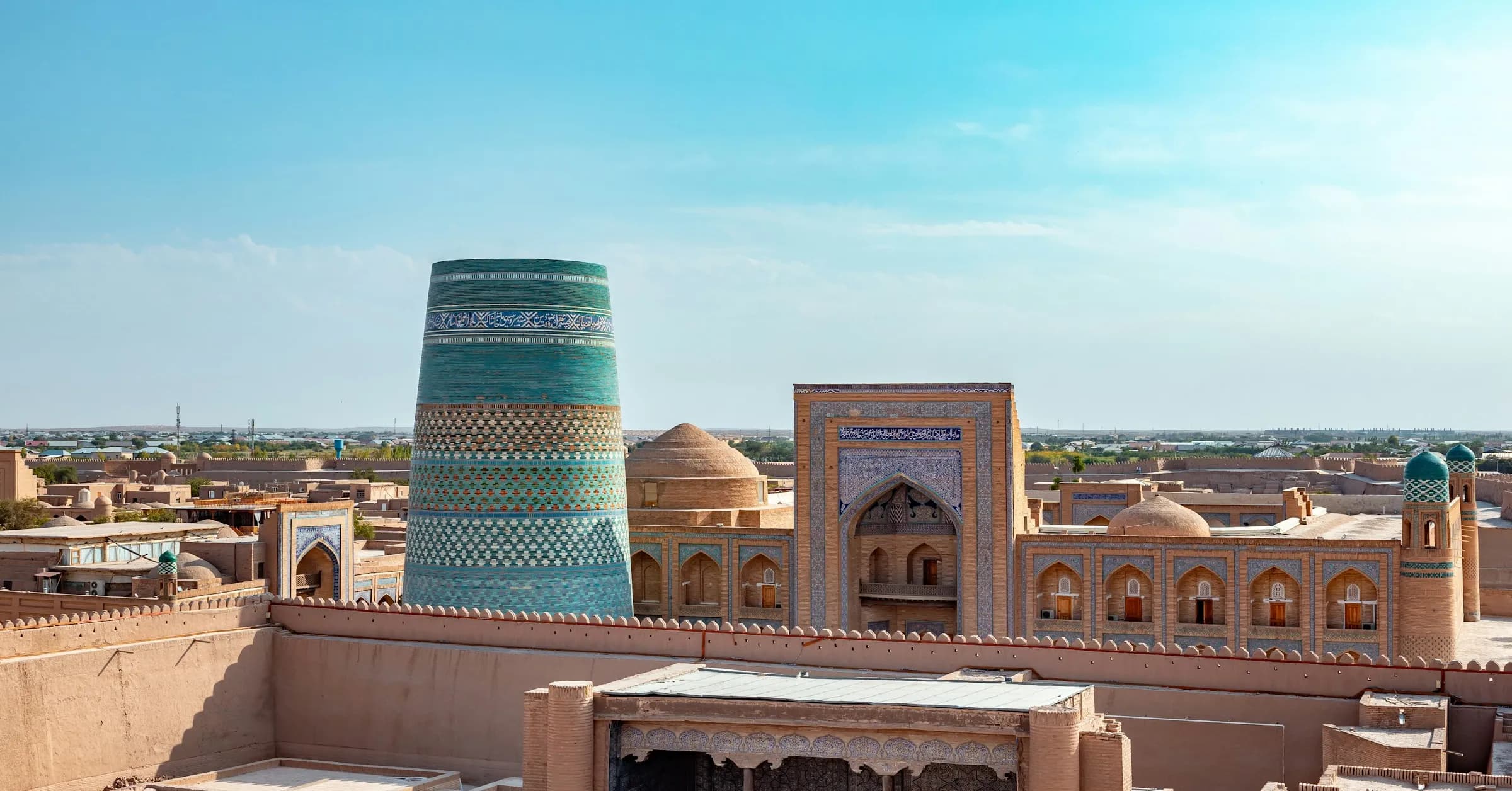
Itchan Kala is small enough to walk across in about 15 minutes, and it's packed with minarets, madrasas and palaces: the unfinished, turquoise Kalta Minor minaret, the Kunya Ark fortress, and the Juma Mosque, with its forest of carved wooden columns. The day-trippers leave in the late afternoon, so stay at least one night, ideally two, in a guesthouse inside or just outside the walls.
- Ticket: a combined ticket covers most of the sights inside the walls. Recent traveller reports put it at around 150,000 som for a foreign adult, with some quoting up to 250,000, plus small extra fees for climbing a minaret or the walls. Check the price at the West Gate when you arrive.
8. Climb a minaret and walk Khiva's walls at sunset
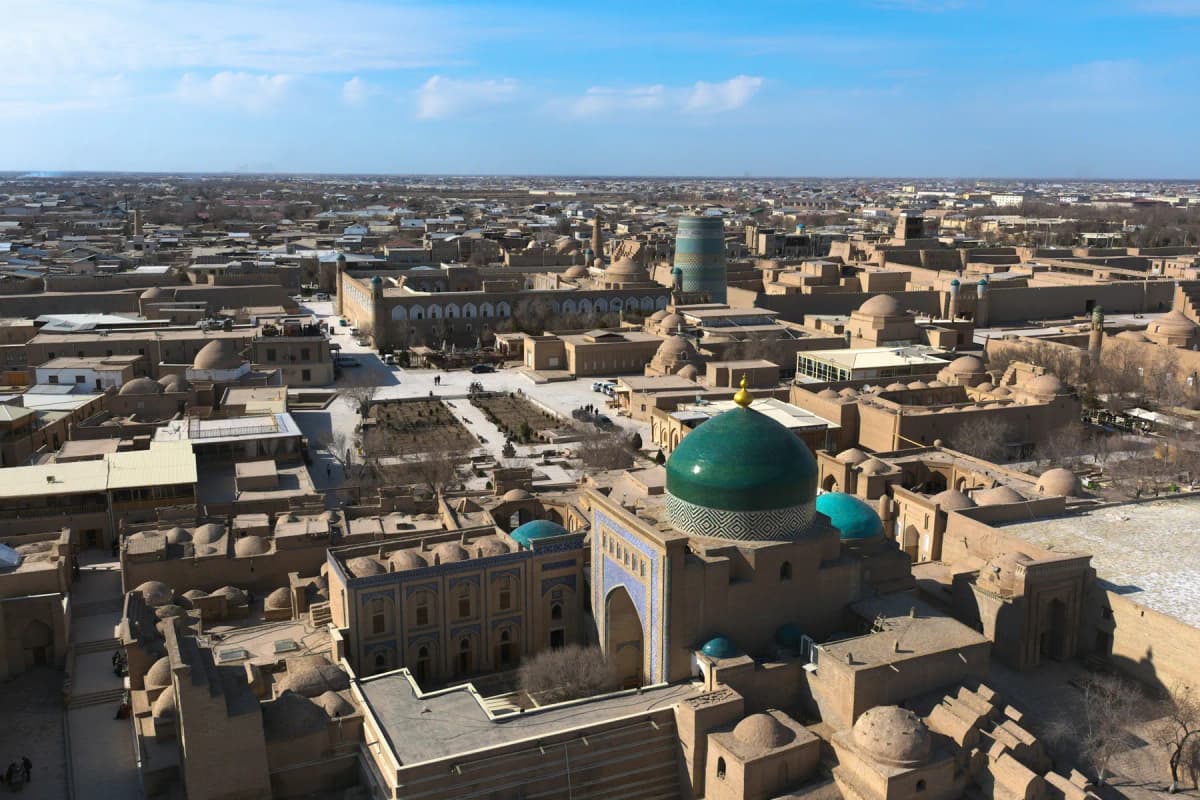 Photo:
 For the best view over Khiva's flat roofs and domes, climb the Islam Khodja minaret, the tallest in the town, or one of the watchtowers of the Kunya Ark. Then walk a section of the thick mud-brick walls at sunset, when the town turns gold. The steps inside the minaret are steep, narrow and dark, so take it slowly.
Tashkent
Tashkent is a big, green, modern capital that was largely rebuilt after an earthquake in 1966. It's not the reason most people come to Uzbekistan, but it deserves a full day.
9. Ride the Tashkent metro
The Tashkent metro is one of the most beautiful in the former Soviet Union, and one of the cheapest sightseeing trips anywhere. Stations such as Kosmonavtlar (with portraits of cosmonauts) and Alisher Navoi (with domes and carved plaster) look more like palaces than transport hubs.
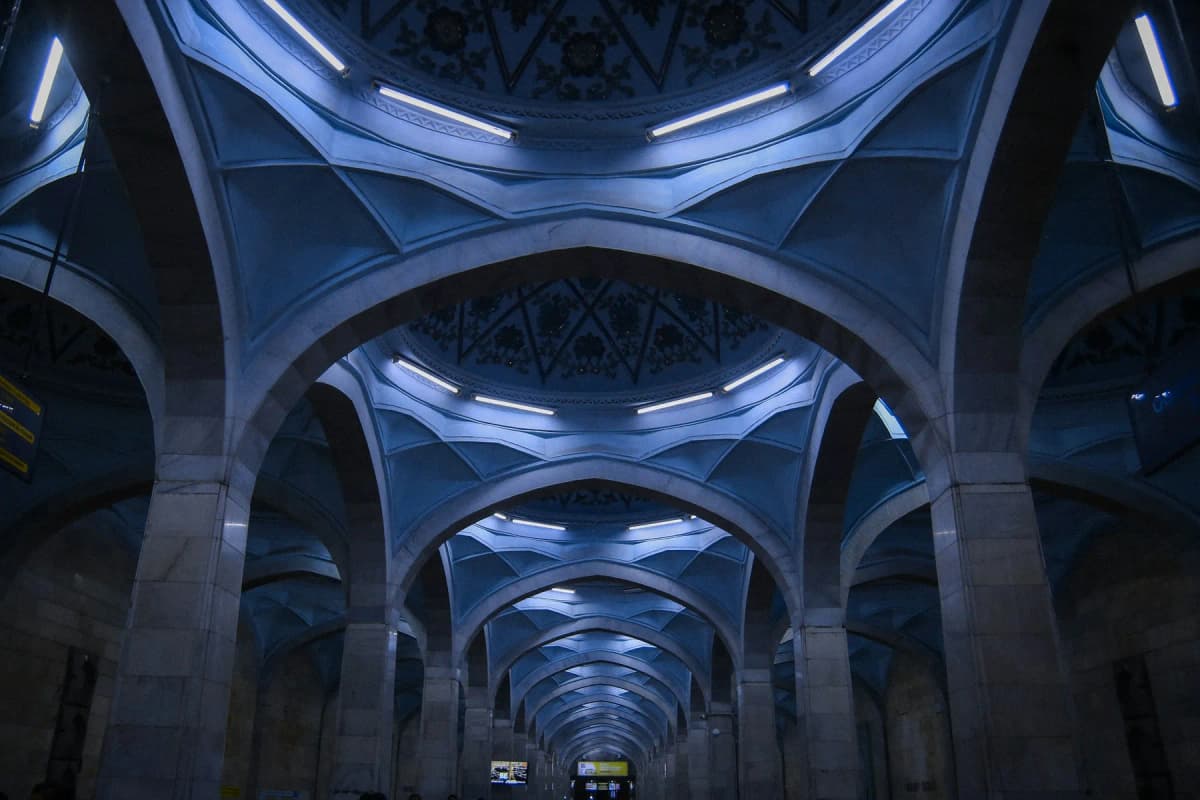 Photo: Salohiddin Kamolov on Unsplash
Photography in the metro has been allowed since 2018.
- Fare: from 1 October 2026, a single ride costs 2,500 som with a transport card or contactless payment and 3,000 som in cash, according to Uzbekistan's Ministry of Transport on gov.uz.
10. Shop at Chorsu Bazaar and visit Hazrati Imam
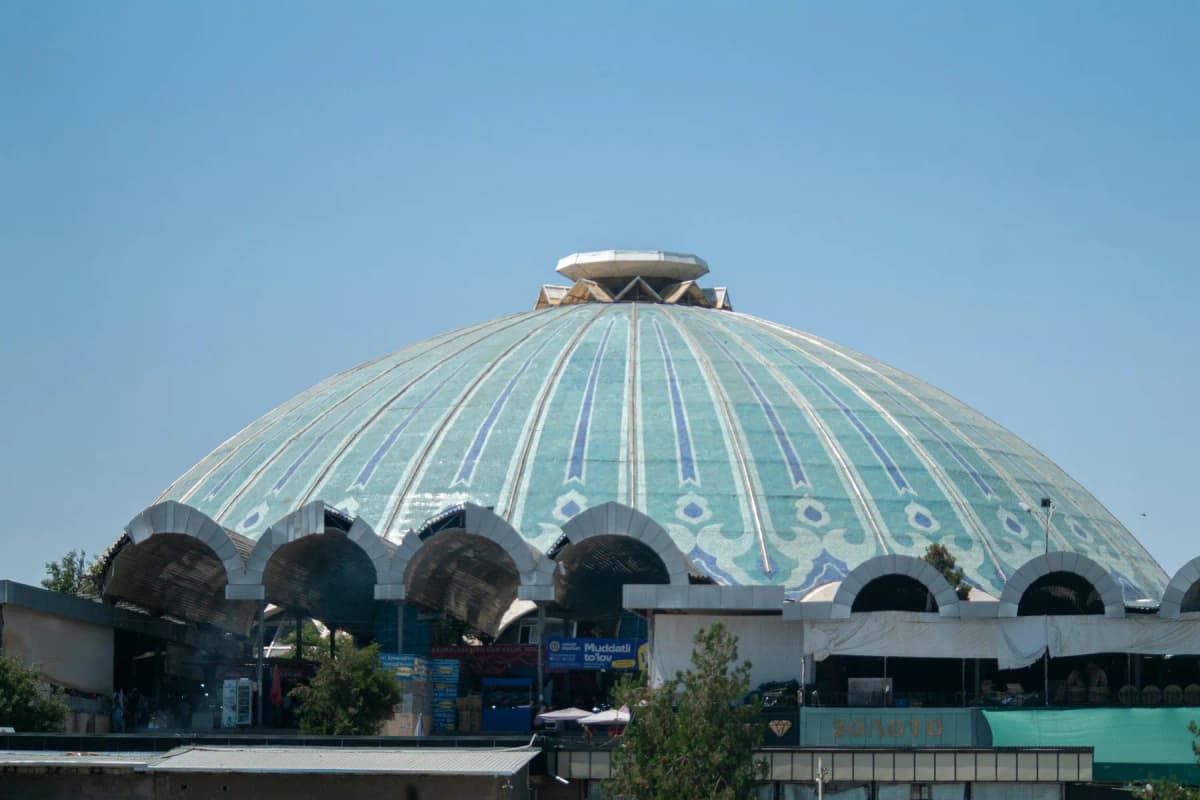 Photo: Dasha Novikova on Unsplash
Under a huge green dome, Chorsu Bazaar sells dried fruit, nuts, spices, round non bread, and meat and dairy in the hall below. Around it, the streets fill with stalls selling everything else. A short ride away, the Hazrati Imam (Khast Imam) complex in the old town has a library that holds a Qur'an traditionally said to be the copy Caliph Uthman was reading when he was killed in 656. Combine the two in one morning.
11. Eat plov from a giant cauldron
Plov, rice cooked with meat, carrots, onions and spices, is Uzbekistan's national dish, and every region has its own version. In Tashkent, the Central Asian Plov Centre near the TV tower cooks it in enormous kazans (cauldrons) over open fires, and it's one of the best places to see the scale of it. Plov is traditionally a lunchtime dish, and the best places often sell out early in the afternoon, so go before about 1 pm.
Around the country
12. Ride the Afrosiyob high-speed train
The Afrosiyob is Uzbekistan's high-speed train, and it makes the classic route easy: Tashkent to Samarkand takes just over two hours, and Samarkand to Bukhara under two hours. Economy from Tashkent to Samarkand costs about 311,000 som (around $26). Tickets are sold on the official Uzbekistan Railways site, eticket.railway.uz, and sell out fast in spring and autumn. Our guide to getting from Tashkent to Samarkand explains how to book.
13. Take a day trip to Shahrisabz
Timur was born near Shahrisabz, about 90 km south of Samarkand, and the town's historic centre is a UNESCO World Heritage Site. The surviving fragments of his Ak-Saray ("White Palace") gateway are so massive that you can still imagine the scale of the palace. The drive crosses the Takhtakaracha pass in the Zarafshan mountains, which is half the fun. Allow about 1.5 to 2 hours each way, or book a private Shahrisabz day tour from Samarkand with a driver and guide.
14. Sleep in a yurt camp in the Kyzylkum Desert
Between Samarkand and Bukhara, several yurt camps near Lake Aydarkul offer a night in the Kyzylkum Desert, usually with dinner, a camel ride, a campfire and a sky full of stars. It works best as a one-night detour by car from Samarkand, continuing to Bukhara the next day. Spring and autumn are the best seasons: summer days in the desert are very hot, and winter nights are freezing.
15. Visit the desert fortresses of ancient Khorezm
North of Khiva, in the region known as Elliq Qala ("fifty fortresses"), the ruins of mud-brick forts stand alone in the desert. Some, such as Ayaz Kala and Toprak Kala, are over 2,000 years old. You'll need a car and driver for a half-day trip from Khiva, or you can stop on the drive from Bukhara.
16. Watch silk and ceramics made in the Fergana Valley
The fertile Fergana Valley, in the far east of the country, is Uzbekistan's craft heartland. In Margilan, workshops dye and weave silk by hand using the ikat technique the town is known for. Rishtan, about an hour west, has made blue-glazed ceramics for centuries, and several family workshops welcome visitors. The train from Tashkent takes around 5 to 6 hours through the mountains. Allow two days, including Kokand and its tiled Khudoyar Khan Palace.
17. See the avant-garde art of the Savitsky Museum
In Nukus, the capital of the Karakalpakstan region in the far west, the Savitsky Museum holds one of the world's largest collections of Russian avant-garde art. In the Soviet era, the artist Igor Savitsky gathered tens of thousands of works that had been banned in Moscow and hid them in a provincial museum in the desert. It's a long way from anywhere, but it's the most unusual museum in Central Asia. Part of the museum was restored and rehung in 2025, so check opening hours before you go.
18. Stand among the ships of the dried-up Aral Sea
The Aral Sea was once one of the largest lakes in the world, but since the 1960s it has shrunk dramatically after its rivers were diverted to irrigate cotton fields. At Moynaq, once a fishing port, rusting ships lie on the sand of the old seabed, and a small museum tells the story. It's a long and sobering day trip from Nukus, and one of the most memorable places in the country.
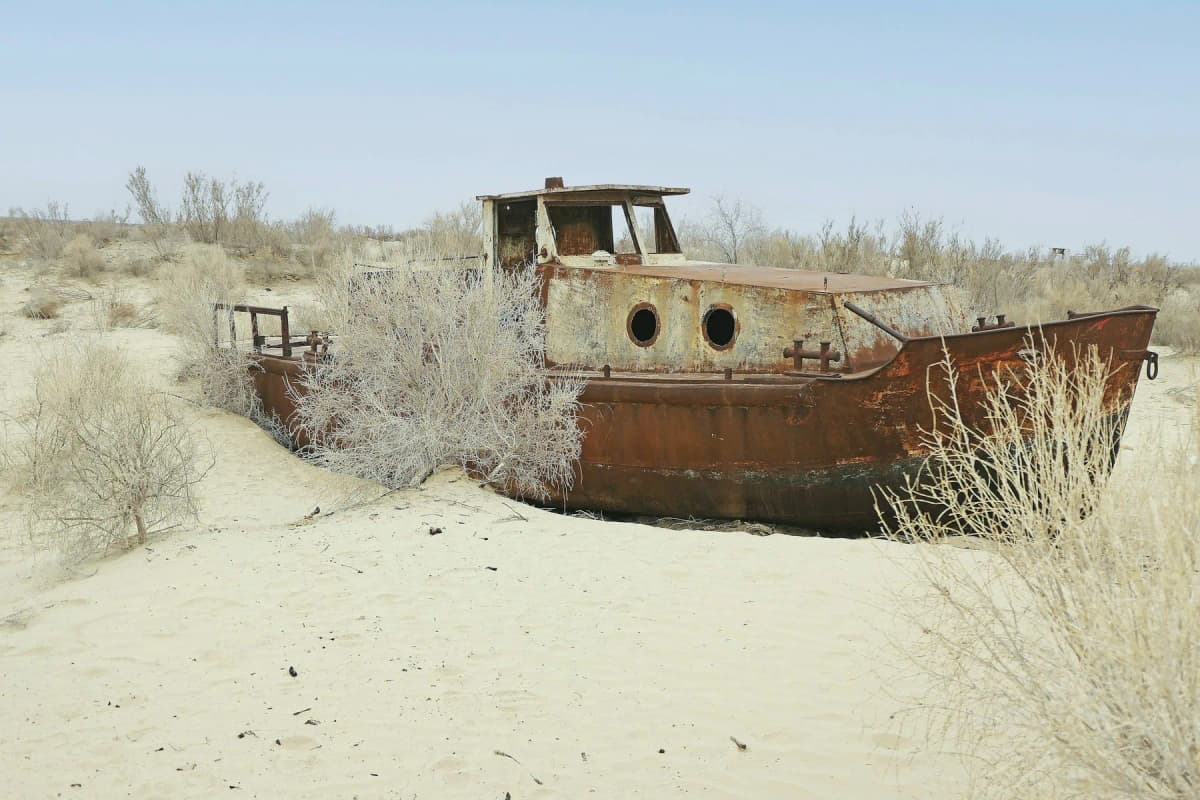 Photo: Tim Broadbent on Unsplash
What else to do if you have more time
- Hike in the Chimgan mountains. About two hours by road from Tashkent, the mountains and the Charvak reservoir are where Tashkent goes to escape the summer heat.
- Visit a hammam in Bukhara. A few historic bathhouses in the old town are still in use; book a session through your guesthouse.
- Watch paper made by hand at Konigil. Just outside Samarkand, a workshop makes paper from mulberry bark using a centuries-old method.
- Try Uzbek wine. Samarkand has a long winemaking history, and several wineries offer tastings.
How much do things to do in Uzbekistan cost?
Most sights in Uzbekistan are cheap by international standards, but fees in Samarkand have risen sharply. In 2026 a foreign adult paid 100,000 som for the Registan, 80,000 som for Shah-i-Zinda and 75,000 som each for Gur-e-Amir and Bibi-Khanym. Seeing all of Samarkand's main sights costs about 600,000 to 700,000 som ($50 to $58). Bukhara is much cheaper, at roughly 200,000 to 350,000 som ($17 to $30) for all the main paid sights, with many squares and pools free.
Prices are in Uzbek som. In September 2026, there were roughly 12,000 som to the US dollar. Carry cash for tickets, taxis and bazaars; cards work in hotels and on the railway website.
Getting around Uzbekistan
- Trains connect Tashkent, Samarkand, Bukhara and Khiva, and are the easiest way to travel. Book early in spring and autumn.
- Yandex Go is the app most people use for taxis in the cities. It shows the fare upfront.
- Shared taxis run between cities when trains are full and leave when all four seats are sold.
- Domestic flights are useful for the long legs, such as Tashkent to Urgench (for Khiva) or Nukus.
If you land late at night, a fixed-price Tashkent airport transfer saves you haggling at the terminal, and an Uzbekistan eSIM from Airalo gets Yandex Go and the train app working as soon as you arrive.
When to go
The best months for sightseeing in Uzbekistan are April to May and September to October, when highs in Samarkand are roughly 20 to 30 °C and it rarely rains. Summer is dry but very hot, especially in Bukhara and Khiva, and winter is cold and quiet. Our guide to the best time to visit Uzbekistan has official month-by-month weather data for every city on the route.
Practical tips
- Visa: citizens of many countries, including the US, UK, most of the EU, Canada and Australia, can visit for up to 30 days without a visa. Check the current rules for your passport before you book.
- Dress: Uzbekistan is relaxed, but cover your shoulders and knees in mosques, shrines and mausoleums.
- Cash: ATMs in the big cities accept foreign cards. Keep small notes for tickets and tea.
- Heat: in summer, sightsee early and late and rest in the middle of the day.
- Insurance: medical care outside Tashkent is basic, so travel insurance with good medical cover is worth having.
Frequently asked questions
What is Uzbekistan most famous for? Uzbekistan is most famous for its Silk Road cities: Samarkand, Bukhara and Khiva, with their tiled madrasas, mosques, minarets and mausoleums. It's also known for plov, its national rice dish, and for its crafts, including silk, ceramics and suzani embroidery.
How many days do you need in Uzbekistan? Seven days covers Tashkent, Samarkand and Bukhara. Ten days lets you add Khiva, and two weeks gives time for the Fergana Valley or a night in a desert yurt camp.
Is it safe to tour Uzbekistan now? Uzbekistan is generally considered one of the safest countries in Central Asia for tourists. Violent crime against visitors is rare, and the main risks are ordinary ones: overcharging taxi drivers, the summer heat and petty theft in crowded places. Check your government's travel advice before you go.
Do they drink alcohol in Uzbekistan? Yes. Uzbekistan is a Muslim-majority but secular country, and beer, wine and vodka are widely sold in shops, restaurants and hotels, especially in Tashkent and Samarkand. Some traditional teahouses and restaurants near religious sites don't serve alcohol, and drinking in public is frowned upon.
What to buy in Bukhara? Bukhara is known for suzani (embroidered textiles), carpets, gold embroidery, miniature paintings, ceramics, and hand-forged scissors shaped like storks. You'll find them in the trading domes and the old madrasa courtyards. Bargaining is expected.
Is Samarkand or Bukhara better? They're different. Samarkand has the grandest single monuments, such as the Registan and Shah-i-Zinda, spread across a modern city. Bukhara has a smaller, more intimate old town that you can walk everywhere. Most people visit both.
How we researched this guide
Ticket prices for Samarkand and Bukhara are the 2026 foreign adult prices from our city guides, collected from official ticket offices, recent traveller reports and 2026 guides; sources don't always agree, so treat them as a guide. The Khiva combined ticket is based on recent traveller reports and is not confirmed by an official source. The Tashkent metro fare comes from Uzbekistan's Ministry of Transport on gov.uz. Train times and fares come from Uzbekistan Railways. Background on the World Heritage sites comes from UNESCO's listings for Samarkand, Bukhara, Itchan Kala and Shahrisabz. Prices and opening hours were checked in October 2026 and change often. Found something out of date? Let us know.
Ready to plan? Read our Uzbekistan itinerary for 7, 10 and 14 days, find out the best time to visit Uzbekistan, or browse all our Uzbekistan guides.