15 Best Things to Do in Bukhara (2026 Prices & Tips)
September 30, 2026 · Uzbekistan
This post contains affiliate links. We may earn a commission if you book through them, at no extra cost to you. Disclaimer.
If Samarkand is the Silk Road's showpiece, Bukhara is the place where it still feels lived in. The old city is a low, sand-coloured maze of lanes, domed bazaars and courtyards, with more than a hundred listed monuments packed into an area you can cross on foot in half an hour. People still shop under the sixteenth-century trading domes, drink tea by a seventeenth-century pool and study in a madrasah that has barely closed its doors since the 1530s. The historic centre is a UNESCO World Heritage Site, and unlike many old towns, it hasn't been turned into a museum you visit and leave.
This guide covers the best things to do in Bukhara, what each sight costs in 2026, the best time of day for each one, and how to fit them into two or three days. We've also answered the questions people ask most before they go: whether two days is enough, what to do at night, and whether Bukhara or Samarkand deserves more of your time.
Things to do in Bukhara: the quick list
| If you have… | Do this |
|---|---|
| 1 day | Po-i-Kalyan at sunrise, the trading domes, Magoki-Attori and the Ark, then dinner and a night walk around Lyabi-Hauz |
| 2 days | Add Chor Minor, the Ismail Samani Mausoleum and Chashma Ayub, Bolo-Hauz Mosque, the Ulugbek madrasah and an evening folk show |
| 3 days | Add the emir's summer palace (Sitorai Mohi-Khosa), the Bahauddin Naqshband shrine and a hammam |
| 4+ days | Slow down: craft workshops, a long plov lunch, sunset from a rooftop terrace, and a day in the lanes away from the main sights |
Our short version: give Bukhara two full days and three nights if you can. The old town is at its best early in the morning and after dark, when the day-trippers have gone and the monuments are lit up, and you'll only see that if you sleep inside or next to it. Stay near Lyabi-Hauz, walk everywhere, and carry cash in som for tickets.
2026 entry fees at a glance
Most of Bukhara's best sights are cheap or free: the pools, the trading domes and the squares cost nothing, and several of the smaller madrasahs charge around 20,000 som. These are the foreign adult prices we found for 2026, in Uzbek som (roughly 12,000 som to the US dollar in September 2026).
| Sight | Foreign adult ticket |
|---|---|
| The Ark fortress | 60,000 som (about $5) |
| Sitorai Mohi-Khosa (emir's summer palace) | 30,000–60,000 som |
| Kalyan Mosque | About 20,000 som |
| Ulugbek Madrasah | About 20,000 som |
| Abdulaziz-Khan Madrasah | About 20,000 som |
| Magoki-Attori Mosque (carpet museum) | About 20,000 som |
| Nodir Devon Begi Madrasah | About 20,000 som |
| Chashma Ayub (water museum) | About 20,000 som |
| Lyabi-Hauz, trading domes, Bolo-Hauz, Chor Minor (outside), Mir-i-Arab (entrance hall), Bahauddin Naqshband | Free |
Seeing all the main paid sights costs roughly 200,000–350,000 som ($17–30) per adult, much less than Samarkand. Sources don't always agree: one 2026 guide quotes 25,000–50,000 som per site, and small extra fees for climbing a tower or for a camera are common. Treat the table as a guide and keep some small notes handy.
Guide or no guide? Bukhara is easy to explore alone, but the stories behind the buildings (the emirs, the executions, the Great Game spies) make much more sense with someone to tell them. If you want that context without paying for a private guide, a small-group walking tour of Bukhara's old city with an English-speaking guide costs around $20–25 and leaves in the morning. Do it on your first day and you'll get more out of everything else.
1. Look up at the Kalyan Minaret (Po-i-Kalyan)
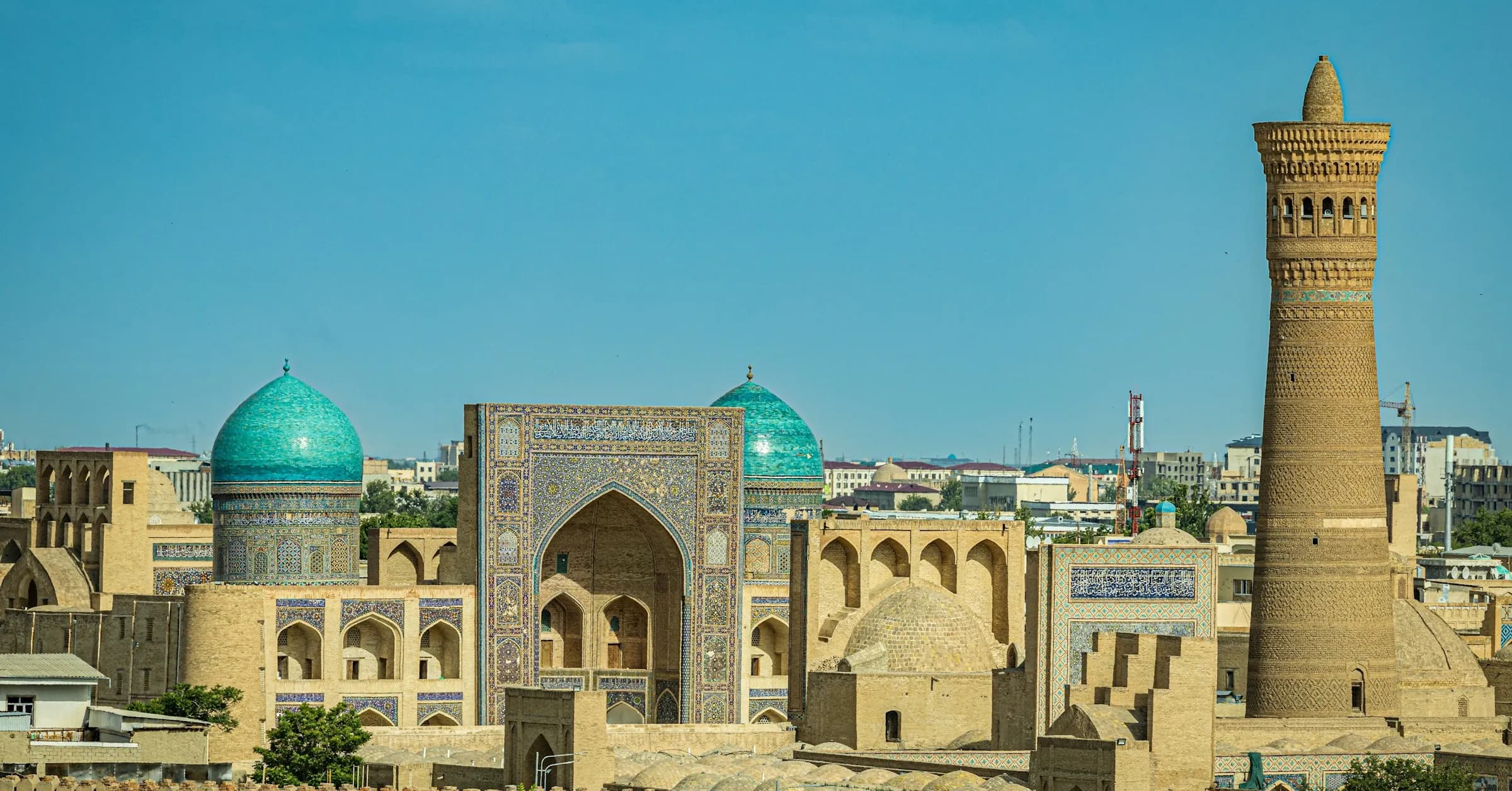
The Kalyan Minaret has been Bukhara's landmark since 1127. At about 46 metres it was one of the tallest buildings in Central Asia, and its bands of patterned brickwork have barely changed in nine centuries. The story goes that when Genghis Khan took the city in 1220 and destroyed almost everything else, he was so impressed by the minaret that he ordered it spared. It was later nicknamed the "Tower of Death", because criminals were said to have been thrown from the top.
The minaret is the centrepiece of the Po-i-Kalyan ensemble, a square framed by the Kalyan Mosque and the Mir-i-Arab Madrasah. The Kalyan Mosque (rebuilt in 1514) is huge: its arcaded courtyard was designed to hold around 10,000 worshippers for Friday prayers, and the lone pavilion in the middle, with a mulberry tree beside it, is one of the most photographed spots in the city.
- Hours: the square is open all the time; the mosque courtyard generally keeps daytime hours (roughly 9:00 to 18:00, longer in summer).
- Best time: sunrise, when the square is empty and the brick turns gold, and again after dark, when the minaret is lit up.
- Watch out for: the minaret itself is not open to climb. Anyone offering to take you up for a tip is asking for trouble.
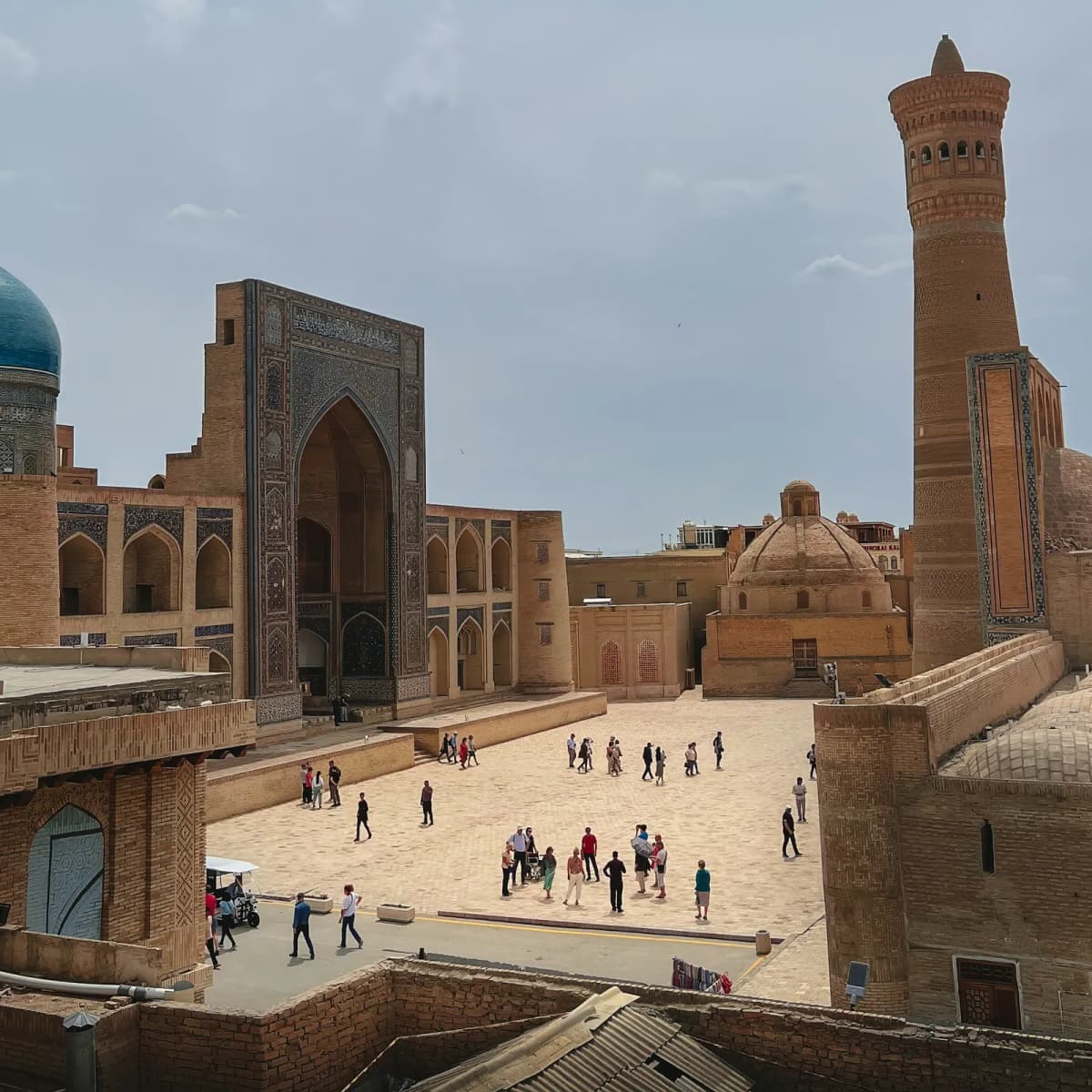 Photo: Alexander Popovkin on Unsplash
2. Step inside the Mir-i-Arab Madrasah
Opposite the Kalyan Mosque, the two turquoise domes of the Mir-i-Arab Madrasah (built in the 1530s) are the picture most people take home from Bukhara. It's one of the few madrasahs in the country that is still a working religious school, even through the Soviet period, so visitors can't go beyond the entrance hall. Step in anyway: from the vestibule you can look through the grille into the courtyard and see the students' cells.
Come back in the late afternoon, when the sun hits the façade straight on, or stand in the square after dark, when the domes and the minaret are floodlit. Dress modestly here: shoulders and knees covered.
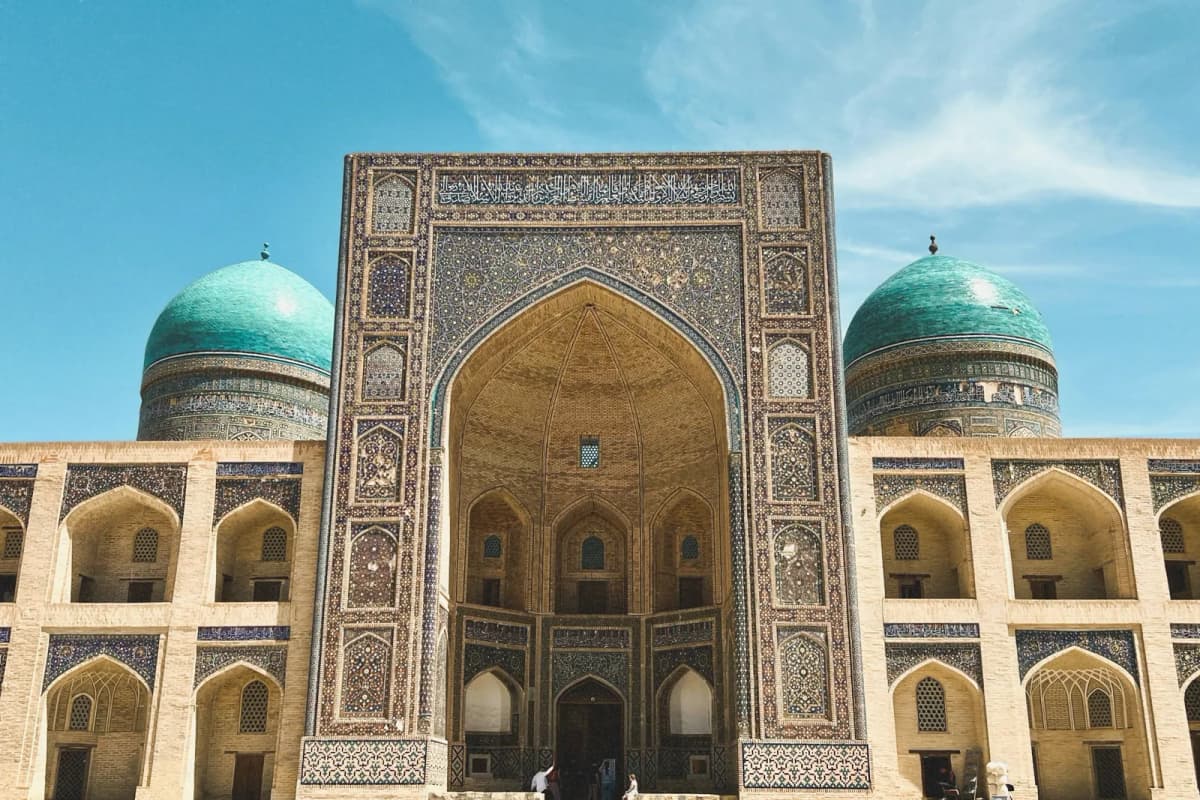 Photo: Alex Sirin on Unsplash
3. Explore the Ark fortress (and Bolo-Hauz Mosque)
The Ark is a massive walled citadel on a man-made mound at the western edge of the old city, and the site has been fortified for well over a thousand years. It was the seat of Bukhara's emirs until 1920, when the Red Army captured the city and much of the interior was destroyed. Today you walk up the ramp through the main gate to courtyards, a throne room, a mosque with a carved wooden porch and a series of small museums covering Bukhara's history, coins and crafts.
The square in front of the gate, the Registan (not to be confused with Samarkand's), was where public executions took place. The most famous victims were two British officers, Charles Stoddart and Arthur Conolly, beheaded here in 1842 after years in the emir's prison, one of the darker episodes of the "Great Game" between Britain and Russia.
Across the road, the Bolo-Hauz Mosque (1712) was the emir's Friday mosque. Its front porch is held up by twenty tall, carved wooden columns, and with their reflections in the pool in front, locals call it the mosque of forty columns. It's free to look at, and lovely at dusk.
- Ticket: 60,000 som for the Ark in 2026.
- Best time: mid-morning, then cross to Bolo-Hauz in the late afternoon.
- Worth knowing: the museum displays are uneven and the labelling is patchy. The walls, the view over the old city and the story are the real draw.
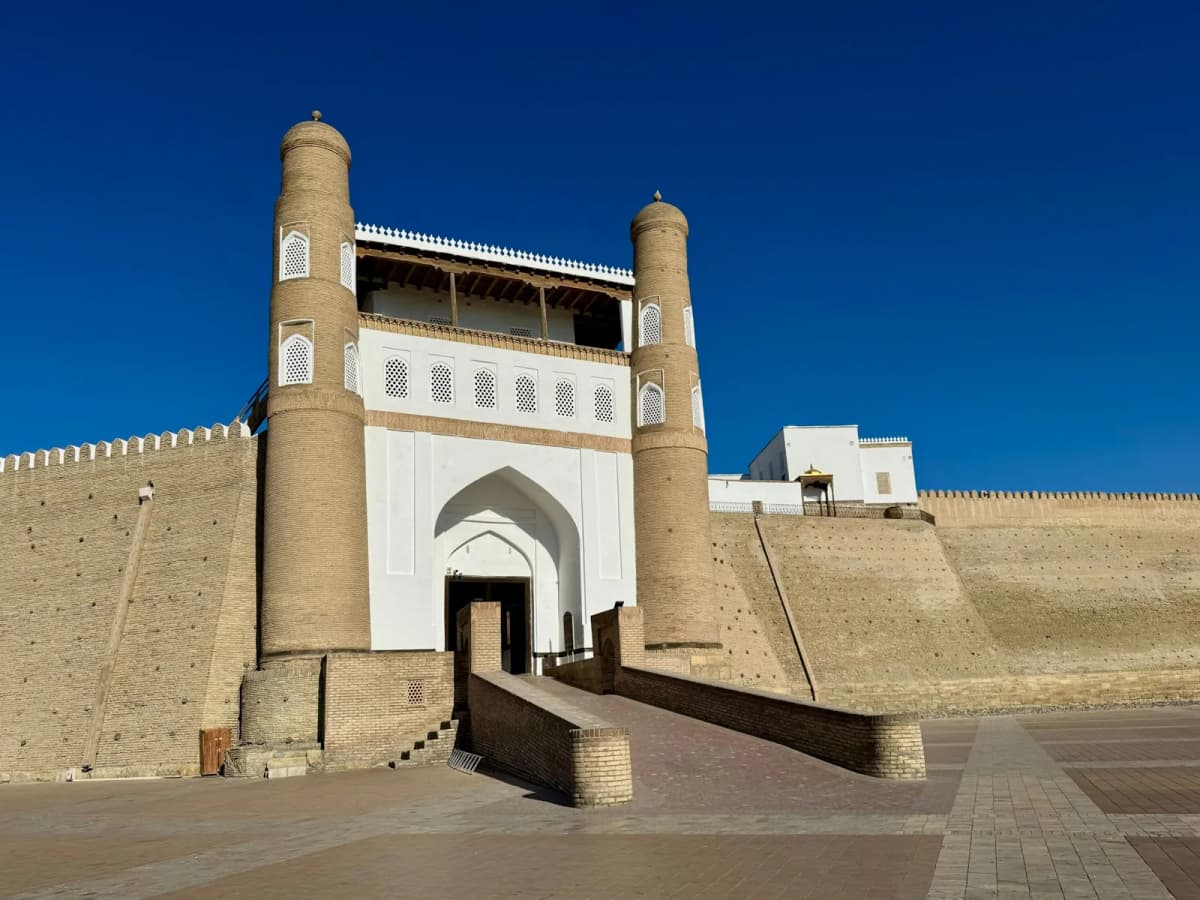 Photo: Nodir Khalilov on Unsplash
4. Slow down at Lyabi-Hauz
Lyabi-Hauz, a stone-edged pool built in 1620, is the heart of the old town and the place you'll keep coming back to. Old mulberry trees shade the water, teahouses set out tables along its edge, and in the evening half of Bukhara seems to be sitting around it. On three sides are the Kukeldash Madrasah (1568–69), once one of the largest in Central Asia, and the Nodir Devon Begi Madrasah and Khanaka (1620s). Look up at the Nodir Devon Begi portal: its mosaic shows two phoenix-like birds carrying deer towards a face in the sun, a bold departure from the usual rule against images of living things.
By the pool you'll also find a bronze statue of Khodja Nasreddin on his donkey. The trickster-philosopher of Central Asian folk tales is a local favourite, and rubbing the donkey is supposed to bring luck.
This is also where to eat. Order plov, shashlik or a pot of green tea at one of the terraces and watch the square. A simple meal in Bukhara costs roughly 80,000–90,000 som ($7) in 2026, and tea costs much less.
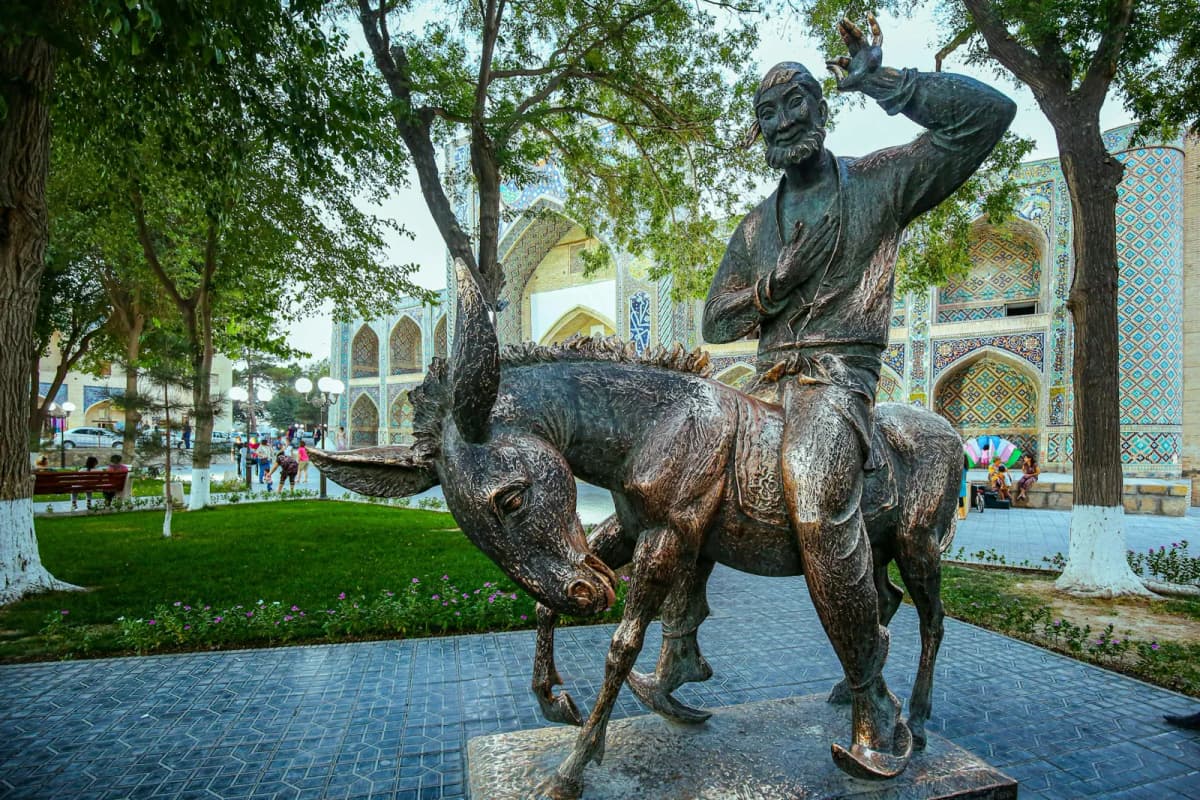 Photo:
 5. Shop under the trading domes
Between Lyabi-Hauz and Po-i-Kalyan, the main street passes under a chain of domed bazaars built in the sixteenth century, when Bukhara was one of the great markets of the Silk Road. Each dome was named after its trade, and some still echo it:
- Toki Sarrofon, the dome of the money changers, closest to Lyabi-Hauz.
- Toki Telpak Furushon, the hat sellers' dome, where five streets meet.
- Toki Zargaron, the jewellers' dome, the largest, just before Po-i-Kalyan.
Between them is the Tim of Abdullah Khan (1577), a covered market hall now full of silk and carpet stalls. Expect suzani embroidery, ceramics, knives, hats, spices and a lot of souvenirs. Browsing is free and nobody minds if you just look. Bargain politely, and compare a few stalls before you buy anything expensive.
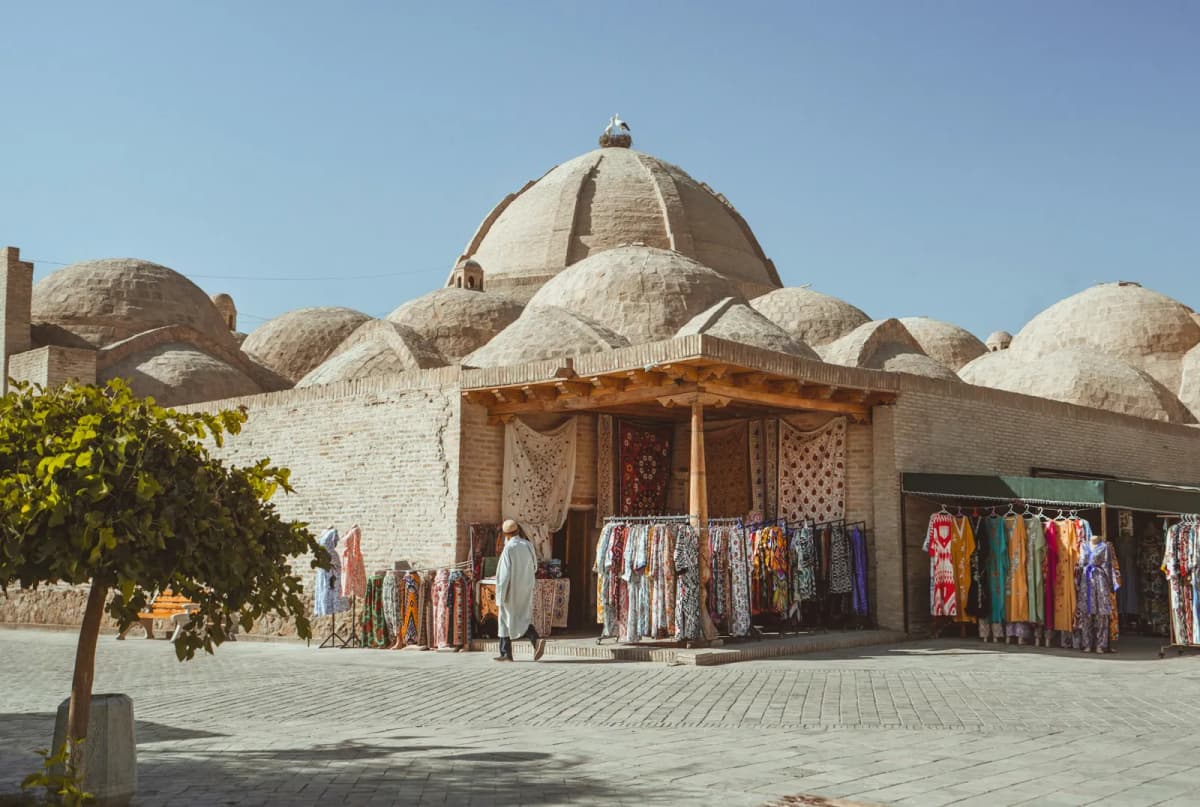 Photo: Evgeny Matveev on Unsplash
6. Find Magoki-Attori, the mosque below street level
Just off the street between the first two domes, the Magoki-Attori Mosque sits several metres below the pavement, because the city has risen around it over the centuries. It's one of the oldest surviving mosques in Central Asia: the carved brick façade dates from the twelfth century, and archaeologists found traces of earlier temples on the site. Inside is a small carpet museum (around 20,000 som). Even if you skip the museum, walk down to the entrance to see how far the ground has risen.
7. Compare the Ulugbek and Abdulaziz-Khan madrasahs
A few minutes from Toki Zargaron, two madrasahs face each other across a narrow street. The Ulugbek Madrasah (1417) was built by Timur's astronomer grandson, the same Ulugh Beg who built the observatory in Samarkand, and it's the oldest surviving madrasah in Central Asia. Its decoration is restrained and geometric.
The Abdulaziz-Khan Madrasah opposite (1652) is its flamboyant opposite, with painted interiors, stalactite vaulting and even images of birds and dragons in its tilework. Seeing the two side by side is a quick lesson in how Bukhara's architecture changed over two centuries. Each has charged around 20,000 som, and part of each is taken up by craft shops.
8. Hunt down Chor Minor
Chor Minor ("four minarets") is hidden in a residential lane about a 10-minute walk north-east of Lyabi-Hauz, and it's one of the most charming buildings in Uzbekistan. Built in 1807 as the gatehouse of a madrasah that has since vanished, it has four small towers topped with blue domes, each decorated slightly differently. There's a story that they represent the four religions the builder's daughters encountered, but nobody knows for sure.
Looking at it from outside is free. A souvenir shop occupies the ground floor, and for a small fee you've usually been able to climb to the roof for a close-up of the domes. Go in the late afternoon, when the light is soft and the lane is quiet.
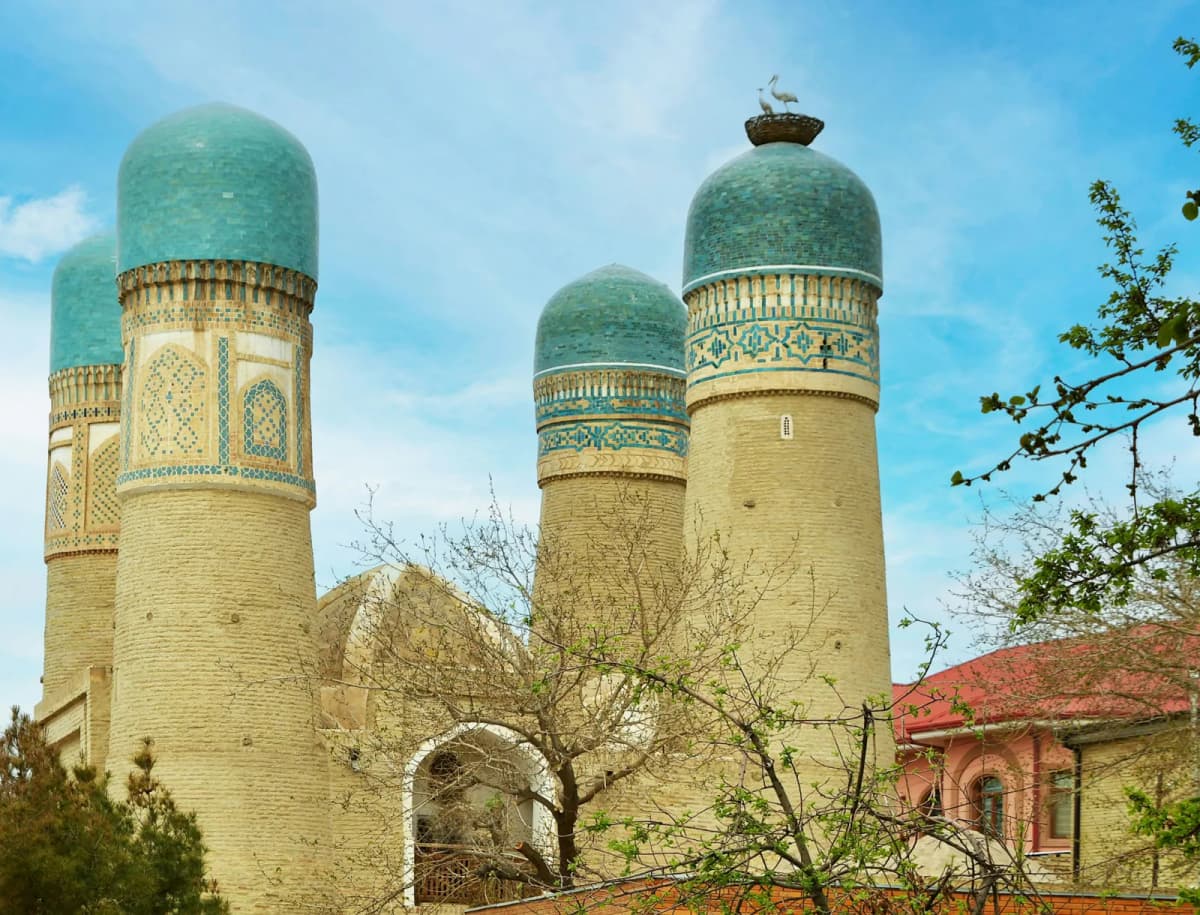 Photo: Tim Broadbent on Unsplash
9. See the Ismail Samani Mausoleum and Chashma Ayub
West of the Ark, in the leafy Samanid Park, the Ismail Samani Mausoleum is one of the oldest Islamic buildings in Central Asia, built in the tenth century for the founder of the Samanid dynasty. It's a small cube of baked brick, but the brick is laid in so many patterns that the walls look woven, and the effect changes with the light through the day. It survived because it was buried under silt and forgotten until archaeologists dug it out in the 1920s and 30s. Sources disagree on whether there's a fee; expect it to be free or cost a few thousand som.
A short walk away, Chashma Ayub ("Job's spring") is built over a well that, according to legend, the prophet Job struck from the ground with his staff. Its unusual conical dome dates from the Timurid period, and inside is a small museum about water in this desert region (around 20,000 som). Combine the two in a morning, and follow the path through the park to the Ark.
10. Browse carpet and craft workshops
Bukhara has been a crafts city for centuries, and many of the workshops in and around the old town still make things by hand. Look for carpet workshops where you can watch women knotting rugs on large looms, suzani embroiderers, gold-thread embroidery, ceramics, puppet makers and blacksmiths making knives and the famous stork-shaped scissors. The madrasah courtyards around the trading domes are full of small studios.
If you plan to buy a carpet, take your time. Ask whether it's handmade, what it's made of (wool, silk or wool on cotton) and where it was woven, and get a receipt: you may need it to take an older or valuable carpet out of the country.
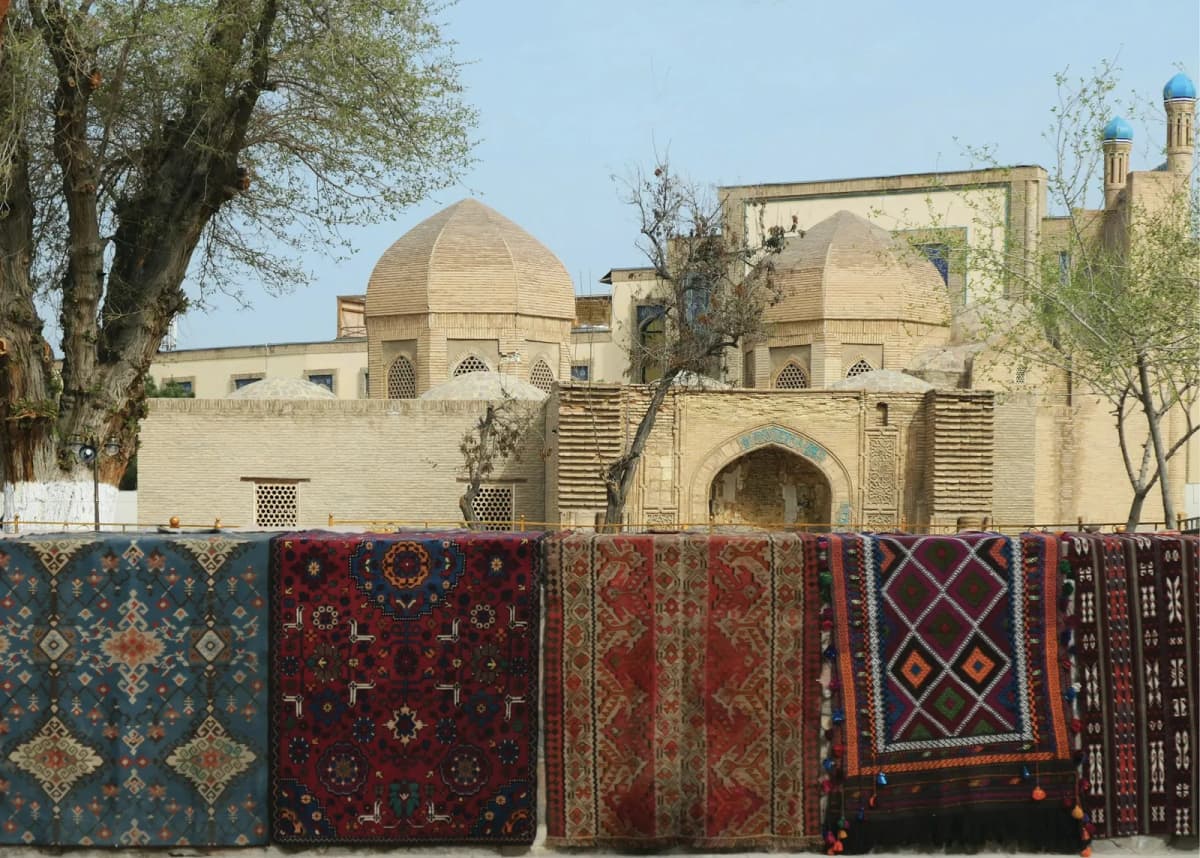 Photo: Tim Broadbent on Unsplash
11. Sweat it out in a historic hammam
Bukhara's old bathhouses are among the few in Central Asia still in use, and a traditional hammam is a good way to recover from a day of walking on hot stone. The best known is in a sixteenth-century bathhouse near the jewellers' dome, where you lie on a heated marble slab under brick domes before a vigorous scrub and massage. Some baths have set times or separate sessions for men and women, and it's worth booking a slot through your guesthouse the day before. Prices vary with what you choose, so confirm the full cost before you start.
12. Watch a folk show or a concert at Nodir Devon Begi
In the season (roughly spring to autumn), the courtyard of the Nodir Devon Begi Madrasah on Lyabi-Hauz hosts evening shows of traditional music and dance, often with a fashion show of local costume and embroidery, and dinner served in the courtyard. Some evenings feature shashmaqam, the classical music of Bukhara recognised by UNESCO. It's touristy, but it's done well, and it's a good use of an evening when many of the monuments close. Ask at the madrasah or your guesthouse for that week's schedule and price.
13. Walk the old town after dark
Bukhara at night is one of the reasons to stay rather than pass through. From about sunset, the Kalyan Minaret, the Mir-i-Arab domes and the Ark walls are floodlit, the trading domes glow, and the lanes between them are quiet. It's generally safe to wander; stick to the main lit routes between Lyabi-Hauz, the domes and Po-i-Kalyan, and use a phone torch in the side streets, where the paving can be uneven.
A good night walk: start with dinner at Lyabi-Hauz, follow the main street under the domes to Po-i-Kalyan, stand in the square for a while, then continue to the Ark and Bolo-Hauz before looping back. Many hotels and cafés near Po-i-Kalyan have rooftop terraces, which are also the best place for sunset over the domes.
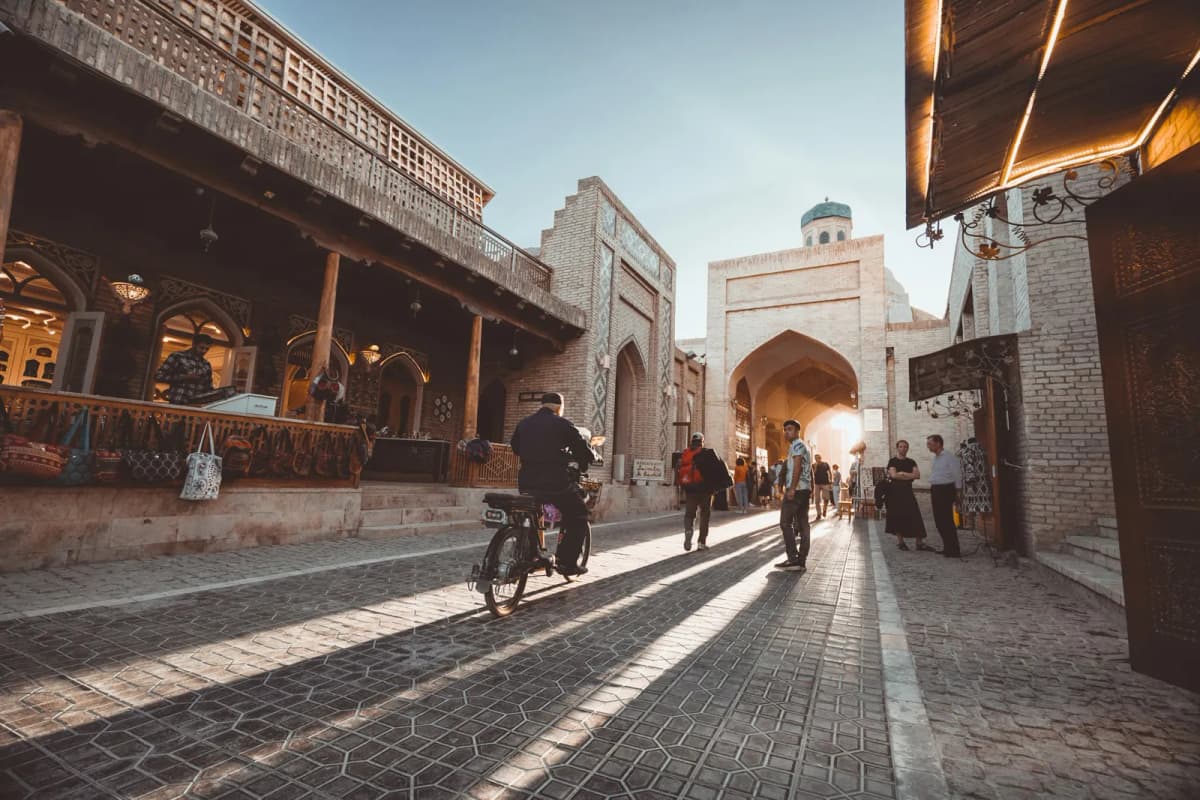 Photo: Evgeny Matveev on Unsplash
14. Visit the emir's summer palace, Sitorai Mohi-Khosa
About 4 kilometres north of the old town, Sitorai Mohi-Khosa ("palace of the moon and stars") was the summer residence of the last emir of Bukhara, Alim Khan, completed in the years just before the 1920 revolution. It's a strange and fascinating mix of Russian and Central Asian styles: mirrored halls and European furniture next to carved plaster and painted ceilings, plus a harem building and a pool where the emir is said to have watched his wives bathe. Peacocks roam the gardens.
A Yandex Go ride from Lyabi-Hauz takes about 15 minutes. Tickets have been quoted at 30,000–60,000 som in 2026. Allow an hour and a half, and go in the morning if it's hot.
15. Make the pilgrimage to Bahauddin Naqshband
About 12 kilometres north-east of the city, the shrine of Bahauddin Naqshband is one of the most important pilgrimage sites in Central Asia. Naqshband, who died in 1389, founded the Naqshbandi Sufi order, which has followers from Turkey to India, and pilgrims come to his tomb, the surrounding mosques and a courtyard with an ancient tree that's said to grant wishes. It's peaceful, green and very much a living religious site, so dress modestly and be discreet with your camera during prayers.
Entry is free. A Yandex Go ride takes about 20–25 minutes each way. Many people combine it with Sitorai Mohi-Khosa in half a day, with a taxi driver waiting at each stop or a short ride between them.
How many days do you need in Bukhara?
- 1 day: enough to see Po-i-Kalyan, the trading domes and the Ark, and to have dinner at Lyabi-Hauz, but you'll be rushing and you'll miss the quieter corners.
- 2 days: the sweet spot for most people, and the answer to the most common question: yes, two days is enough for the highlights. Day one covers Po-i-Kalyan, the domes, Magoki-Attori, the Ulugbek and Abdulaziz-Khan madrasahs and a night walk. Day two covers the Ark, Bolo-Hauz, Samanid Park and Chashma Ayub, and Chor Minor in the afternoon, followed by a folk show.
- 3 days: add Sitorai Mohi-Khosa and Bahauddin Naqshband in the morning and a hammam in the afternoon, with plenty of time left for workshops and tea.
Getting to and around Bukhara
Arriving. Bukhara is on the main rail line. The Afrosiyob high-speed train takes about 1.5 hours from Samarkand and just under four hours from Tashkent; our guide to Tashkent to Samarkand explains how to book Uzbek train tickets. Bukhara also has an international airport a short drive from the old town, with flights from Tashkent and a handful of international routes, so check whether you can fly straight in or out:
The station is not in Bukhara. Bukhara's main station is in the town of Kagan, about 12–15 kilometres south-east of the old city. A Yandex Go ride takes 20–30 minutes; skip the drivers touting at the exit, who ask several times the app price.
Getting around. Almost everything in this guide is within walking distance of Lyabi-Hauz, and the main street through the trading domes is largely pedestrianised. For the station, Sitorai Mohi-Khosa and Bahauddin Naqshband, use Yandex Go. You'll need mobile data for it, so set up an Uzbekistan eSIM before you fly, or buy a local SIM with your passport at the airport.
Where to stay. Stay in or right next to the old town, ideally within a few minutes of Lyabi-Hauz, so you can walk everywhere and come back for a rest in the midday heat. Many guesthouses are in restored merchants' houses with courtyards. In 2026 a double room cost roughly 300,000–600,000 som a night in a simple guesthouse and 650,000 to 1.2 million som in a mid-range hotel, plus a small tourist tax per night that's often added at check-in.
Travel insurance. Bukhara is hot and dry, and heat exhaustion is the most common problem for visitors; the best hospitals are in Tashkent. It's worth having medical cover: you can compare EKTA travel insurance plans before you go.
Moving on. Most travellers continue west to Khiva. The new fast train covers it in just over three hours on three days a week, and there are overnight trains and private drivers too; our guide to Bukhara to Khiva compares every option. If the trains are full, you can pre-book a private transfer from Bukhara to Khiva across the desert.
Best time to visit Bukhara
April to May and September to October are ideal: warm days, cool evenings and soft light on the brick. They're also the busiest months, so book trains and guesthouses early. Bukhara sits on the edge of the Kyzylkum desert, and summer is fierce: afternoons regularly pass 40°C, so sightsee from dawn until late morning, rest, and go out again from late afternoon. Winter is cold, sometimes below freezing, but quiet, and the monuments are open.
Practical tips
- Dress modestly at Mir-i-Arab, the Kalyan Mosque and Bahauddin Naqshband: shoulders and knees covered. Women may want a light scarf for the shrine.
- Carry cash. Tickets, taxis hailed in the street, teahouses and many stalls run on som. There are ATMs in the old town, but not all accept foreign cards.
- Keep your passport on you. Guesthouses register you with it, and you need it for every train.
- Protect yourself from the sun. Bring a hat, sunscreen and a refillable water bottle; there's little shade between the sights at midday.
- Start early. Tour groups arrive around 9:30–10:00 at Po-i-Kalyan and the Ark. The old town before 9:00 is a different place.
Frequently asked questions
What not to miss in Bukhara? The Po-i-Kalyan ensemble (the Kalyan Minaret, Kalyan Mosque and Mir-i-Arab Madrasah), the Ark, Lyabi-Hauz, the trading domes, Chor Minor and the Ismail Samani Mausoleum. If you only have a few hours, walk from Lyabi-Hauz through the domes to Po-i-Kalyan and on to the Ark.
Is 2 days in Bukhara enough? Yes. Two full days covers all the main sights in the old town at a comfortable pace, with time for an evening show. Add a third day for Sitorai Mohi-Khosa, Bahauddin Naqshband and a hammam.
What should I do in Bukhara in 3 days? Spend day one around Po-i-Kalyan, the trading domes and Magoki-Attori; day two at the Ark, Bolo-Hauz, Samanid Park and Chor Minor; and day three outside the centre at Sitorai Mohi-Khosa and Bahauddin Naqshband, finishing with a hammam and dinner at Lyabi-Hauz.
Is Samarkand or Bukhara better? They're different. Samarkand has the grander monuments, like the Registan and Shah-i-Zinda (see our 15 best things to do in Samarkand); Bukhara has the more intact, walkable old town and a slower, more atmospheric feel. Most first-time visitors see both, and they're only 1.5 hours apart by train. Many people end up liking Bukhara more.
What is there to do in Bukhara at night? Walk the floodlit old town from Lyabi-Hauz to Po-i-Kalyan and the Ark, watch a folk show in the Nodir Devon Begi courtyard, have dinner by the pool, or catch the sunset from a rooftop terrace. Bukhara is quiet at night rather than lively; there's little nightlife beyond the teahouses.
How much are entry fees in Bukhara? In 2026 the Ark cost a foreign adult 60,000 som, and most smaller madrasahs and museums charged about 20,000 som each. Lyabi-Hauz, the trading domes and the squares are free. Seeing all the main sights costs roughly 200,000–350,000 som ($17–30).
Is Bukhara safe for tourists? Yes. Bukhara is generally very safe, including after dark in the old town. The main annoyances are taxi touts at the station and pushy sellers in the domes, so use Yandex Go and take your time before buying.
How we researched this guide
Entry fees were checked in September 2026 against several recent sources, including the Silk Road Tour list of Uzbekistan entrance fees, a September 2026 Kursiv Media report on travel costs in Uzbekistan (the source of the Ark price, hotel rates and meal prices), and recent itineraries from Uzbek tour operators. History and dates come from UNESCO's listing for the Historic Centre of Bukhara. Where sources disagreed, we've given a range or used the most recent figure. Prices in Uzbekistan have changed quickly over the past two years, so double-check at the booth. Found something out of date? Let us know.
Planning the rest of your trip? Browse all our Uzbekistan guides, start with Tashkent to Samarkand, use Bukhara to Khiva for the long leg west, and fit it all together with our Uzbekistan itinerary for 7, 10 and 14 days. The day our founder learned the hard way about Bukhara's afternoon heat, standing outside Lyabi-Hauz in 38°C, is on the About page.