Tashkent to Samarkand: Train, Taxi or Bus? (2026 Prices & Times)
September 29, 2026 · Uzbekistan
This post contains affiliate links. We may earn a commission if you book through them, at no extra cost to you. Disclaimer.
Tashkent to Samarkand is the first journey almost every visitor to Uzbekistan makes. Most international flights land in the capital, but most of what people come to see is in Samarkand, Bukhara and Khiva. The two cities are about 300 kilometres apart, and you have more ways to cover that distance than most guides let on, from a Spanish-built bullet train to a shared taxi that leaves when its fourth seat is filled.
This guide compares every option with the fares, journey times and booking rules we checked in September 2026, so you can pick the one that suits your budget and your schedule.
Tashkent to Samarkand: the quick answer
| Option | Journey time | Typical price (one way) | Best for |
|---|---|---|---|
| Afrosiyob high-speed train | 2h10–2h20 | 311,000 som (about $26) in economy | Almost everyone |
| Sharq or Nasaf train | 3h15–4h | From 200,060 som (about $17) | Afrosiyob sold out, lower budget |
| Overnight sleeper train | 4–9h | Varies by berth | Saving a night's accommodation |
| Shared taxi | 4–5h plus waiting | Around $15–20 per seat | Flexible, last-minute trips |
| Bus | About 4h30–5h | Around $5–8 | The tightest budgets |
| Private transfer | About 4h | From about $120 locally, $325 pre-booked | Groups, heavy luggage, stops on the way |
| Flight | About 1h in the air | Varies | Rarely worth it on this route |
Our recommendation: take the Afrosiyob and book it as soon as sales open. It's the fastest, most comfortable and most predictable option, and at about $26 it's not much more than a seat in a shared taxi. If the Afrosiyob is sold out, a Sharq train is the next best choice.
How far is Samarkand from Tashkent?
By rail, Samarkand is roughly 300 kilometres south-west of Tashkent. By road it's a little more, about 300–335 kilometres depending on the route, mostly on the M39 highway through Jizzakh. On paper the drive takes four hours. In practice, with fuel stops, police checkpoints and traffic getting out of Tashkent, allow closer to five.
That's why the train wins so clearly on this route. The high-speed line cuts the trip to just over two hours, city to city, and you don't have to think about who's driving.
Option 1: the Afrosiyob high-speed train (best for most people)
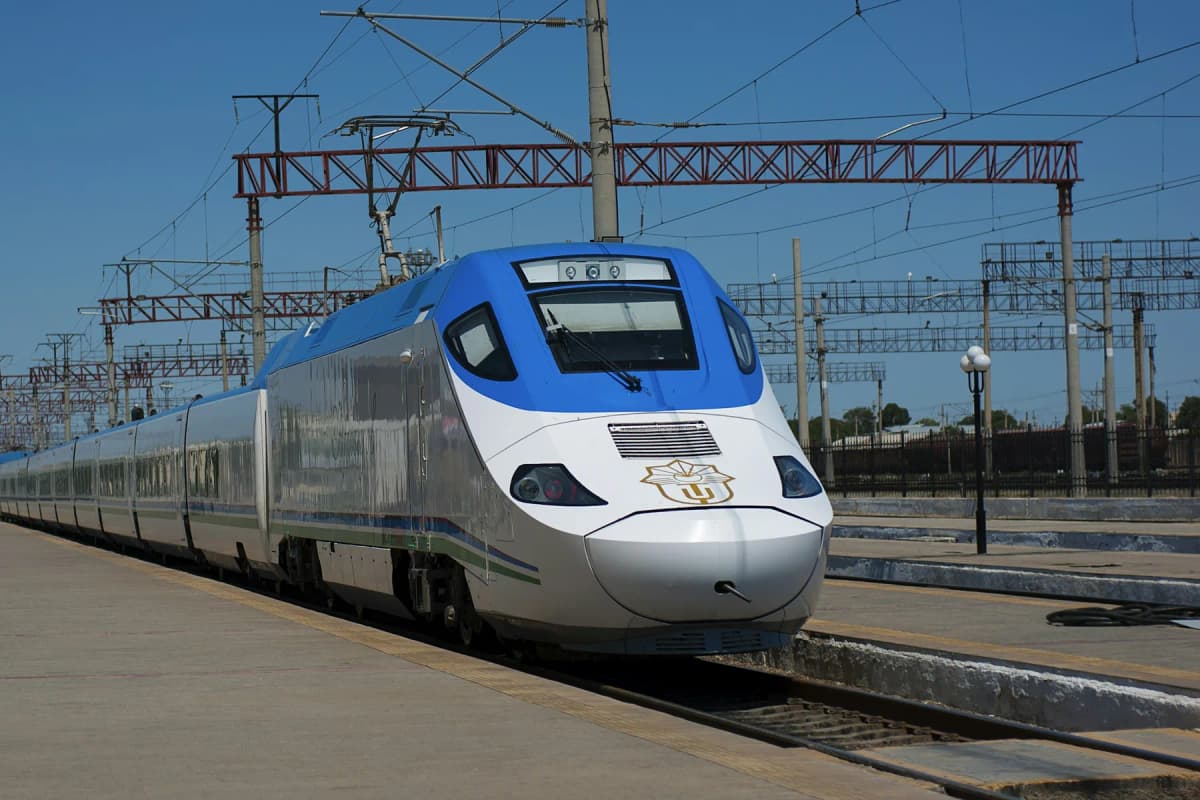 Photo: Olga Kovalski on Unsplash
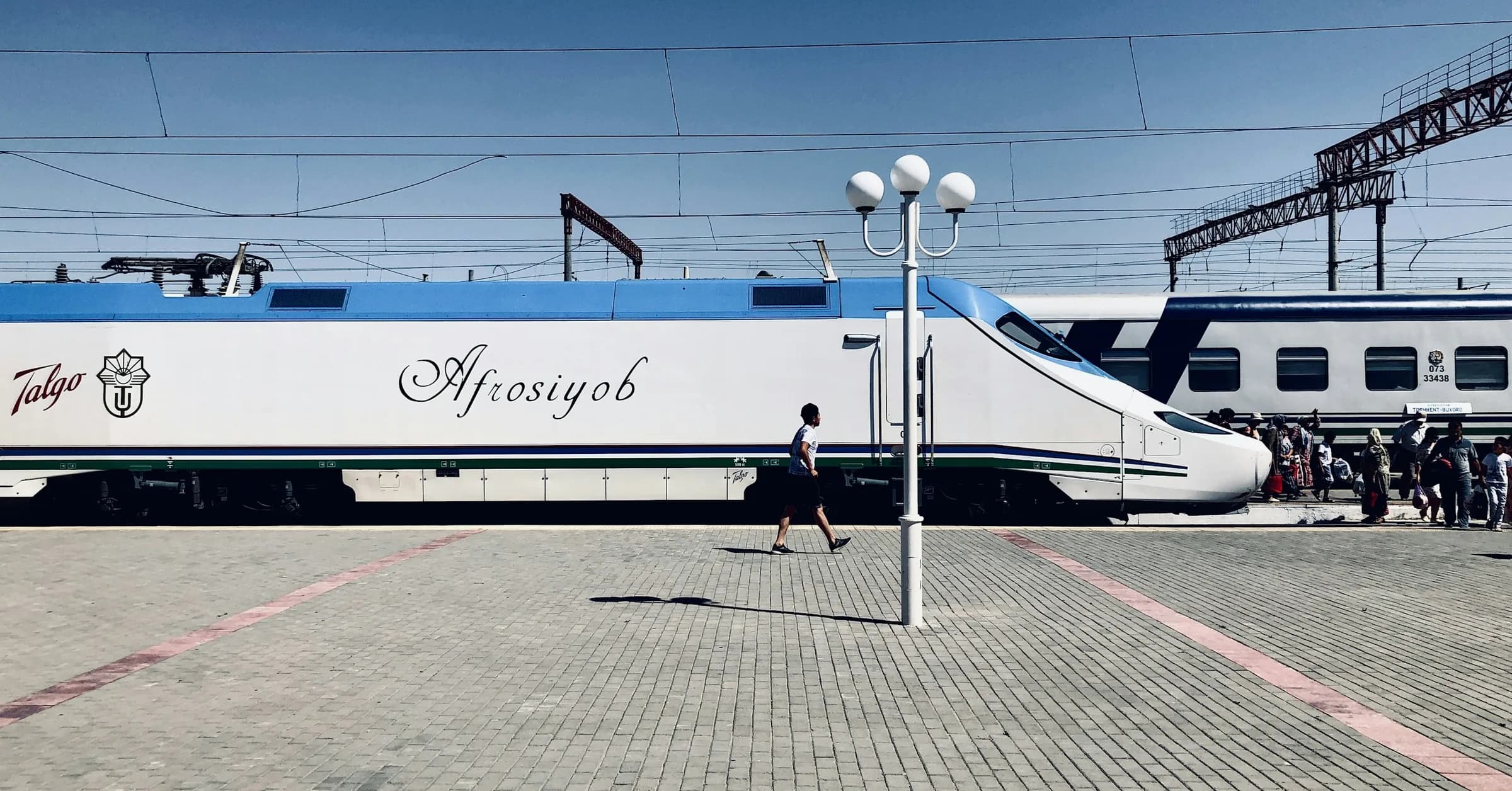
The Afrosiyob is Uzbekistan's high-speed train, built by the Spanish firm Talgo and named after the ancient site on the edge of Samarkand. It reaches up to 250 km/h, and the Tashkent to Samarkand run takes about 2 hours 10 minutes to 2 hours 20 minutes. The carriages are modern and air-conditioned, with luggage racks big enough for full-size suitcases, and there's a café car serving tea, coffee, snacks and simple hot meals.
Timetable. There are several Afrosiyob departures a day, clustered in the morning and again in the evening. In the September 2026 timetable, the first trains leave Tashkent at 06:10 and 06:33 and arrive in Samarkand at 08:23 and 08:46, with more departures at 07:00, 07:30 and 08:30. Some trains continue to Bukhara (about 1h30 further) and a few go on to Karshi. Timetables change with the season, so check the exact times when you book.
Fares. Afrosiyob fares from Tashkent to Samarkand are currently:
- Economy: 311,000 som (about $26)
- Business: 455,000 som (about $38)
- VIP: 709,000 som (about $59)
Economy is perfectly comfortable for a two-hour journey: reclining seats in a 2+2 layout with plenty of legroom. Business gives you wider seats in a 2+1 layout. VIP is a small, separate section with only a few seats and is only worth it if you want extra space and privacy. Fares vary a little from train to train and by date, so treat these as a guide.
Which station? Afrosiyob trains leave from Tashkent's main station (also called Tashkent Central or Tashkent North, Toshkent Shimoliy). Some slower and overnight trains leave from Tashkent South (Toshkent Janubiy) instead, about 7 kilometres away. Your ticket shows the station. Check it carefully the night before, as getting it wrong costs you a taxi ride across the city and possibly the train.
How far ahead to book. This is the part that catches people out. The Afrosiyob is popular with locals as well as tourists, and in spring and autumn the best departures sell out within hours of going on sale. According to The Man in Seat 61, booking opens 60 days before departure; some agencies quote 45 days. Either way, the rule is the same: book the day sales open for any date in April, May, September or October. In winter you can usually find seats a week or two ahead.
How to book Uzbekistan train tickets online
You have three main ways to buy tickets:
- The official Uzbekistan Railways site, eticket.railway.uz. It has an English version and accepts foreign Visa and Mastercard cards (some travellers report their card being declined at first; trying a different card usually works). You'll need each passenger's name and passport number exactly as they appear in the passport. The official Uzrailway tickets app for iOS and Android works the same way.
- An agency such as 12Go or Bookaway. They charge a booking fee but have simpler checkout pages, handle foreign cards more reliably and let you pay in dollars or euros. Useful if the official site won't take your card.
- At the station. Ticket offices at Tashkent's stations sell tickets for any train, and you'll need your passport. This works for slower trains but is a gamble for the Afrosiyob in high season.
Most tickets are electronic. Save the PDF or a screenshot to your phone and keep your passport handy: you'll show both at the station entrance, and again on the platform.
Option 2: Sharq, Nasaf and other slower trains
If the Afrosiyob is full, don't give up on the train. The Sharq (trains 709–712) and Nasaf (703, 715 and 716) are older but air-conditioned "classic" trains that run daily between Tashkent and Samarkand in about 3 hours 15 minutes to 4 hours. Sharq services continue to Bukhara.
They're cheaper too. A second-class seat on the Sharq costs 200,060 som (about $17), first class 300,560 som (about $25), and there's an extra-spacious first-class option for 566,450 som. The seats are comfortable enough, there's a buffet trolley, and you get a slower, more scenic ride through cotton fields and small towns. Tickets usually sell out later than the Afrosiyob, so a week or two ahead is often fine outside the peak months.
There are also overnight sleeper trains from Tashkent (mostly long-distance services heading south and west towards Termez, Urgench and Khiva) that stop in Samarkand. Journey times range from about four to nine hours depending on the train, and some arrive in the middle of the night. They make much more sense for the long leg to Khiva than for Samarkand.
Getting to Tashkent station
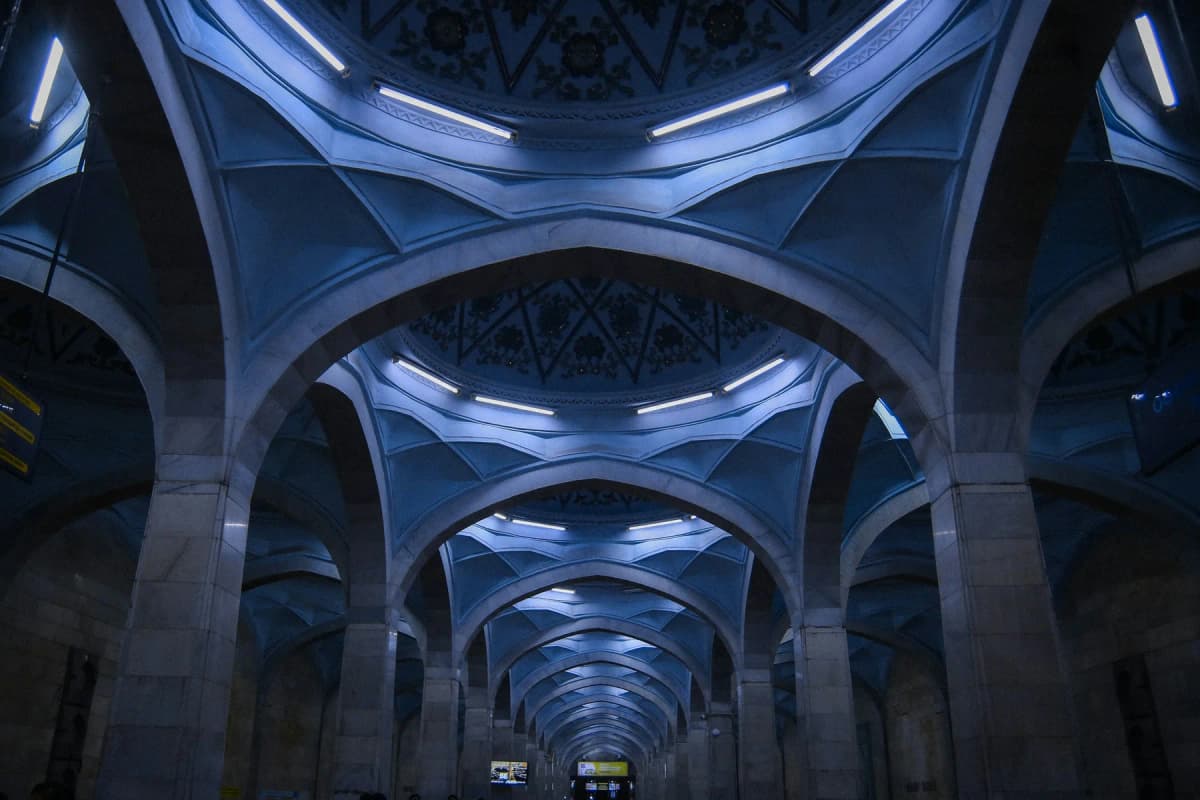 Photo: Salohiddin Kamolov on Unsplash
Tashkent's main station has its own stop on the metro, Toshkent station on the Oʻzbekiston (blue) line, and the metro is cheap, fast and beautiful: several of its stations are famous for their chandeliers and carved ceilings. With big bags or an early departure, order a car on Yandex Go instead. It works like Uber, shows the fare before you book and costs far less than a street taxi.
Allow 45 minutes at the station. Security is tight. You'll show your ticket and passport to get into the station building, put your bags through an X-ray machine, and then show them again at the platform. Boarding closes a few minutes before departure, and the Afrosiyob leaves on time.
If you're flying in and heading straight to the station, a fixed-price Tashkent airport transfer saves you haggling after a long flight. The airport is only about 20–30 minutes from the main station by road.
Option 3: shared taxi
Shared taxis are how many Uzbeks travel between cities. Drivers wait at collection points and leave once all four seats are sold, which means anywhere from 10 minutes to an hour and a half of waiting before you set off. For Samarkand, the main pick-up point is around the Tashkent bus station near Olmazor metro, in the south-west of the city.
Expect to pay around $15–20 per seat (roughly 150,000–250,000 som), a little more if you want the front seat or have large luggage. You can also buy all four seats and have the car to yourself. The drive takes 4–5 hours, usually with a stop for tea and samsa (baked pastries) in Jizzakh, and drops you at a roundabout or bus station on the edge of Samarkand, not at your hotel.
Shared taxis make sense if the trains are full, you've missed yours, or you're travelling on a whim. But they're less comfortable than the train, not much cheaper and a lot less predictable. We learned that the hard way further along the same route, when a shared taxi "you can hail any time" turned out not to exist in the middle of a Bukhara afternoon (the full story is on our About page). Agree the price per seat before you get in, and don't pay until you arrive.
Option 4: bus
Buses from the Tashkent bus station (Toshkent avtovokzali) next to Olmazor metro run to Samarkand's main bus station through the day. They're the cheapest option at around $5–8, but also the slowest at about 4h30–5 hours. Samarkand's bus station is a few kilometres from the old town, so budget for a Yandex Go ride at the end. Buy tickets at the bus station itself. Unless you're travelling on a very tight budget, the Sharq train is better value for a little more money.
Option 5: private transfer
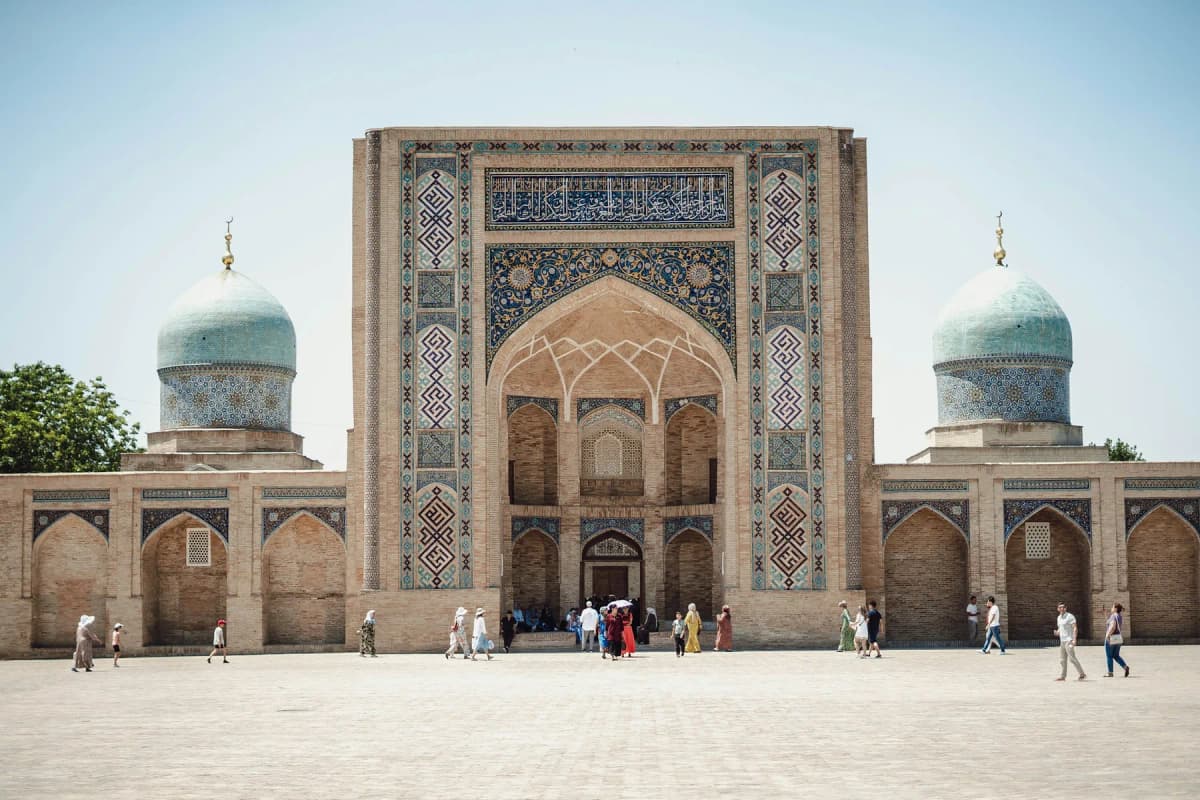 Photo: Dmitriy Efimov on Unsplash
A private car is worth considering if you're a group of three or four, have lots of luggage, or want to stop on the way. The drive takes about four hours door to door. Private drivers arranged through a local agency or your hotel typically quote $100–150 per car. International booking platforms cost more: a pre-booked Tashkent to Samarkand transfer starts at about $325 per car, but you get a fixed price, an English-speaking booking process and door-to-door pick-up at a time you choose.
There isn't much to see on the M39 itself, so for most travellers the train is still the better choice. A private car pays off if you want to add a detour, for example to the mountain town of Zaamin, on the way.
Option 6: flying
Uzbekistan Airways and a few smaller domestic carriers fly between Tashkent and Samarkand, with about an hour in the air. But once you add getting to Tashkent airport, checking in, security and the ride into Samarkand, the door-to-door time is about the same as the Afrosiyob or longer, and it usually costs more. Flying makes sense only if you're connecting from an international flight on the same ticket, or if every train is sold out and you're short on time.
Arriving in Samarkand
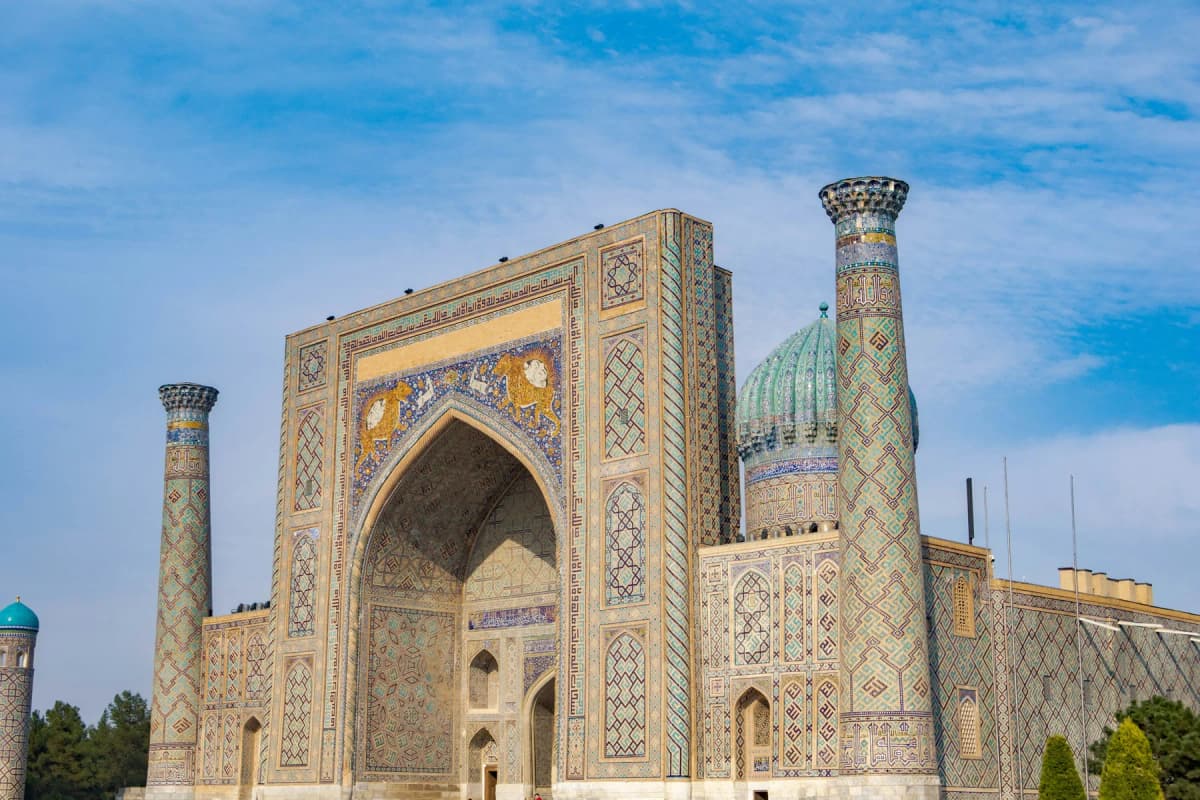 Photo: Aleksander Stypczynski on Unsplash
Samarkand's railway station is about 6 kilometres from Registan Square. The easiest way into the centre is a Yandex Go ride, which costs around 15,000–25,000 som ($1.20–2) and takes about 20 minutes. Taxi drivers wait outside the station too. If you take one, agree the price first and don't pay more than about 30,000 som to the old town. Local buses and marshrutkas (minibuses) also run into the centre for a few thousand som, but they're harder to work out with luggage.
Most visitors stay near Registan, the Gur-e-Amir mausoleum or along the pedestrian street towards Bibi-Khanym Mosque, all within walking distance of each other. Give Samarkand at least two full days: one for Registan, Gur-e-Amir and Bibi-Khanym, and one for the Shah-i-Zinda necropolis, the Ulugh Beg Observatory and the Afrosiyob museum.
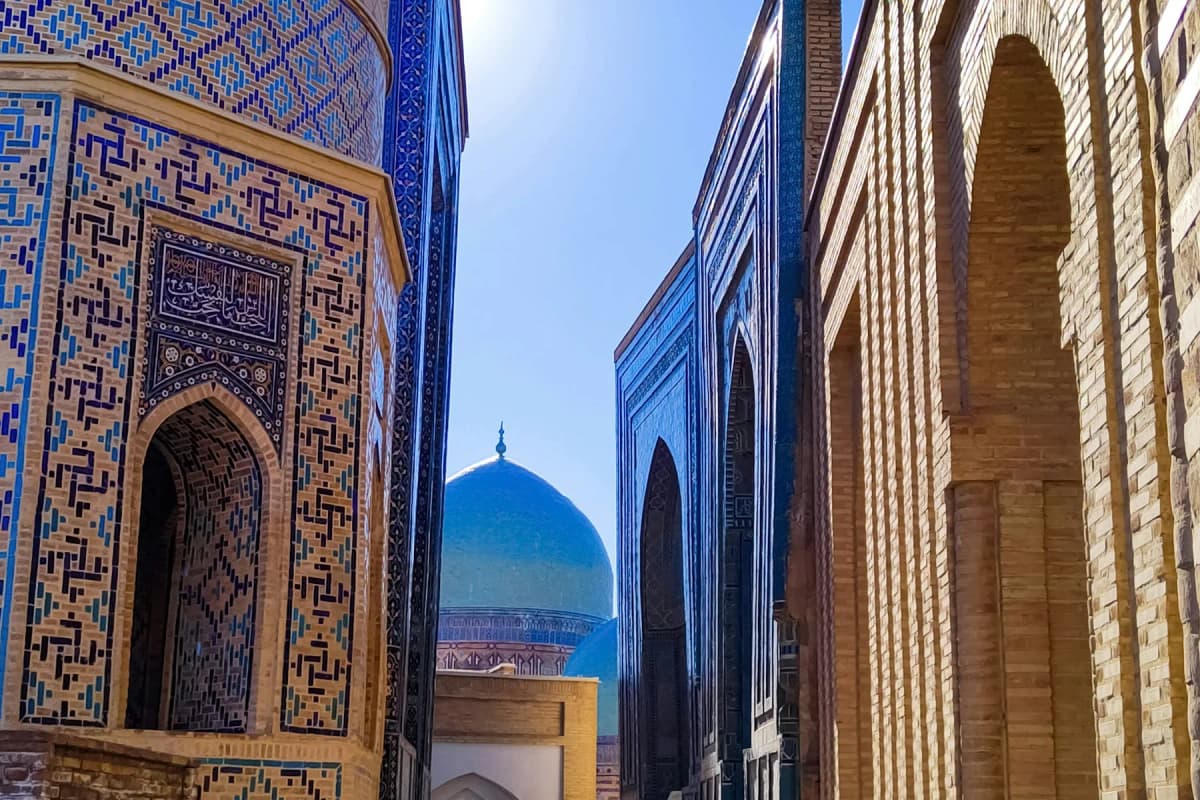 Photo: Alexander Gluschenko on Unsplash
Can you do Samarkand as a day trip from Tashkent?
Technically, yes. Take the 06:10 or 06:33 Afrosiyob, spend the day in Samarkand and catch an evening train back. But it's a long day with two early security checks, and you'd see Registan in the midday heat instead of in the soft morning or evening light when it looks its best. Samarkand also works much better as a stop on the way west than as a return trip. The Afrosiyob continues to Bukhara in about 1h30, and from there you can go on to Khiva. If your schedule allows it, stay at least one night.
Best time to travel from Tashkent to Samarkand
Spring (April to May) and autumn (September to October) are the best seasons for Uzbekistan: warm, sunny days and cool evenings. They're also when Afrosiyob tickets are hardest to get, so book as early as you can. Summer (June to August) is extremely hot, with afternoons regularly above 40°C in Samarkand, but trains are easier to book. Winter is cold and quiet, with the cheapest hotels and plenty of seats.
Avoid travelling on or just before the big public holidays, especially Navruz (around 21 March) and the Eid holidays, when trains fill up with Uzbeks heading home.
Tips for the Tashkent to Samarkand journey
- Get a local data plan before you land. You'll need mobile data for Yandex Go, your e-tickets and maps. An Uzbekistan eSIM from Airalo works as soon as you land, or you can buy a local Beeline, Ucell or Uzmobile SIM at the airport with your passport.
- Carry some cash. Cards work at hotels and on the railway website, but shared taxis, buses and small cafés are cash-only. ATMs in Tashkent and Samarkand accept foreign cards.
- Keep your passport on you. You'll need it to buy tickets, enter stations and board trains, and hotels register every guest with it.
- Buy snacks before boarding. The Afrosiyob café is fine, but the stations have better bakeries. Pick up some fresh non (round bread) and fruit before you go through security.
To compare flights into Tashkent, use the search below.
Frequently asked questions
How long is the train from Tashkent to Samarkand?
The Afrosiyob high-speed train takes about 2 hours 10 minutes to 2 hours 20 minutes. Slower Sharq and Nasaf trains take about 3 hours 15 minutes to 4 hours, and overnight sleeper trains can take much longer.
How much is the train from Tashkent to Samarkand?
On the Afrosiyob, economy costs 311,000 som (about $26), business 455,000 som (about $38) and VIP 709,000 som (about $59). On the Sharq, second class is 200,060 som (about $17) and first class 300,560 som (about $25). Fares were checked in September 2026 and vary slightly by train.
How far in advance should I book the Afrosiyob?
As early as possible. Sales open up to 60 days before departure, and the best spring and autumn trains can sell out within hours of going on sale. In summer and winter, a week or two ahead is usually enough.
Can I buy Afrosiyob tickets at the station?
Yes, with your passport, at the ticket offices in Tashkent's stations. But the Afrosiyob is often sold out on the day in high season, so it's much safer to book online at eticket.railway.uz or through an agency.
Which Tashkent station does the Afrosiyob leave from?
Afrosiyob trains to Samarkand leave from Tashkent's main (Central or North) station, which has its own metro stop. Some slower and overnight trains use Tashkent South instead, so always check the station on your ticket.
Is it better to take a taxi or the train from Tashkent to Samarkand?
The train, in almost every case. The Afrosiyob is twice as fast, similar in price to a shared-taxi seat, and leaves at a fixed time. A shared taxi is only worth it if the trains are full; a private car makes sense for groups with lots of luggage.
How many days do you need in Samarkand?
Two full days is enough to see the main sights: Registan, Gur-e-Amir, Bibi-Khanym Mosque, Shah-i-Zinda and the Ulugh Beg Observatory. Add a third day for a slower pace or a trip to the Konigil paper workshop or Urgut market.
How we researched this guide
This guide is based on the timetables and fares published by Uzbekistan Railways on eticket.railway.uz, cross-checked against The Man in Seat 61 (updated June 2026) and current traveller reports on shared-taxi, bus and Yandex Go prices. Transfer prices come from the booking platforms themselves. Fares, timetables and booking windows were checked in September 2026 and can change, so always confirm before you travel. Found something out of date? Let us know.
Planning more of the Silk Road? Browse our Uzbekistan guides, where we'll be adding Samarkand, Bukhara and Khiva guides next.