15 Best Things to Do in Samarkand (2026 Prices & Tips)
September 30, 2026 · Uzbekistan
This post contains affiliate links. We may earn a commission if you book through them, at no extra cost to you. Disclaimer.
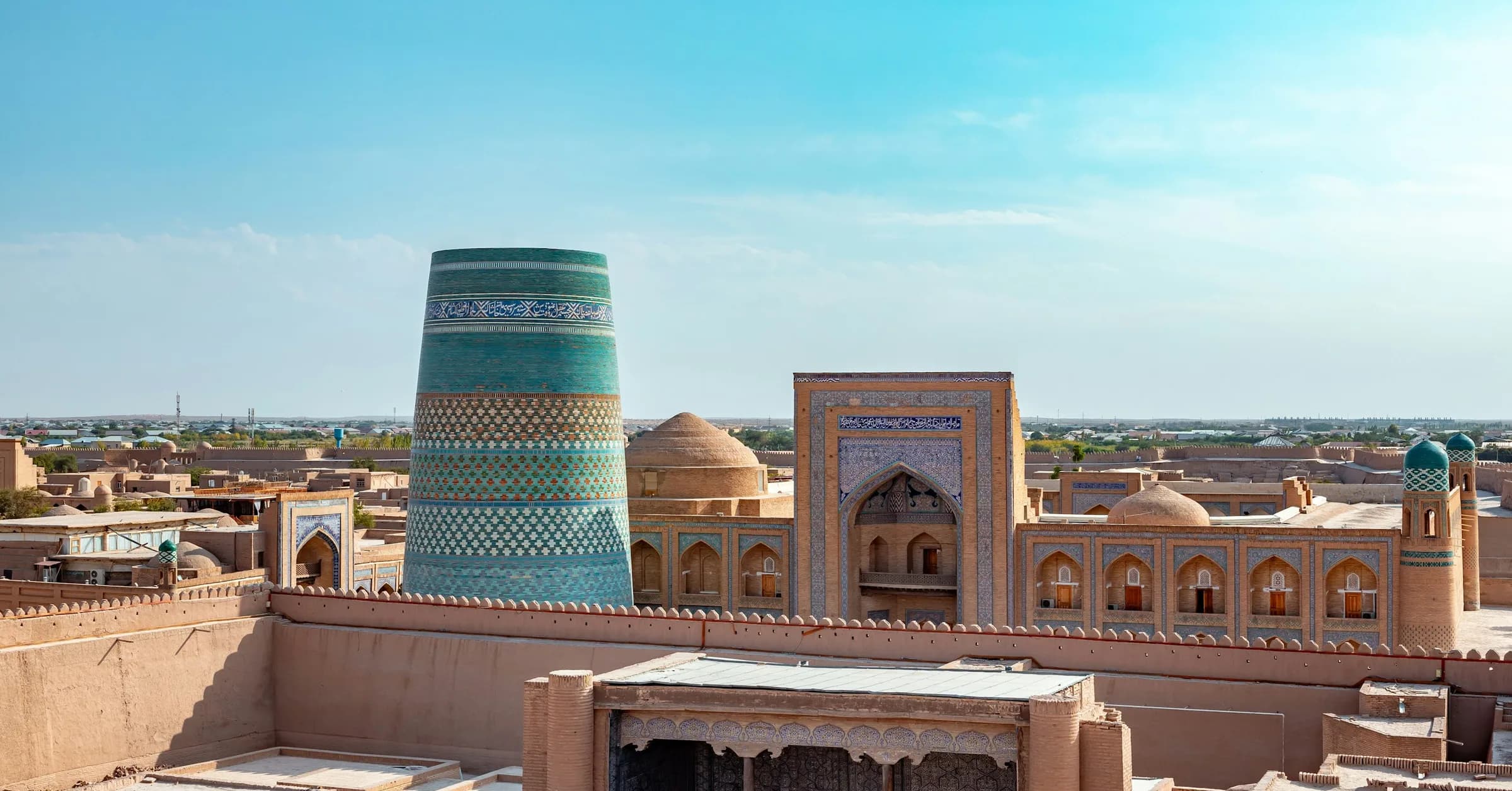
Samarkand is the city most people picture when they think of the Silk Road, and it lives up to the picture. Timur, the fourteenth-century conqueror who made it his capital, wanted it to be the most beautiful city in the world, and his builders and their successors left behind turquoise domes, tiled portals the height of apartment blocks and an avenue of tombs that glows blue in the morning sun. The historic centre is a UNESCO World Heritage Site, and almost everything worth seeing sits within a half-hour walk of the Registan.
This guide covers the best things to do in Samarkand, what each sight costs in 2026 (entry fees rose sharply over the past year, and most older guides are now wrong), when to go to beat the tour groups, and how to fit it all into two or three days.
Things to do in Samarkand: the quick list
| If you have… | Do this |
|---|---|
| 1 day | Registan in the morning, Gur-e-Amir, Bibi-Khanym and Siyob Bazaar, then the Registan again after dark |
| 2 days | Add Shah-i-Zinda early on day two, the Afrosiyob Museum, the Ulugh Beg Observatory and the Tomb of Daniel |
| 3 days | Add a day trip to Shahrisabz, or the Konigil paper mill and an evening at the Eternal City |
| 4+ days | Slow down: a cooking class or long plov lunch, University Boulevard, and a second evening on the Registan |
Our short version: give Samarkand two full nights, not a day trip from Tashkent. The Registan and Gur-e-Amir are at their best lit up after dark, Shah-i-Zinda is at its best before 9:00, and you can't do both on a same-day return train. Carry cash in som for tickets, and budget roughly 600,000–700,000 som (about $50–58) per adult for all the main entry fees.
2026 entry fees at a glance
These are the foreign adult prices we found for 2026. Children usually pay about half, and prices are in Uzbek som (roughly 12,000 som to the US dollar in September 2026).
| Sight | Foreign adult ticket |
|---|---|
| Registan Square | 100,000 som (about $8) |
| Shah-i-Zinda | 80,000 som |
| Gur-e-Amir (Timur's mausoleum) | 75,000 som |
| Bibi-Khanym Mosque | 75,000 som |
| Ulugh Beg Observatory | 75,000 som |
| Afrosiyob Museum | 80,000 som |
| Tomb of Daniel (Khoja Doniyor) | 40,000 som |
| Konigil (Meros) paper mill | About 25,000 som |
| Siyob Bazaar, Rukhobod Mausoleum, Eternal City | Free |
Fees in Samarkand have climbed fast: Shah-i-Zinda cost 15,000 som in spring 2025 and 50,000 by that summer, and the Registan went from 65,000 to 100,000. Treat the table as a guide and bring a little more than you think you'll need. Card machines at the ticket booths exist but aren't reliable.
1. Stand in the middle of Registan Square
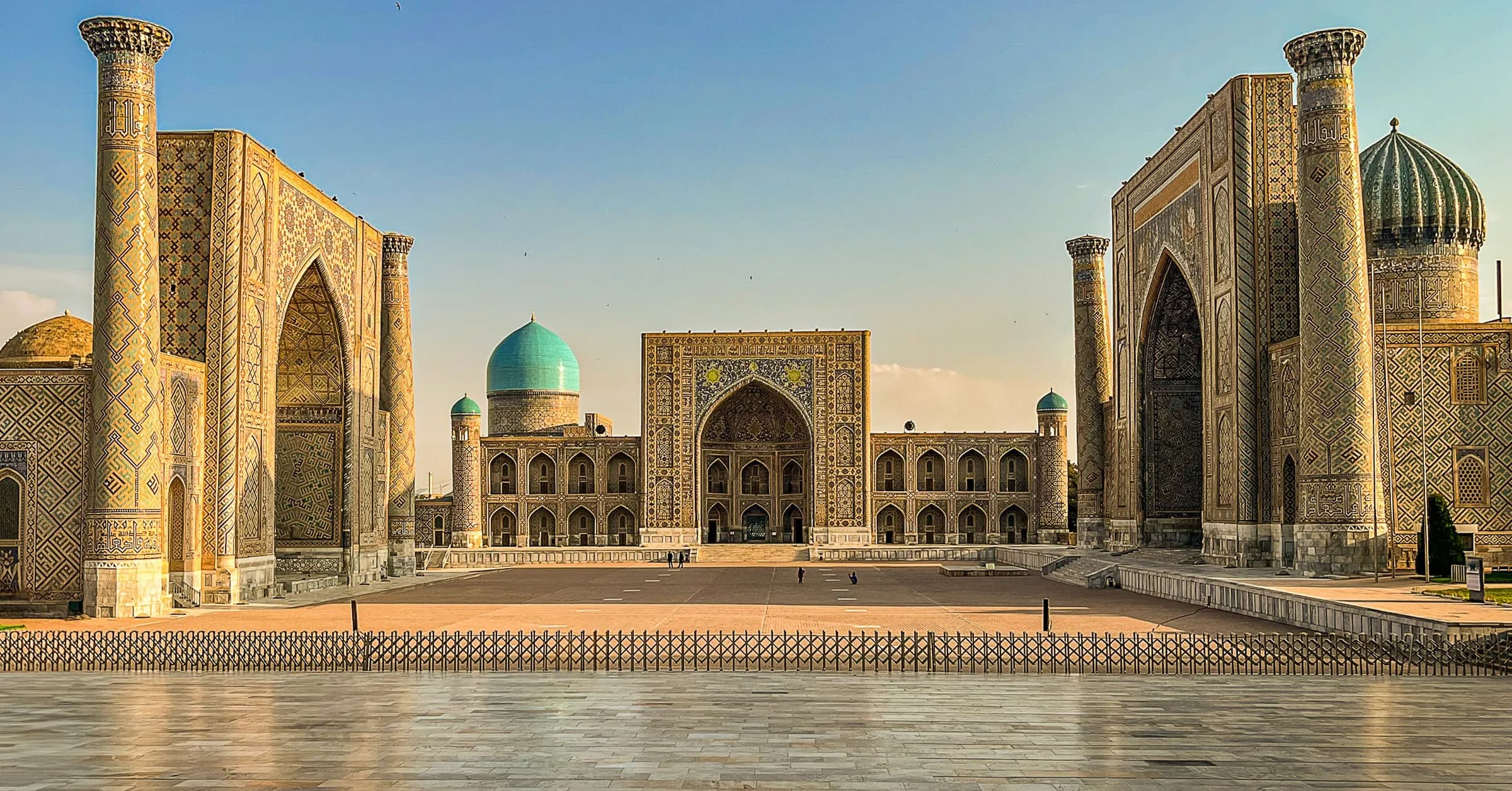
Registan means "sandy place", and for centuries it was Samarkand's main square, a place for markets, proclamations and public executions. Today it's framed on three sides by three madrasahs (Islamic schools) that face each other across a paved square:
- Ulugh Beg Madrasah (on the left as you face the square, built 1417–1420) by Timur's astronomer grandson, who is said to have taught mathematics here himself.
- Sher-Dor Madrasah (on the right, 1619–1636), famous for the tiger-like lions chasing deer above its entrance arch, an unusual choice for Islamic art that ended up on the Uzbek 200-som note.
- Tilya-Kori Madrasah (in the middle, 1646–1660), which doubled as the city's main mosque. Its name means "gilded", and you'll see why inside.
You can see the façades for free from the viewing area on the street side. The ticket (100,000 som) lets you walk onto the square itself and into the madrasah courtyards, where the old student cells are now craft and souvenir shops. It's worth paying for: the scale only really lands when you're standing under the portals.
- Hours: in the high season (roughly 20 February to 20 November) the complex has been open from early morning until late evening; in winter it closes earlier. Hours change, so check at the booth.
- Best time: first thing in the morning, before the tour buses, or late afternoon when the sun warms the tiles.
- Watch out for: guards offering to take you up a minaret "unofficially" for a tip. It's not allowed, and the stairs are not built for visitors.
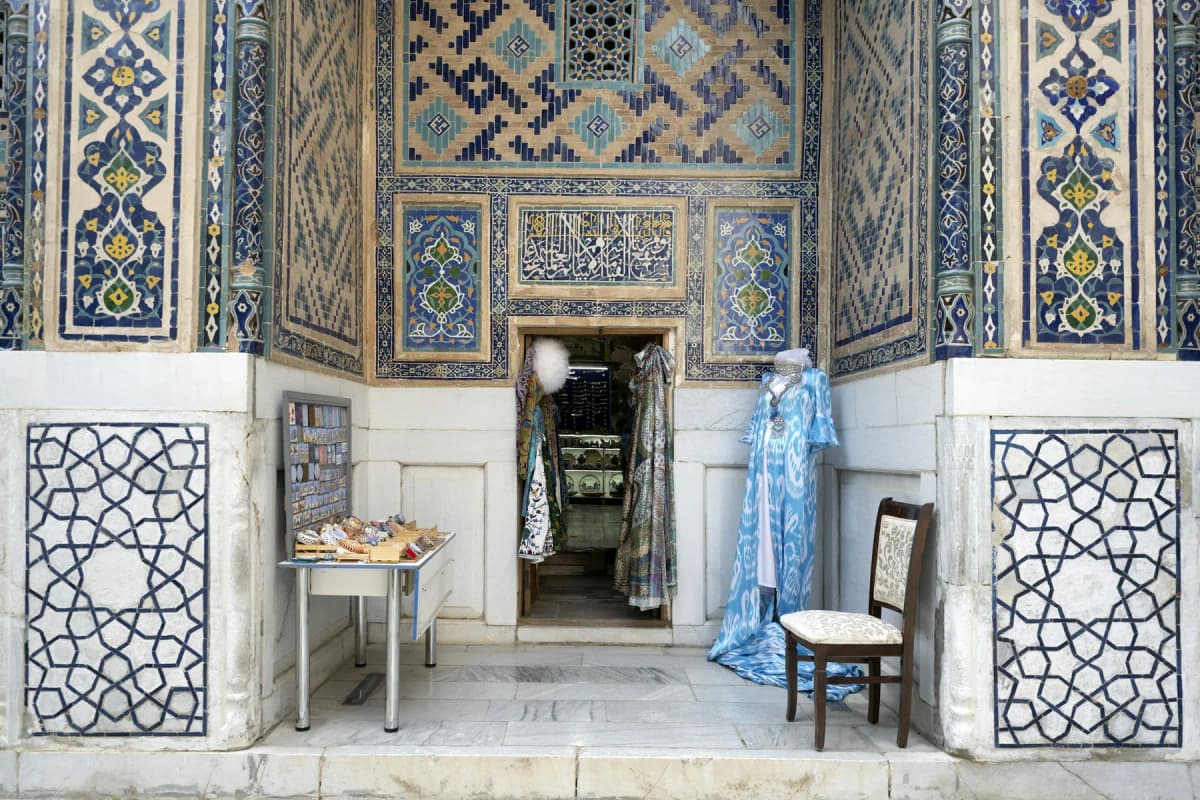 Photo: Dave Meckler on Unsplash
2. Go back to the Registan after dark
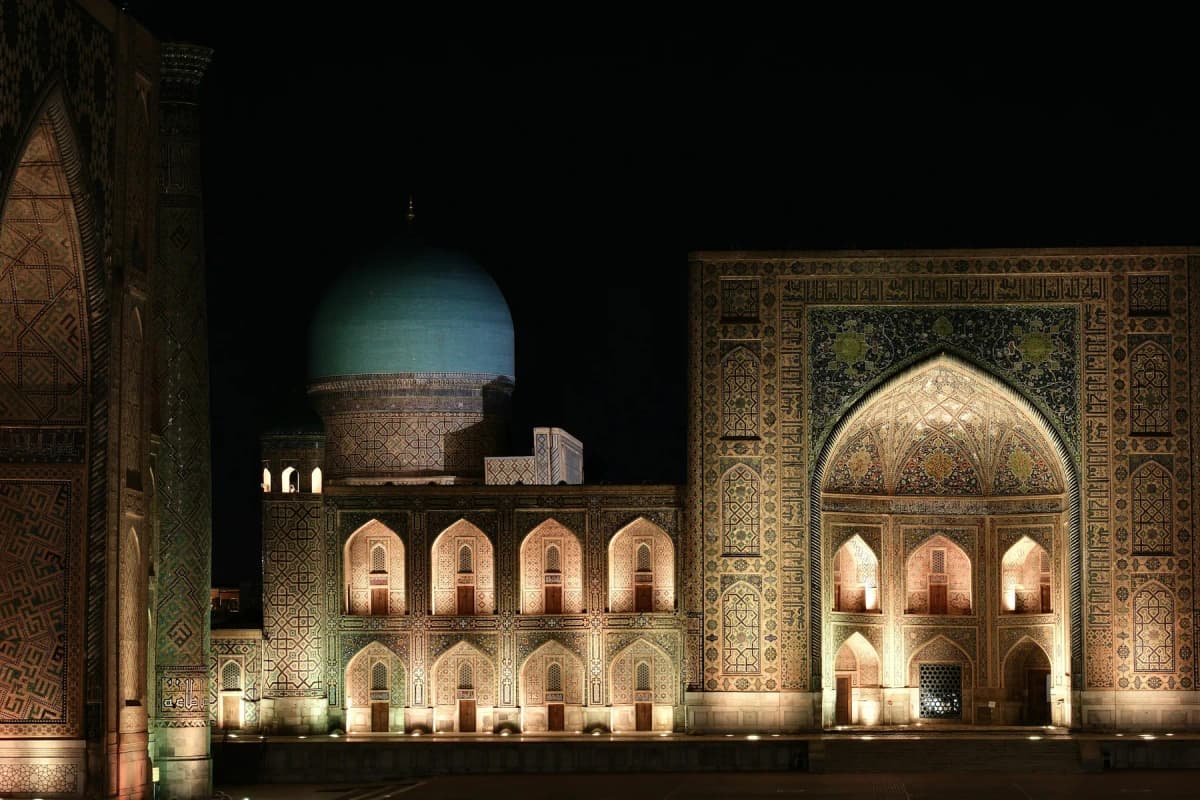 Photo: Alessio Roversi on Unsplash
The Registan is floodlit every evening, and the effect is very different from the daytime: the colours soften, the crowds thin out and locals come out to stroll and take photos. You don't need a ticket for this; the view from the street-side steps is free.
From spring to autumn there's also a sound and light show, with projections and music across the three façades for about 20–25 minutes. In 2026 it started between roughly 20:00 and 21:30 depending on the month, with the commentary rotating between languages (including English on many nights). Watching from the steps is free; seats on the square have been sold for around 150,000 som. Ask at your hotel or the ticket office on the day, as the schedule shifts with the season and events.
3. Walk the avenue of tombs at Shah-i-Zinda
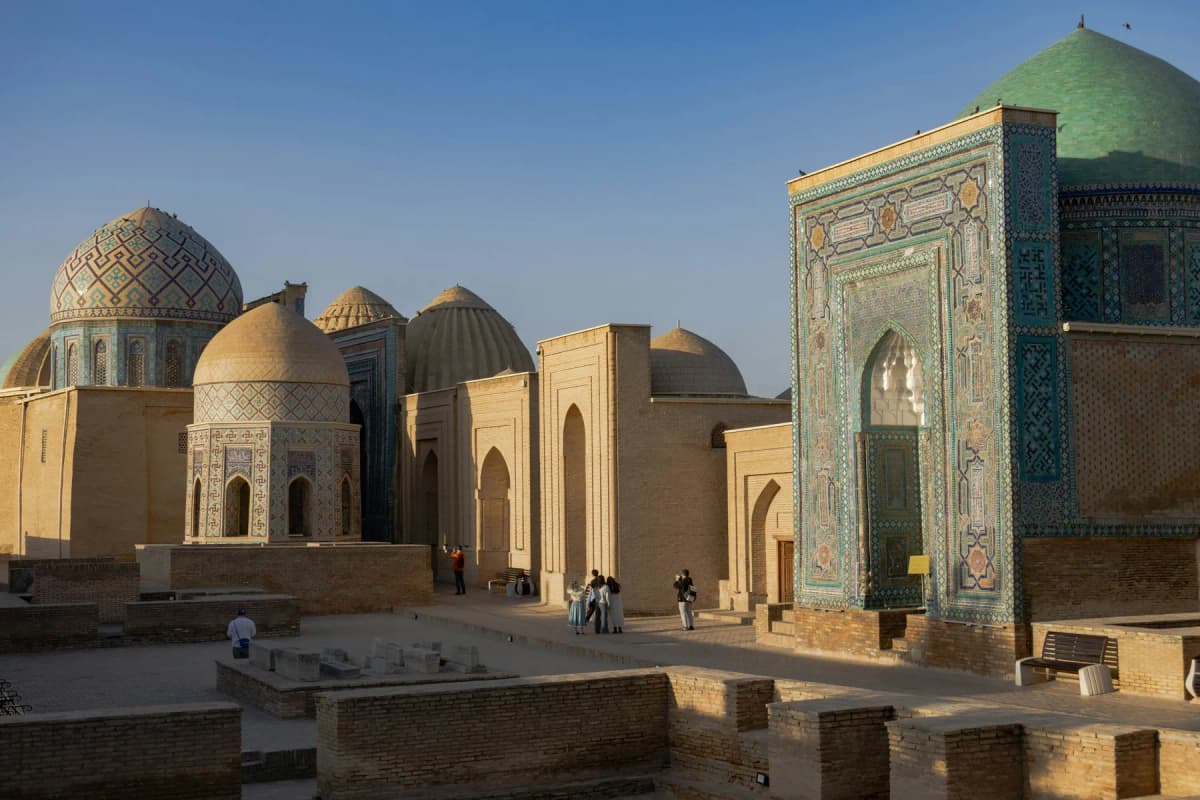 Photo: Aleksander Stypczynski on Unsplash
If the Registan is Samarkand's grand statement, Shah-i-Zinda is its masterpiece. It's a narrow, stepped street of mausoleums built between the eleventh and nineteenth centuries, most of them for members of Timur's family and court, and each one is covered in a different pattern of blue, turquoise and white tiles. The name means "the living king" and refers to Qusam ibn Abbas, a cousin of the Prophet Muhammad, who is said to be buried at the top of the complex. That makes it a real pilgrimage site as well as a monument, so dress modestly and keep your voice down near the shrine.
- Ticket: 80,000 som.
- Best time: as soon as it opens. The low sun lights up the tiles, and by mid-morning the narrow lanes fill with groups.
- Don't miss: the climb up the "Stairway of the Heavens" at the entrance. Local tradition says you should count the steps on the way up and again on the way down, and if the numbers match, your sins are forgiven.
4. See Timur's tomb at Gur-e-Amir
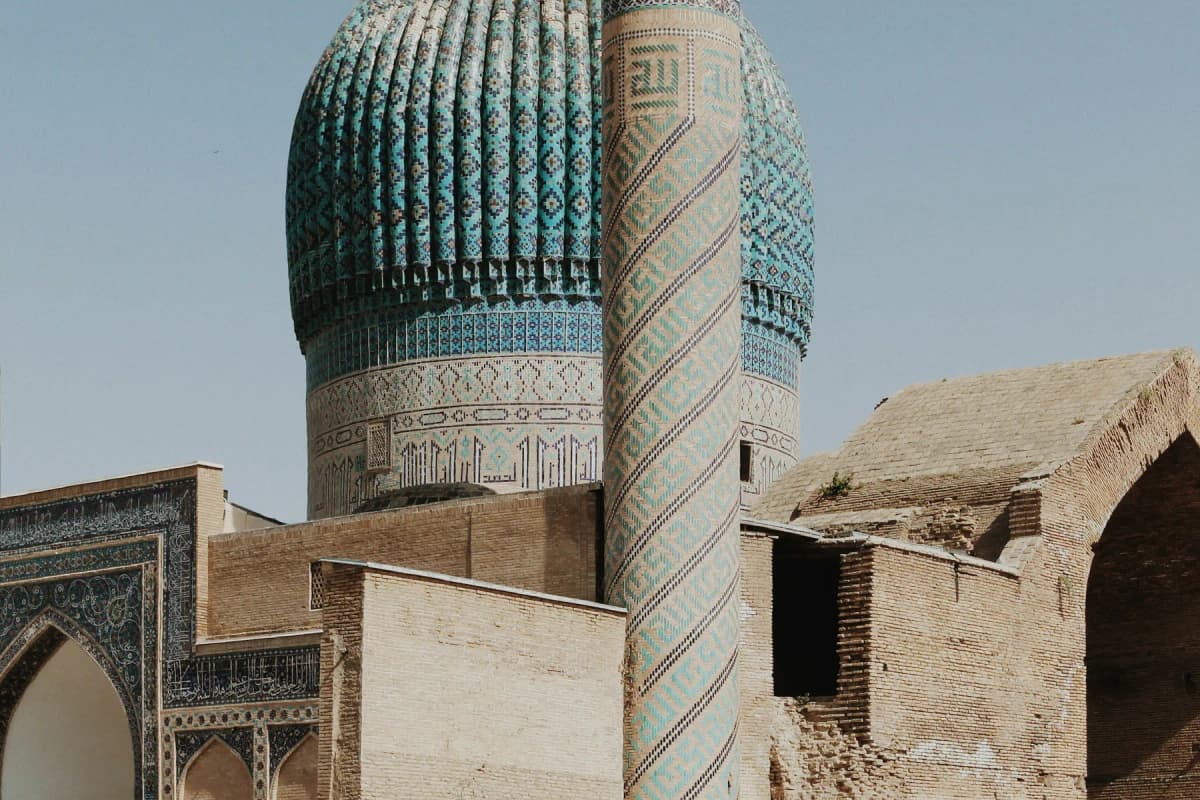 Photo: Ildar Garifullin on Unsplash
Gur-e-Amir, "the tomb of the king", was built at the start of the fifteenth century for Timur's favourite grandson, and Timur himself was buried here after he died in 1405. Outside, a fluted turquoise dome sits on a tall drum covered in giant calligraphy. Inside, the walls are covered in gold leaf and blue paint, and Timur's tombstone is a single block of dark green jade (nephrite) among the marble tombs of his sons and grandsons, including Ulugh Beg. The real graves are in a crypt below.
- Ticket: 75,000 som.
- Tip: Gur-e-Amir is about 10 minutes' walk from the Registan and is also beautifully lit at night. The legend of "Timur's curse" (a Soviet team opened the tomb in June 1941, days before Germany invaded the USSR) is the story every guide will tell you here.
5. Look up at Bibi-Khanym Mosque
Timur ordered Bibi-Khanym after his campaign in India in 1399, meaning it to be the largest mosque in the Islamic world. It was built so fast, and so ambitiously, that bricks were reportedly falling from the dome within a few years of its completion. An earthquake in 1897 brought down much of what was left, and a lot of what you see today is a Soviet and Uzbek reconstruction.
It's still overwhelming. The entrance portal is enormous, the courtyard holds a giant marble Quran stand, and the whole complex gives you a sense of how Timur thought. It sits on Tashkent Street, the pedestrianised boulevard that runs from the Registan, so it's an easy stop between the square and the bazaar.
- Ticket: 75,000 som. If you're short on time or money, the view of the portal from the street and from the bazaar next door is impressive for free.
6. Shop and snack at Siyob Bazaar
Right next to Bibi-Khanym, Siyob Bazaar is Samarkand's main market and the best place to see the city's everyday life. Look for:
- Samarkand non, the city's famous round bread, thick-rimmed and stamped with patterns. Locals say it tastes better here than anywhere else in Uzbekistan, and that it stays fresh for days (travellers take it home as a souvenir).
- Dried fruit and nuts, including apricots, raisins in half a dozen colours, and almonds and apricot kernels roasted in salt.
- Halva and nisholda, a white whipped sweet made from egg whites and sugar.
Entry is free. Vendors are generous with tastings, prices are usually per kilo, and a little haggling is normal. The bazaar is liveliest in the morning.
7. Visit the Ulugh Beg Observatory
Timur's grandson Ulugh Beg was a ruler, but he's remembered mostly as an astronomer. In the 1420s he built a three-storey observatory on a hill north-east of the centre, with a giant meridian arc cut into the ground to measure the positions of the stars. His star catalogue was one of the most accurate of its time. The building was destroyed after his murder in 1449, and only rediscovered by the archaeologist Vasily Vyatkin in 1908.
What you see today is the curved underground section of the instrument and a small museum about Ulugh Beg's work. It's a short visit (30–45 minutes), best combined with the Afrosiyob Museum and the Tomb of Daniel, which are nearby.
- Ticket: 75,000 som.
8. Step back 2,500 years at the Afrosiyob Museum
Before Samarkand was Samarkand, there was Afrosiyob, the ancient city on the plateau just north of today's centre. It was settled by the Sogdians more than 2,500 years ago, captured by Alexander the Great and eventually destroyed by Genghis Khan's army in 1220. You can walk across the grassy mounds that cover it, but the highlight is the museum at the edge of the site, which holds the "Ambassadors' Painting", a seventh-century mural from a Sogdian king's palace showing envoys arriving from China, Korea and elsewhere along the Silk Road.
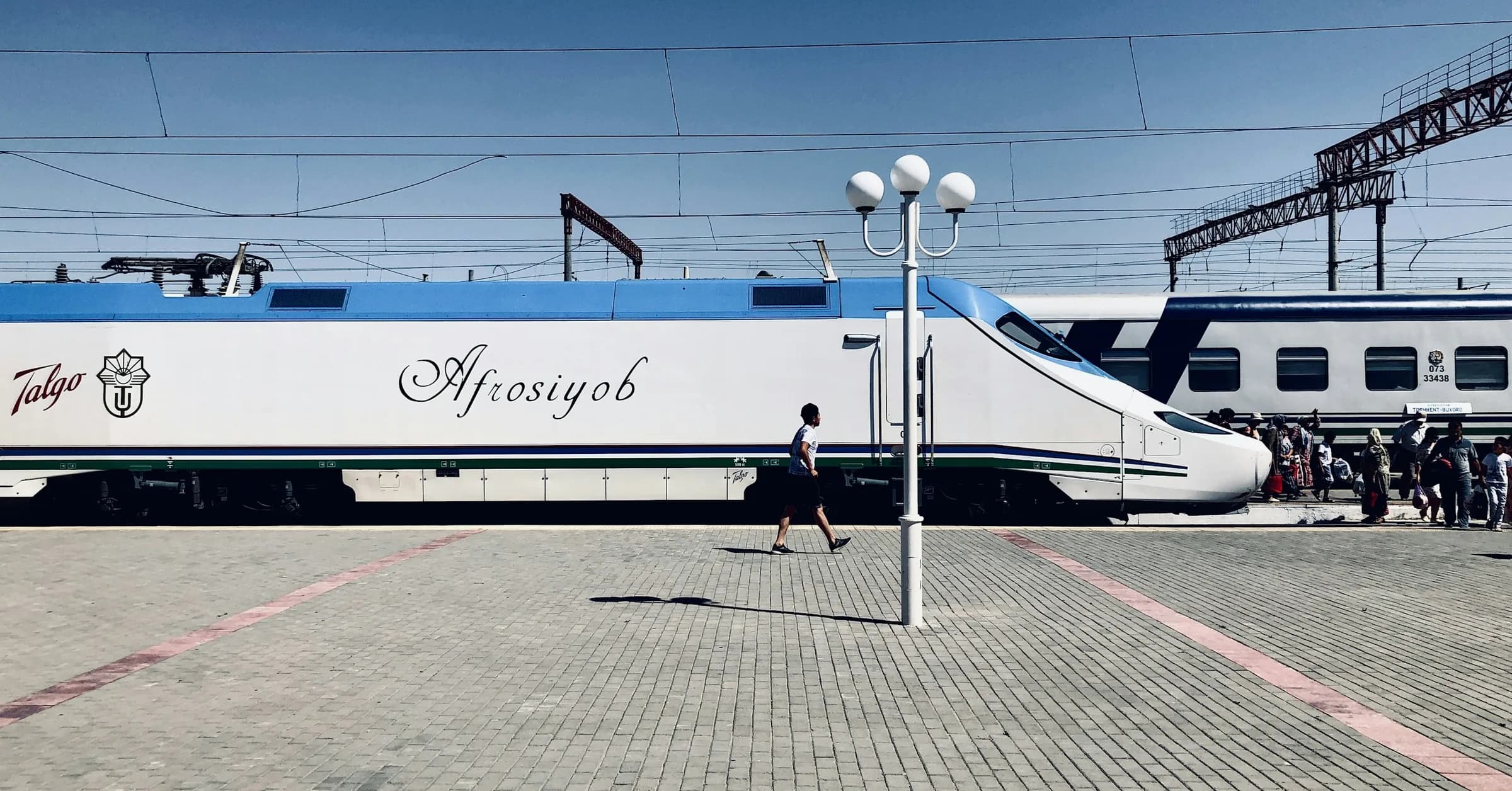
- Ticket: 80,000 som. The Afrosiyob high-speed train you probably arrived on is named after this site.
9. Visit the Tomb of Daniel (Khoja Doniyor)
On the far side of Afrosiyob, above the Siyob river, a long, low mausoleum holds what local tradition says are the remains of the Old Testament prophet Daniel, supposedly brought back by Timur from Persia. The sarcophagus is about 18 metres long, and the legend goes that the body keeps growing. Muslims, Christians and Jews all come here to pray, and there's a holy spring and an old pistachio tree that locals say came back to life after years of standing dead, on the terrace below.
- Ticket: 40,000 som. It's peaceful, green and much less visited than the central sights, a good end to a morning around Afrosiyob.
10. Watch the city from Hazrat Khizr Mosque
Just across the road from Siyob Bazaar, on the edge of the Afrosiyob mound, the small Hazrat Khizr Mosque has carved wooden columns, a painted ceiling and one of the best views in Samarkand: Bibi-Khanym's domes to one side and the old city spread out below. Next to it is the mausoleum of Islam Karimov, Uzbekistan's first president, so expect a steady stream of Uzbek visitors. There's a small fee to go inside, but the view from the terrace is the main reason to come.
11. Admire the tiles inside the madrasahs
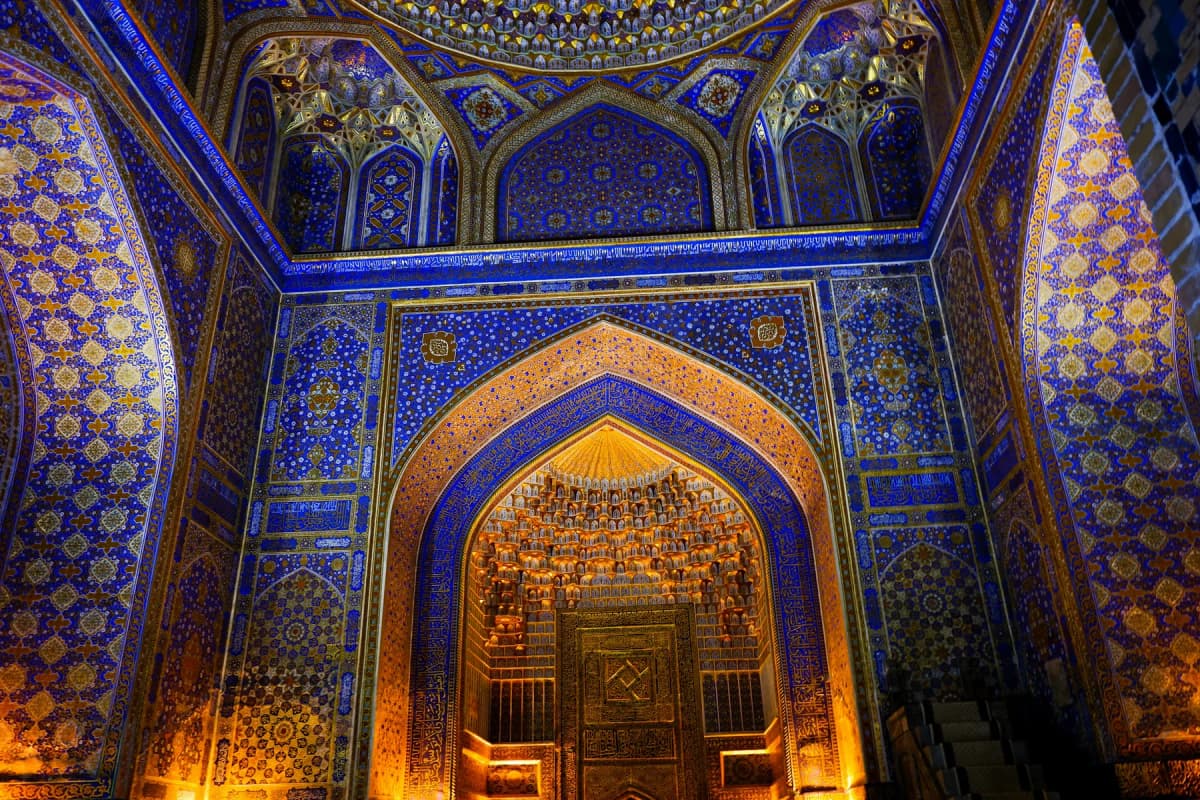 Photo: Catherine Zaidova on Unsplash
It's easy to rush through the Registan courtyards and miss the best part: the interior of the Tilya-Kori mosque. Its dome is actually flat, painted to look curved and deep, and covered in gold. Spend a few minutes there with your neck craned upwards. It's included in your Registan ticket and it's often quieter than the square outside.
If you'd rather have someone explain what you're looking at, a guided walking tour of the centre fills in the history behind every portal. You can book a small-group Samarkand heritage tour that covers the main sights with an English-speaking guide (from about $45 at the time of writing), or hire a licensed guide at the Registan.
12. See paper made by hand at Konigil
On the edge of the city, roughly 10 kilometres from the centre, in the village of Konigil, the Meros paper mill has revived Samarkand's medieval tradition of making paper from mulberry bark. A water-powered mill pounds the fibres, and you can watch the paper being pressed, dried and polished with stones, then buy notebooks and prints in the shop. The setting by the stream, under mulberry and walnut trees, is lovely on a hot afternoon.
- Ticket: about 25,000 som, paid at the shop. A Yandex Go taxi there costs a few dollars each way.
13. Spend an evening at the Eternal City
The Eternal City (Boqiy Shahar) is a new heritage-style park at the Silk Road Samarkand resort, on the city's eastern edge, with streets and pavilions inspired by Samarkand, Bukhara and Khiva, plus craft workshops, cafés and shows. It's a reconstruction, not a historic site, and some travellers find it too polished. But entry is generally free, it comes alive after dark when the monuments in the centre are closing, and a Yandex Go ride from the Registan takes about 15 minutes and costs around 20,000–25,000 som. It makes the most sense if you have three or more nights.
14. Eat Samarkand plov (and walk it off on University Boulevard)
Plov, rice slow-cooked with meat, carrots and onions in a big cast-iron kazan, is Uzbekistan's national dish, and every region claims to make it best. Samarkand's version is served in layers rather than stirred together, with yellow carrots and chunks of meat laid on top of the rice. Plov is a lunch dish: the big plov restaurants cook from the morning and are often sold out by mid-afternoon, so go around midday.
Afterwards, walk west from Gur-e-Amir along University Boulevard, the leafy spine of the nineteenth-century Russian part of town, with its Tsarist-era buildings and shady park. It's where locals spend their evenings, and it's a good reminder that Samarkand isn't only a museum. Along the way, the small Rukhobod Mausoleum near Gur-e-Amir, one of the oldest buildings in the city, is free to visit.
15. Take a day trip to Shahrisabz
Timur was born near Shahrisabz, about 90 kilometres south of Samarkand, and he planned his most ambitious palace there. What survives of the Ak-Saray ("White Palace") is two fragments of an entrance arch, but they're so massive that you can still imagine how the palace looked, and the town's historic centre is a UNESCO World Heritage Site. The Kok Gumbaz mosque and the Dorut Tilovat memorial complex are nearby.
The drive is half the fun: the road crosses the Takhtakaracha pass in the Zarafshan mountains, with views back over the valley. Allow around 1.5–2 hours each way. You can go by shared taxi from Samarkand, but most people find it easier to book a private Shahrisabz day tour from Samarkand with a driver and guide, which also means you can stop on the pass for photos.
How many days do you need in Samarkand?
- 1 day: possible, but rushed. You'll see the Registan, Gur-e-Amir, Bibi-Khanym and the bazaar, and you'll miss the evening lights if you're on a same-day return train.
- 2 days: the sweet spot for most people. Day one covers the centre (Registan, Gur-e-Amir, Bibi-Khanym, Siyob Bazaar and the Registan again after dark); day two starts early at Shah-i-Zinda and continues to the Afrosiyob Museum, the observatory and the Tomb of Daniel.
- 3 days: add Shahrisabz, or the Konigil paper mill and the Eternal City.
Getting to and around Samarkand
Arriving. Most travellers come by train from Tashkent. The Afrosiyob high-speed train takes just over two hours; our guide to Tashkent to Samarkand compares every option with current fares and how to book. If you'd rather go door to door, you can pre-book a private transfer from Tashkent. Samarkand also has its own international airport, with direct flights from Istanbul, Moscow and a handful of other cities, so it's worth checking whether you can fly straight in:
The station is not in the centre. Samarkand's railway station is about 6 kilometres from the Registan. A Yandex Go taxi costs roughly 15,000–25,000 som; ignore the drivers touting at the exit, who will ask several times that.
Getting around. The Registan, Gur-e-Amir, Bibi-Khanym, Siyob Bazaar and Shah-i-Zinda are all within walking distance of each other, and the pedestrianised Tashkent Street links most of them. For the observatory, the Tomb of Daniel, Konigil or the Eternal City, use Yandex Go: short rides across town cost around $1–2. You'll need mobile data for it, so set up an Uzbekistan eSIM before you fly, or buy a local SIM with your passport at the airport.
Travel insurance. Summer heat and long days on your feet catch a lot of visitors out, and the best hospitals are in Tashkent. It's worth having medical cover: you can compare EKTA travel insurance plans online before you go.
Moving on. Bukhara is about 1.5 hours further west on the Afrosiyob, and from Bukhara the new fast train continues to Khiva; see Bukhara to Khiva for times and options.
Best time to visit Samarkand
April to May and September to October are ideal: warm days, cool evenings and clear light for photographs. They're also the busiest months, so book trains and hotels early. Summer is very hot, with afternoons regularly above 35–40°C, so sightsee early and late and rest in the middle of the day. Winter is quiet and can be cold, sometimes with snow, but the monuments are open and you'll have them almost to yourself.
Practical tips
- Dress modestly at Shah-i-Zinda, Hazrat Khizr and the Tomb of Daniel: shoulders and knees covered, and a scarf for women is appreciated at shrines.
- Carry cash. Entry fees, taxis flagged in the street and the bazaar all run on som. ATMs are common in the centre, but not all accept foreign cards, so have a backup.
- Keep your ticket. Some sites check it more than once, so don't throw it away at the gate.
- Photography is allowed almost everywhere. A few sites have charged a small extra fee for professional cameras or drones; phones are fine.
- Start early. Tour groups arrive around 9:30–10:00. An hour at Shah-i-Zinda before then is worth more than three in the afternoon.
Frequently asked questions
What is Samarkand most famous for? The Registan, the square framed by three tiled madrasahs, is Samarkand's symbol. The city is also famous for Shah-i-Zinda's avenue of tombs, Timur's mausoleum at Gur-e-Amir and its role as one of the great cities of the Silk Road.
How many days do you need in Samarkand? Two full days is ideal: one for the Registan, Gur-e-Amir, Bibi-Khanym and the bazaar, and one for Shah-i-Zinda, the Afrosiyob Museum and the observatory. Add a third day for Shahrisabz.
Can you visit Samarkand as a day trip from Tashkent? Yes, with the early Afrosiyob train you can have around 10 hours in the city, but you'll miss the monuments lit up at night and Shah-i-Zinda in the early morning. We'd stay at least one night.
How much are entry fees in Samarkand? In 2026 a foreign adult paid 100,000 som for the Registan, 80,000 for Shah-i-Zinda and 75,000 each for Gur-e-Amir, Bibi-Khanym and the Ulugh Beg Observatory. Seeing all the main sights costs about 600,000–700,000 som (roughly $50–58).
Is Samarkand safe for tourists? Yes. Samarkand is generally very safe, including at night around the Registan and University Boulevard. The main annoyances are taxi touts at the station and the occasional overpriced souvenir, so use Yandex Go and compare prices before buying.
Samarkand or Bukhara: which is better? They're different. Samarkand has the grandest monuments and the biggest "wow" moments; Bukhara has a more intact, walkable old town where you feel like you're living inside the history. Most first-time visitors see both, and they're only 1.5 hours apart by train.
Is there a dress code in Samarkand? Not in the city in general, but at religious sites cover your shoulders and knees. Women may want a light scarf for Shah-i-Zinda and the Tomb of Daniel.
How we researched this guide
Entry fees and opening hours were checked in September 2026 against several recent sources, including the Silk Road Tour list of Uzbekistan entrance fees for 2026, the Uzbekistan Wanderer Samarkand guide (updated September 2026) and Saiga Tours' report on the July 2025 price rises. Registan hours and prices came from a June 2026 visit report, and the history from UNESCO's listing for Samarkand. Where sources disagreed, we've used the most recent figure or given a range. Samarkand's ticket prices have changed several times in the past year, so double-check at the booth. Found something out of date? Let us know.
Planning the rest of your trip? Browse all our Uzbekistan guides, start with Tashkent to Samarkand, and use Bukhara to Khiva for the long leg west. Our founder's own Samarkand to Bukhara misadventure is on the About page.