17 Best Things to Do in Essaouira, Morocco (2026 Guide)
October 4, 2026 · Morocco
This post contains affiliate links. We may earn a commission if you book through them, at no extra cost to you. Disclaimer.
The best things to do in Essaouira are to walk the 18th-century sea ramparts, watch the blue fishing boats unload in the harbour, eat grilled fish by the port, wander the small walled medina and spend an afternoon on the long, windy beach. Essaouira is a port town on Morocco's Atlantic coast, about three hours west of Marrakech by bus, and its whole medina has been a UNESCO World Heritage Site since 2001. Two days is enough to see it properly, and one day covers the highlights.
What sets it apart from Marrakech and Fes is the pace. The medina is laid out on a grid, so you can't really get lost. Nobody pushes very hard to sell you anything. The wind off the ocean keeps summer highs near 22°C when the inland cities are close to 40°C. This guide covers 17 things to do in Essaouira, with prices checked in October 2026, plans for one, two and three days, and how to get there.
Things to do in Essaouira at a glance
| Thing to do | Where | Price (2026) | Time needed |
|---|---|---|---|
| Skala de la Ville ramparts | North-west edge of the medina | Free | 30–45 minutes |
| Skala du Port | Harbour entrance | About 60 MAD | 30–45 minutes |
| Fishing harbour | South-west of the medina | Free | 1 hour |
| Grilled fish by the port | Between the port and Place Moulay Hassan | About 60–120 MAD a person | 1 hour |
| Medina and souks | Inside the walls | Free | Half a day |
| Bayt Dakira | Mellah, north of the medina | Free | 45 minutes |
| Essaouira beach | South of the medina | Free | As long as you like |
| Kitesurf or surf lesson | Main beach | From about 550 MAD for 2 hours | Half a day |
| Camel or horse ride | Beach and Diabat dunes | From about 300 MAD | 1–2 hours |
| Sidi Kaouki | 25 km south | Bus about 7 MAD each way | Half a day or more |
Small prices in Essaouira change without much notice, so treat them as a guide and carry cash.
1. Walk the Skala de la Ville ramparts
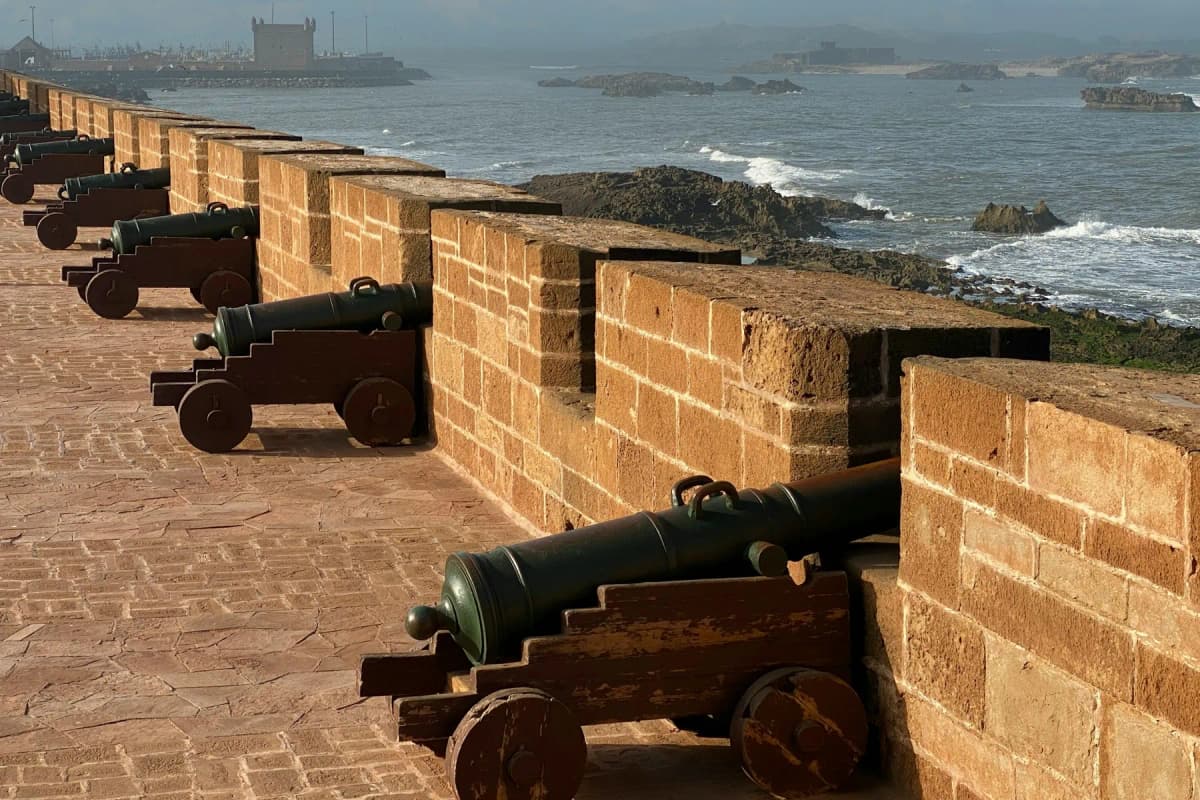 Photo:
 The Skala de la Ville is the sea bastion on the north-west side of the medina: a broad stone platform about 200 metres long, lined with a row of 18th- and 19th-century European bronze cannons that point out over the rocks. Sultan Mohammed ben Abdallah had the town built in the 1760s as a fortified trading port, and he hired a French engineer, Théodore Cornut, to design it along the lines of European coastal forts. That is why Essaouira looks so unlike other Moroccan cities.
From the top you look down on waves breaking on the reef and back across the white and blue rooftops. At the northern end there is a round tower you can climb for the widest view.
- Cost: free. It is open from about 9:00 until sunset.
- Best time: the hour before sunset, when the stone turns orange. It's also the busiest time, so come in the morning for photographs without people.
- Bring: a windproof layer, even in August.
2. Climb the Skala du Port
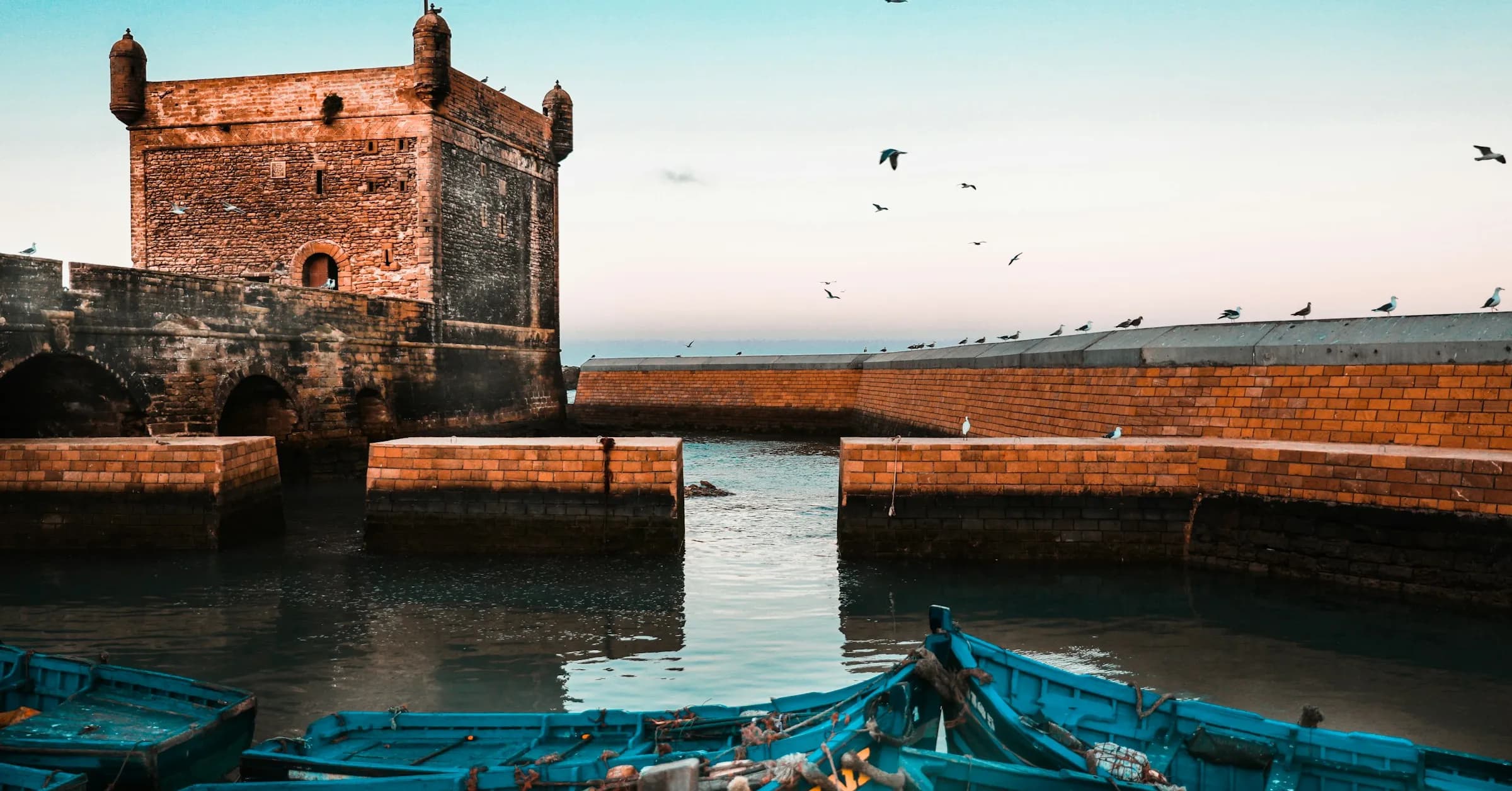
The Skala du Port is the second bastion, a square tower with corner turrets that guards the harbour entrance. It gives the picture that appears on every postcard of Essaouira: the medina walls and the sea framed through a round opening in the stone, with gulls wheeling in front.
You reach it through Bab el-Marsa, the ornate harbour gate dated 1184 in the Islamic calendar (about 1770). Climb the steps to the roof for a view over the fishing fleet on one side and Mogador island on the other.
- Cost: about 60 MAD for adults and 30 MAD for children under 12, cash, according to visitor reports from late 2025 and 2026. It used to cost 10 MAD, so older guides are out of date.
- Hours: roughly 9:00 to 17:00 daily.
- Good to know: this is the only rampart in town with an entry fee. If you'd rather not pay, the Skala de la Ville gives a similar view for free.
3. Watch the blue boats in the fishing harbour
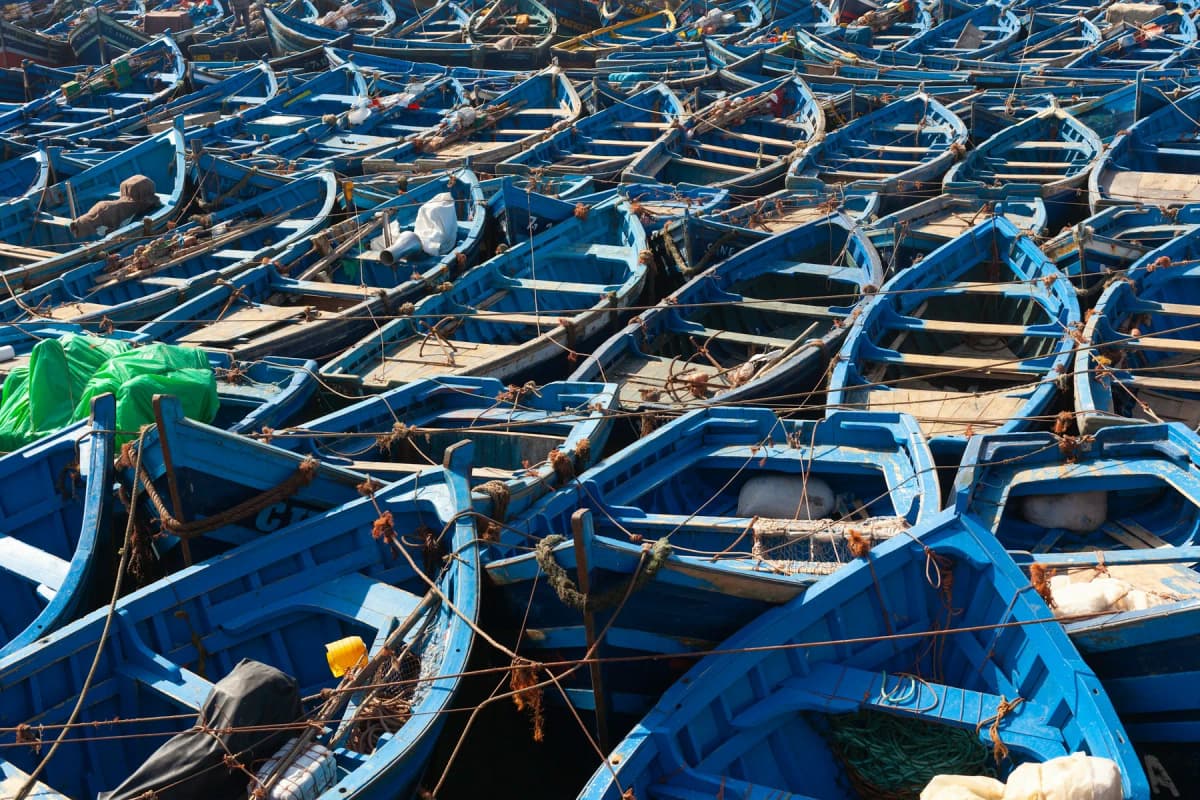 Photo: Simon Gagner on Unsplash
Essaouira is still a working fishing port, and the harbour is the liveliest place in town. Hundreds of small wooden boats, all painted the same deep blue, are moored side by side. Larger trawlers land sardines at the quay, men mend nets on the ground, and boats are still built and repaired by hand in the yard beside the gate.
Fishermen sell part of the catch straight from tables on the quay: sardines, sea bream, sole, conger eel, spider crabs and sea urchins. The gulls are everywhere, and so are the cats.
- Cost: free.
- Best time: mid-morning to early afternoon, when the boats come back in. The light is best late in the afternoon.
- Watch out for: fish scales, puddles and gulls overhead. Wear closed shoes you don't mind getting dirty, and ask before photographing people at work.
4. Eat grilled fish by the port
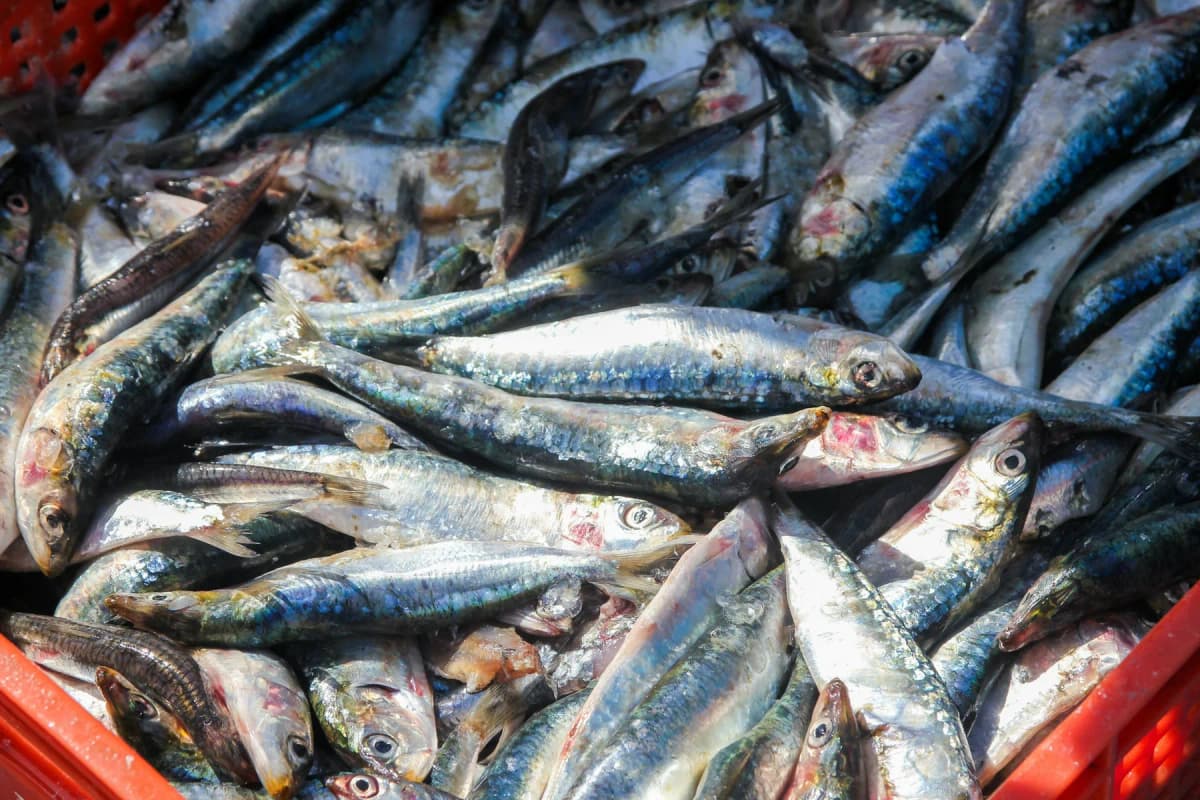 Photo:
 The classic Essaouira lunch is fish that was in the sea that morning. There are two ways to do it.
The first is the row of numbered grill stalls between the harbour and Place Moulay Hassan. Each one displays the day's catch on ice. You choose what you want, they weigh it, and it comes back grilled with bread, salad and a wedge of lemon.
The second is cheaper and more fun. Buy your fish from the fishermen in the port or at the fish souk in the middle of the medina, then carry it to one of the small grill places next door, which will clean and cook it for a few dirhams.
- Cost: budget about 60 to 120 MAD a person at the stalls for a mixed plate. Buying your own costs much less: recent visitors report paying around 10 MAD to have a rack of fish grilled.
- Tip: agree the total price before anything goes on the grill, and check whether bread, salad and drinks are included. Prices at the port stalls are per weight and open to negotiation.
- Don't miss: sardines. They're the cheapest thing on the table and the town's main catch.
5. Wander the medina
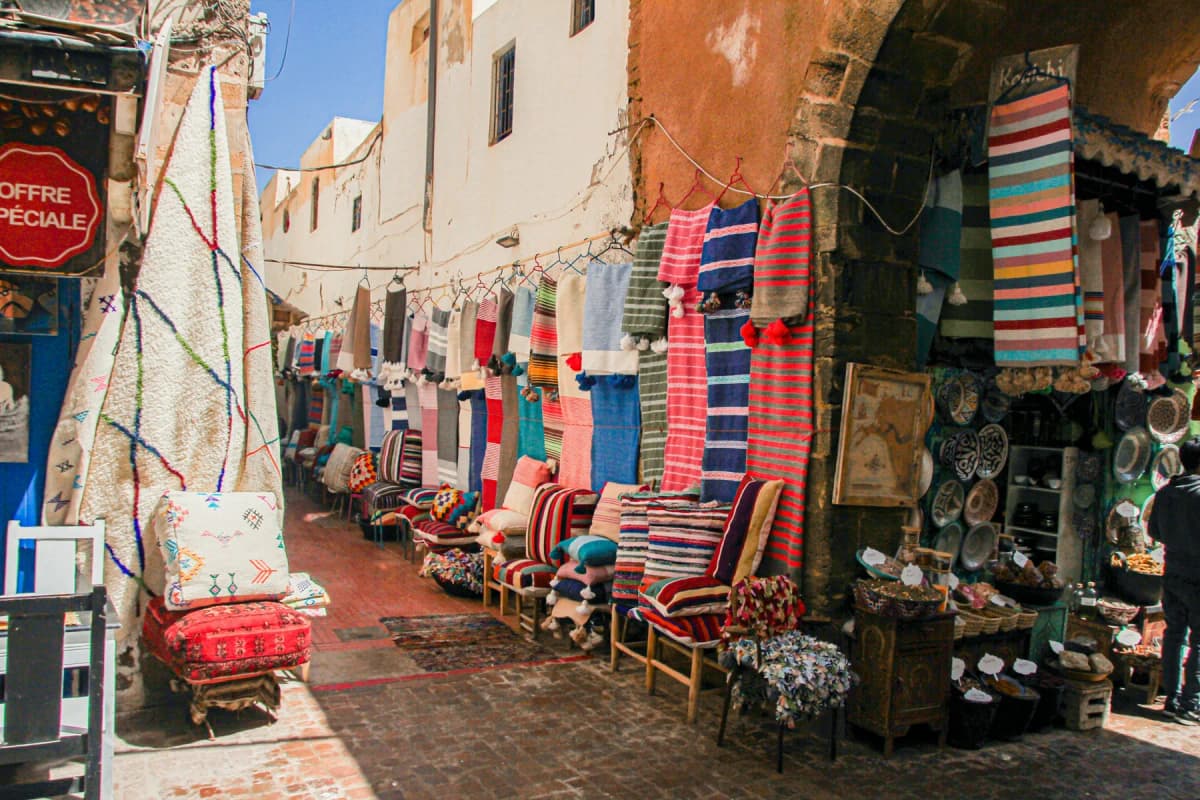 Photo:
 The medina of Essaouira is small, flat and almost impossible to get lost in. Two straight main streets, Avenue de l'Istiqlal and Avenue Sidi Mohammed ben Abdallah, run the length of it, and the lanes between them form a rough grid. You can walk from one end to the other in 15 minutes. UNESCO lists it as an outstanding example of a late 18th-century fortified town built on European military principles in a North African setting.
The pleasure is in the detail: whitewashed walls with blue shutters, carved stone doorways, cats asleep on stacks of rugs, and arches that open onto small squares. The area around the clock tower and the lanes of the old kasbah near the Skala are the prettiest.
- Cost: free.
- Tip: go early. Before 10:00 the lanes are quiet, the bakers are working and the light is soft.
- Good to know: the medina is car-free. Porters with blue handcarts wait at the gates and will take luggage to your riad for about 20 to 30 MAD.
6. Shop the souks
Shopping in Essaouira is calmer than in Marrakech. Sellers will greet you but rarely follow you, and opening prices are closer to the real ones. The main market area is the Souk Jdid, where the two main streets cross: spices and olives on one side, the fish souk and the old grain market on the other, with jewellery, slippers and woven baskets in the lanes around it.
Things the town is known for include thuya woodwork, argan oil, raffia shoes, Berber silver and paintings by local self-taught artists, which you'll see in small galleries all over the medina. On the north side, the Joutia flea market sells second-hand tools, furniture and oddities, and is worth a look on a weekend morning.
- Cost: free to browse. Bargaining is expected, but gently. Offering about half and meeting somewhere near two thirds is normal.
- Tip: most shops open around 10:00 and many close for Friday midday prayers.
7. See the woodworkers under the ramparts
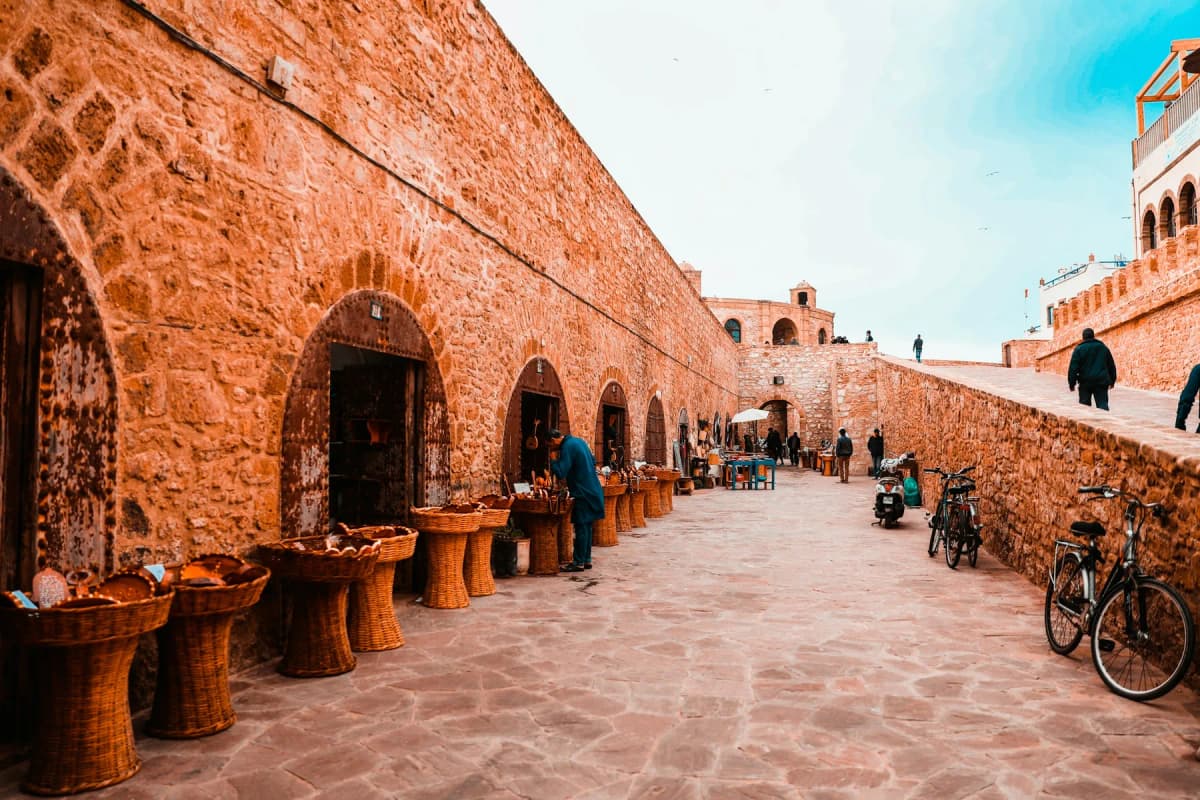 Photo:
 The vaulted rooms under the Skala de la Ville were built to store ammunition. Today they are workshops for Essaouira's best-known craft: thuya wood marquetry. Thuya is a conifer that grows in this part of Morocco, and the knotted burl from its roots is polished into boxes, chessboards, trays and tables, often inlaid with lemon wood, ebony and mother-of-pearl.
You can watch craftsmen cutting and sanding at the doors of the workshops along Rue de la Skala, and the smell of the wood, something like cedar and pepper, fills the street.
- Cost: free to watch. Small boxes start at around 50 MAD and large inlaid pieces cost several thousand.
- Tip: thuya is a slow-growing tree under pressure from overuse. Buy from a workshop or cooperative where you can see the work being done, and choose a small, well-made piece over a large cheap one.
8. Visit Bayt Dakira and the Mellah
In the 19th century, Jewish families made up a large share of Essaouira's population, and Jewish merchants handled much of the sultan's trade with Europe. The Mellah, the old Jewish quarter in the north of the medina, fell into ruin after most of the community left in the 1950s and 1960s, and parts of it are still being rebuilt.
Bayt Dakira, the "House of Memory", opened in 2020 in a restored merchant's house. It combines a small museum of photographs, documents and ritual objects with the restored Slat Attia synagogue and a research centre. It is the best single place to understand how Muslims and Jews lived side by side here. Nearby, the Haim Pinto Synagogue and Slat Lkahal can also be visited when a caretaker is present.
- Cost: Bayt Dakira is free. A small donation is expected at the other synagogues.
- Hours: about 9:30 to 18:30. It is closed on Saturdays.
- Good to know: the town's main museum, the Sidi Mohammed ben Abdallah Museum, has been closed for renovation. An agreement to restore and re-equip it was signed in April 2026, and no reopening date had been announced when we checked. Ask your riad before you plan around it.
9. Walk Essaouira beach
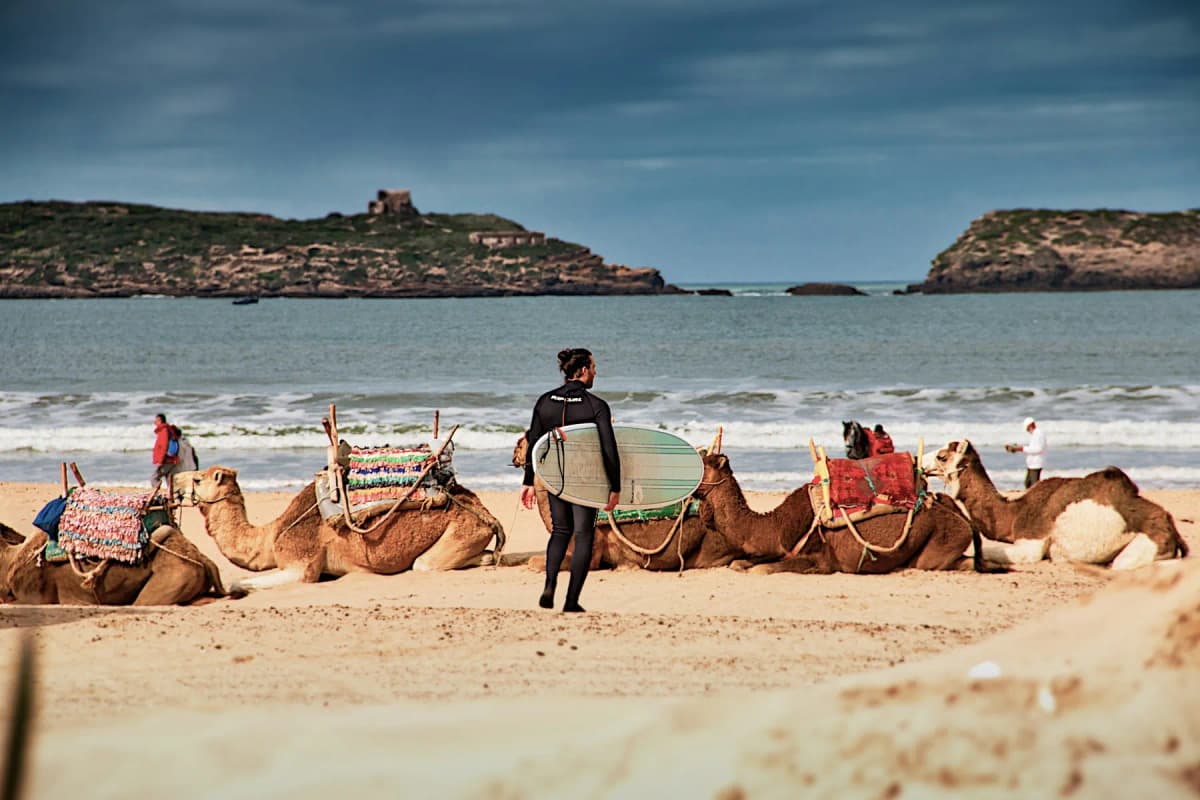 Photo: Peter Schulz on Unsplash
Essaouira beach starts at the harbour wall and curves south for several kilometres of firm, pale sand. It is wide, clean and backed by a promenade with cafés. At low tide the sand near the town turns into dozens of informal football pitches, and further along you'll pass camels, horses and kites.
What it isn't, most of the year, is a sunbathing beach. The trade wind known locally as the alizée blows hard from about April to September, strongest in the afternoon, and it carries sand with it. The sea is cold too, rarely above 21°C. Come to walk, not to lie down, and you'll enjoy it.
- Cost: free. Sunbeds at the beach clubs cost extra.
- Best time: mornings are calmer. For the least wind, come between October and March.
- Walk: it takes about an hour along the sand to the mouth of the Oued Ksob river and the ruined fort beyond it (see number 12).
10. Take a kitesurfing or surf lesson
The same wind that spoils sunbathing has made Essaouira one of the best-known kitesurfing and windsurfing spots in Africa. The bay is shallow, sandy and sheltered from big swell by Mogador island, which suits beginners, and a line of schools at the southern end of the beach rents equipment and gives lessons in English and French.
When the wind drops, usually in the morning and through the winter, the same schools teach surfing on small, forgiving waves.
- Cost: a 2-hour group kitesurf lesson costs roughly 550 to 650 MAD (about US$56 to US$70 on booking sites in 2026). Surf lessons and board hire cost less.
- Season: April to September for wind, October to March for surf.
- Tip: beginners need three or four kite sessions before riding alone, so book a course, not a single lesson, if you're serious.
11. Ride a camel or a horse along the beach
Camels and horses wait on the sand near the southern end of the promenade, and rides head along the shore and into the dunes towards Diabat. A sunset ride is the popular choice, and stables at Diabat run longer treks on horseback for people who can already ride.
- Cost: booked online, a 1-hour camel ride starts at about US$30 (around 300 MAD) and a 2-hour horse ride at about US$50, usually with pick-up. On the beach itself you can pay less for a short ride if you bargain.
- Tip: agree the price and the length of the ride before you get on, and look at the animals first. Pick an operator whose camels and horses look well fed and cared for.
- Also on offer: quad bike tours through the dunes and forest behind Diabat, typically 2 to 3 hours.
12. Walk to Diabat and the ruined fort
At the far end of the bay, where the Oued Ksob meets the sea, the remains of Borj el-Baroud sit half-buried in the sand. This 18th-century watchtower has collapsed into a pile of worn stone blocks that the tide washes around.
Local legend says the ruin inspired Jimi Hendrix's song "Castles Made of Sand". It didn't: the song came out in 1967, and Hendrix only visited Essaouira for a few days in the summer of 1969. The village of Diabat, just inland, still trades on the connection with a Hendrix-themed café.
- Cost: free.
- Getting there: walk about an hour along the beach from town, or take a petit taxi to Diabat for around 30 MAD.
- Good to know: at high tide or after rain the river can be too deep to wade. Check with a surf school before setting off, and take a taxi back if the wind is against you.
13. See Mogador island from the shore
The low island across the bay is Mogador, the largest of the Îles Purpuraires. The Phoenicians traded here, and around 2,000 years ago King Juba II set up a factory that made purple dye from murex shellfish for the Roman world. A ruined 19th-century prison and a small mosque still stand on it.
Today the island is a protected nature reserve and a breeding site for Eleonora's falcons, which arrive in spring and leave in October. Landing is not allowed without a permit, but small boats from the harbour take visitors around the bay when the sea is calm.
- Cost: boat trips are negotiated at the port, so prices vary. Ask at the harbour gate.
- Tip: bring binoculars to the Skala du Port in the late afternoon between May and October, when you can sometimes watch the falcons hunting over the water.
14. Listen to Gnawa music
Essaouira is the home of Gnawa, a spiritual music brought to Morocco by people from West Africa and built around the deep three-stringed guembri and iron castanets called qraqeb. UNESCO added Gnawa to its list of intangible cultural heritage in 2019.
You can hear it most evenings in cafés and restaurants around the medina, and musicians often play near Place Moulay Hassan. Once a year the Gnaoua and World Music Festival fills the town with free outdoor concerts where Gnawa masters play with jazz, blues and African musicians. The next edition is announced for 24 to 26 June 2027.
- Cost: the big outdoor stages at the festival are free. Small venues charge for some concerts.
- Good to know: rooms for festival week sell out months ahead and prices rise sharply. Book early or avoid those dates.
15. Visit an argan oil cooperative
South-west Morocco is almost the only place in the world where the argan tree grows wild, and UNESCO has protected the area as a biosphere reserve since 1998. Women's cooperatives along the road to Marrakech and around the town crack the nuts by hand and press them into cosmetic oil, cooking oil and amlou, a spread of argan oil, almonds and honey that tastes like a looser, nuttier peanut butter.
A visit takes about half an hour. You watch the cracking and grinding, taste the oil and amlou with bread, and end up in the shop.
- Cost: visits are free. Pure oil is expensive because it takes many hours of work to make a litre, so be suspicious of anything very cheap. One recent visitor paid about 500 MAD for 250 ml of cosmetic oil at a cooperative.
- Tip: most day tours from Marrakech stop at a cooperative on the way. If you want to see goats in argan trees, know that the ones beside the main road are placed there for photographs.
16. Unwind in a hammam or take a cooking class
Two good options for a windy afternoon.
A hammam is a steam bath followed by a scrub with black soap and a rough glove. Essaouira has cheap neighbourhood hammams, where you bring your own kit, and several spa hammams in riads that offer a private room, a scrub and an argan oil massage.
A cooking class usually starts with a walk through the spice and fish souks to buy ingredients, then moves to a kitchen where you make a tagine or a fish dish and eat it for lunch. L'Atelier Madada, in a former almond warehouse in the medina, is the best known.
- Cost: a public hammam costs about 15 to 30 MAD plus a tip for a scrub. Spa hammams usually start at around 250 MAD. Cooking classes cost more and need booking a day or two ahead.
- Tip: ask your riad to phone for you. Many places take bookings by phone or WhatsApp only.
17. Take a day trip to Sidi Kaouki or a winery
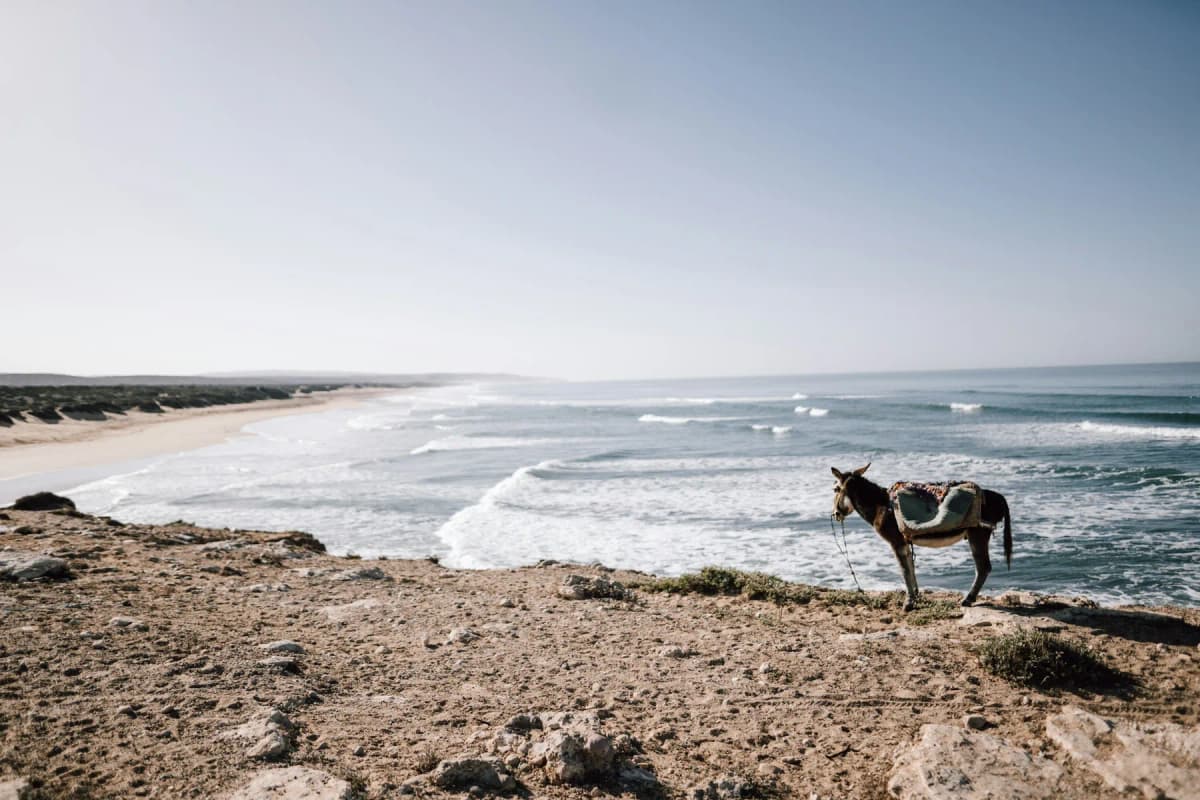 Photo: Elisabeth Jurenka on Unsplash
Sidi Kaouki, 25 km south, is a scattered village on a huge empty beach, with a handful of cafés, surf shops and a white shrine on the rocks. It has better waves for beginners than Essaouira, and far fewer people. Local bus number 2 runs from outside Bab Doukkala several times a day and costs about 7 MAD.
Inland, the Domaine du Val d'Argan near Ounagha, about 25 to 35 km east depending on your route, is one of the few wineries in southern Morocco. It was planted by a winemaker from the Rhône valley, and it offers tastings and lunch among the vines. Recent visitors report paying around 200 MAD to taste four wines.
On Sundays, the country market at Had Draa, about 30 km towards Marrakech, is one of the largest in the region. It is a real farmers' market for livestock, vegetables and tools, and it starts early.
- Getting there: a grand taxi or a driver for half a day is the easy way to reach the winery or the market. Agree the price and waiting time before you leave.
Free things to do in Essaouira
Most of the best of Essaouira costs nothing:
- The Skala de la Ville ramparts and their cannons.
- The fishing harbour and its blue boats.
- The medina, the souks and the woodworkers' street.
- Bayt Dakira, the House of Memory.
- The beach, and the walk to the ruined fort at Diabat.
- Sunset from the ramparts or from Place Moulay Hassan.
- Street music around the square in the evening.
How to spend 1, 2 or 3 days in Essaouira
One day. Start at the Skala de la Ville before the crowds, then walk through the woodworkers' street and the souks to the fish market. Go down to the harbour late in the morning, pay to climb the Skala du Port, and eat grilled fish for lunch. Spend the afternoon on the beach, and be back on the ramparts or a roof terrace for sunset. This is also what a day trip from Marrakech covers. If you can't stay the night, a small-group Essaouira day trip handles the six hours of driving for you.
Two days. Add the Mellah and Bayt Dakira on the second morning, then a kitesurf or surf lesson, or a camel or horse ride to Diabat. Finish with a hammam and an evening of Gnawa music.
Three days. Use the third day for Sidi Kaouki, or combine an argan cooperative with lunch at the Val d'Argan winery.
To see where Essaouira fits in a longer route, our Morocco itinerary adds it to the 14-day version, and our guide to the best places to visit in Morocco compares it with the other main stops.
Getting there and around
From Marrakech by bus. Supratours and CTM both run direct coaches, and the journey takes about 3 hours with a short break on the way. Supratours has around seven departures a day, leaving from its office beside Marrakech railway station. Tickets cost roughly 100 to 140 MAD each way, plus a few dirhams for luggage in the hold. Book a day or two ahead in spring, summer and around holidays, on the Supratours or CTM websites or at the station. In Essaouira, Supratours stops a few minutes' walk from Bab Marrakech, while the CTM station is further out and needs a short taxi ride.
By car or transfer. The drive is about 180 km and takes around 2 hours 45 minutes on a good road. If you're landing in Marrakech and going straight to the coast, a pre-booked transfer saves a trip into the city to find the bus.
By air. Essaouira-Mogador Airport (ESU) is about 17 km from town and has a small number of flights, mostly from European cities. A grand taxi to the medina costs about 150 MAD.
From Agadir. Buses take around 3 hours along the coast road.
Around town. You walk. The medina is car-free and takes 15 minutes to cross. Blue petit taxis charge a flat fare of about 8 MAD by day and 9 MAD at night for trips within town, and they wait at the gates. They can't go to the airport.
A Morocco eSIM is handy for maps and bus bookings, and travel insurance from a provider such as EKTA is sensible if you plan to kitesurf, ride or use quad bikes. Check that the policy covers those activities.
Still comparing dates? Check flight prices to Morocco here:
Best time to visit Essaouira
Essaouira works all year. Average highs move only between about 18°C in January and 23°C in September, according to long-term climate normals for the town.
- April to September is dry and sunny but windy, which is ideal for kitesurfing and for escaping the heat inland. August is the busiest month, when Moroccan families come to the coast.
- October and November are the best all-round months: still warm, with much less wind.
- December to March is mild and quiet, with some rain and the best surf. Evenings are cool and many riads have no heating, so ask.
Our guide to the best time to visit Morocco compares the coast with Marrakech, Fes and the desert month by month.
Tips for visiting Essaouira
- Pack for wind. Bring a light jacket and something to tie back long hair, even in summer. Sunglasses help with blowing sand.
- Carry cash. The Skala du Port, the fish stalls, taxis and most small shops take cash only. There are ATMs near the main gates.
- Mind the gulls. They will take food from an open plate at the port stalls.
- Stay inside the walls or just outside them. Riads in the medina have the atmosphere. Hotels along the beach have pools, parking and easier access with luggage.
- Alcohol is served in a limited number of licensed restaurants, hotel bars and roof terraces, not in ordinary medina cafés.
- Dress is relaxed by Moroccan standards, but cover up away from the beach.
Frequently asked questions
What not to miss in Essaouira? The Skala de la Ville ramparts at sunset, the fishing harbour with its blue boats, a grilled fish lunch by the port, a walk through the medina and an hour on the beach. All five fit into one day.
Is Essaouira in Morocco worth visiting? Yes. It is the most relaxed of Morocco's historic towns, with a UNESCO-listed medina, a working harbour, good seafood and a long beach, and it stays cool in summer. It suits travellers who want a break from the intensity of Marrakech more than those looking for big sights.
How many days do you need in Essaouira? Two days is ideal: one for the ramparts, harbour and medina, and one for the beach, a lesson or ride, and the Mellah. One day covers the highlights, and three lets you add Sidi Kaouki or a winery.
Is a day trip from Marrakech to Essaouira worth it? It is, if that's all the time you have, but it's a long day: about three hours each way for four or five hours in town. Staying one night is far better, because you get the sunset and the quiet early morning.
Can you swim in Essaouira? You can, but the water is cold, usually 17°C to 21°C, and the wind makes the beach more comfortable for walking and water sports than for swimming. Sidi Kaouki and the sheltered end of the bay near the harbour are the calmer spots.
What is there to do in Essaouira at night? Watch the sunset from the ramparts, eat seafood in the medina, and look for live Gnawa music in a café or restaurant. A few roof terraces serve drinks. The town is quiet by midnight.
Was Game of Thrones filmed in Essaouira? Yes. The ramparts stood in for the city of Astapor in season 3. Orson Welles also filmed parts of his "Othello" here around 1950, and a small square near the port is named after him.
Is Essaouira safe for tourists? Generally yes. It is one of the calmer towns in Morocco, with little of the hassle found in bigger cities. Take the usual care with valuables on the beach and in the harbour, and avoid the far end of the beach after dark.
How we researched this guide
This guide is based on research using official sources such as the UNESCO World Heritage listing for the Medina of Essaouira, the Supratours and CTM timetables, and the Gnaoua festival's own announcement of its 2027 dates, plus current traveller feedback and search trends. Entry fees, taxi fares and stall prices aren't published officially, so they were cross-checked across several recent visitor guides and reviews in October 2026 and should be read as approximate. Found something out of date? Let us know.
Planning the rest of your trip? See all our Morocco guides, our 20 best things to do in Morocco, and the best things to do in Marrakech, where most trips to Essaouira begin.