15 Best Things to Do in Chefchaouen, Morocco's Blue City (2026)
October 5, 2026 · Morocco
This post contains affiliate links. We may earn a commission if you book through them, at no extra cost to you. Disclaimer.
The best things to do in Chefchaouen are to walk the blue lanes of the medina early in the morning, sit on Plaza Uta el-Hammam under the 15th-century kasbah, climb to the Spanish Mosque for sunset and spend a day at the Akchour waterfalls in the hills nearby. Chefchaouen is a town of about 46,000 people in the Rif mountains of northern Morocco, roughly two and a half hours by bus from Tangier and four to five from Fes. One full day covers the town itself, and two nights gives you time for the waterfalls as well.
This guide lists 15 things to do in Chefchaouen, grouped by where they are: in the town, in the hills around it, and at the table. Each one has a rough cost, how long it takes and a practical tip. Prices are in Moroccan dirhams (MAD) and were checked in October 2026 against operator listings and recently updated visitor guides. Treat them as approximate, because small-town prices change without notice.
Things to do in Chefchaouen at a glance
| What | Where | Cost (approx.) | Time needed |
|---|---|---|---|
| Walk the blue medina | Old town | Free | 2 to 3 hours |
| Plaza Uta el-Hammam | Centre of the medina | Free; mint tea 10 to 15 MAD | 1 hour |
| Kasbah and museum | On the plaza | About 60 MAD | 45 minutes |
| Ras el-Maa spring | East gate (Bab el-Ansar) | Free | 30 minutes |
| Spanish Mosque at sunset | Hill east of town | Free | 1.5 hours |
| Souks and craft shops | Medina lanes | Free to browse | 1 to 2 hours |
| Weekly market | Below the medina, Monday and Thursday | Free to browse | 1 hour |
| Akchour waterfalls and God's Bridge | 30 km from town | Shared taxi about 25 to 30 MAD each way | Full day |
| Jebel el-Kelaa hike | Peak above town | Free | 4 to 6 hours |
| Tetouan day trip | 60 km north | Bus about 30 to 60 MAD each way | Full day |
In the town
1. Get lost in the blue lanes of the medina
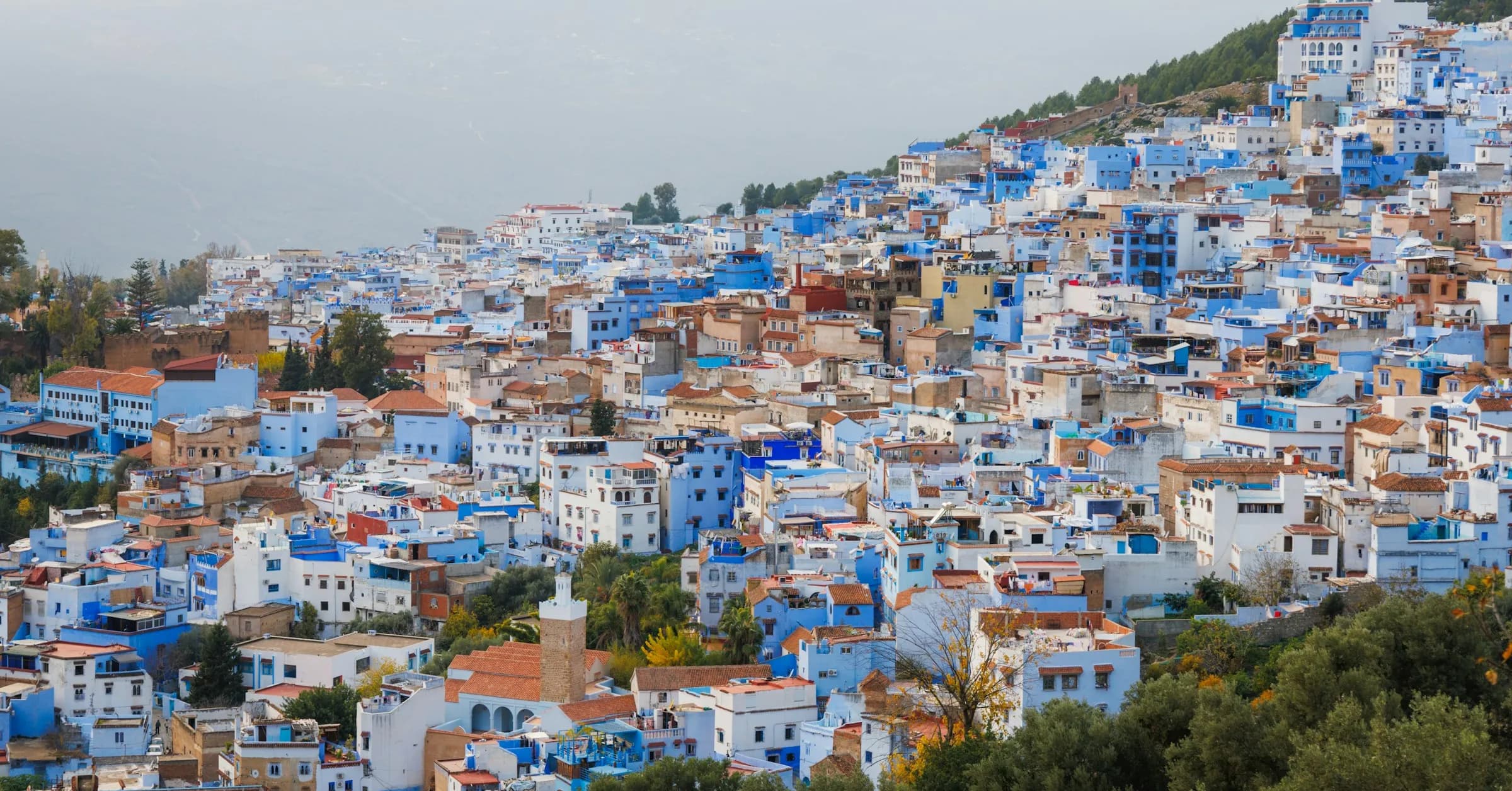
The medina is the reason people come. It is small, steep and almost entirely painted in shades of blue, from pale sky blue on the upper walls to a deep indigo on the steps and doorways. There is no entry fee and no set route. Start at Bab el-Ain, the main gate on the lower side, and walk uphill. You will pass Place El Haouta, a quiet square with a tiled fountain, and Callejón El Asri, the stepped lane lined with flower pots that appears in most photos of the town.
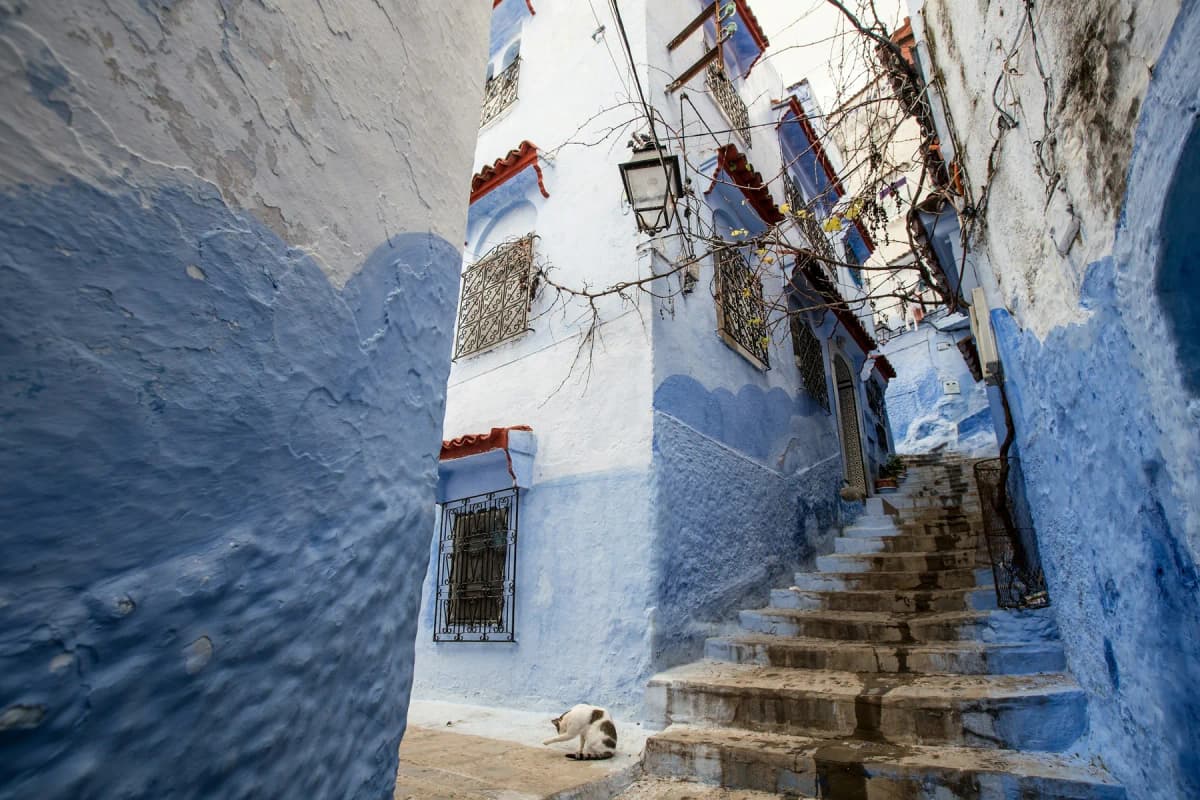
Photo: Ursula Drake on Unsplash
- Cost: Free. Some residents set up decorated corners and ask about 5 MAD for a photo.
- Best time: Before 9:00, when the lanes are empty and the light is soft. Day-trip groups arrive from late morning.
- Tip: The medina is too small to get truly lost in. If you lose your bearings, walk downhill and you will reach either the plaza or Bab el-Ain.
2. Find out why Chefchaouen is blue
Nobody agrees on one answer, and that is part of the fun. Guides and residents give four main explanations. The first is that Jewish refugees who settled here in the 1930s painted their quarter blue, a colour linked to the sky and to heaven, and the habit spread. The second is that blue keeps mosquitoes away. The third is that it keeps houses cool in summer. The fourth is more recent: the town painted more and more of the medina blue from the 1970s onwards because visitors liked it.
What is certain is that the walls are repainted every spring, usually before Ramadan or the summer season, so the colour is at its freshest from April to June. For the oldest blue streets, walk through the Mellah, the former Jewish quarter, between the plaza and Bab el-Ain.
- Cost: Free.
- Tip: A local guide for a two-hour medina walk costs roughly 150 to 250 MAD and is the easiest way to hear the stories. Agree the price before you start.
3. Sit on Plaza Uta el-Hammam
Every lane in the medina seems to lead to this cobbled square. One side is filled by the red walls of the kasbah, another by the Grand Mosque with its unusual octagonal minaret, and the rest by café terraces shaded by mulberry trees. Non-Muslims cannot enter the mosque, but the minaret is easy to admire from a café chair.
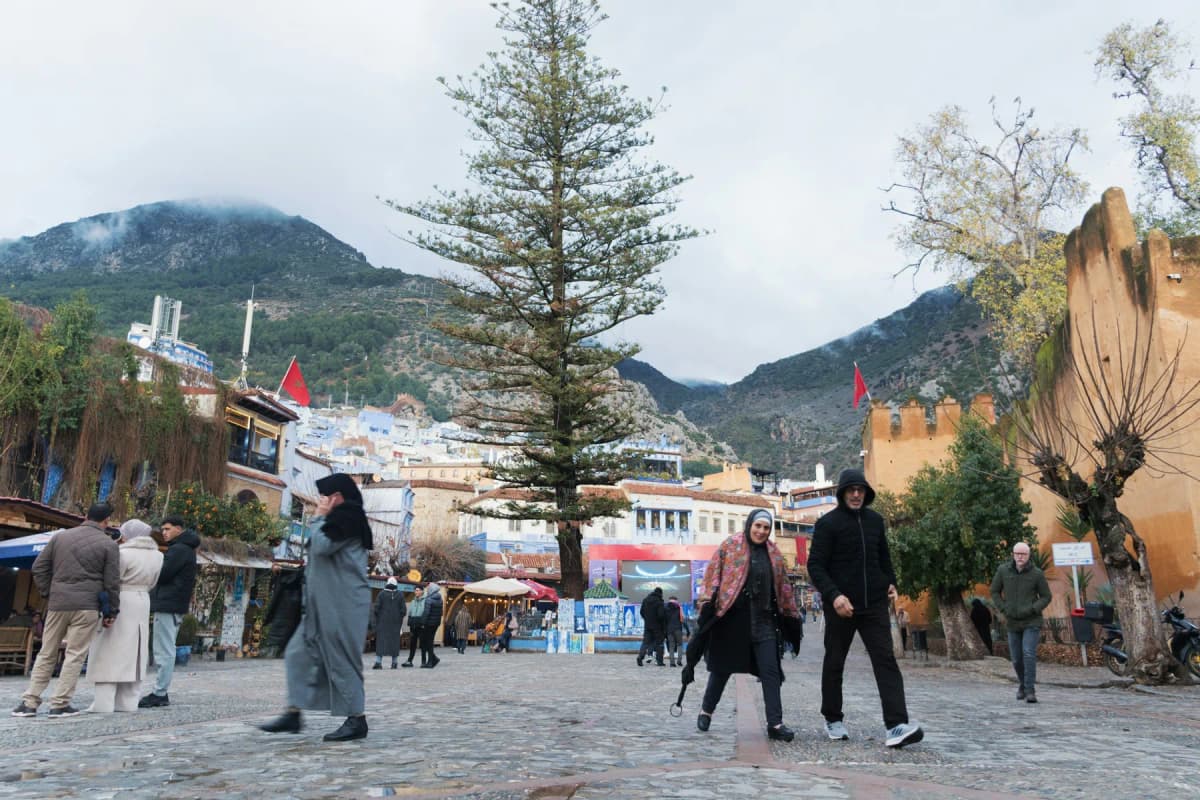
Photo: Youssef Mubarak on Unsplash
- Cost: Free. A mint tea on a terrace is about 10 to 15 MAD.
- Best time: Late afternoon, when families come out and the kasbah walls turn orange.
- Tip: Restaurants on the square charge more than those one lane back. Drink here, eat elsewhere.
4. Visit the kasbah and climb its tower
The kasbah is where the town began. Moulay Ali ibn Rashid founded Chefchaouen in 1471 as a small fortress to hold off Portuguese raids from the coast, and Muslim and Jewish families expelled from Spain settled around it in the following decades. Inside the walls you will find a walled Andalusian garden, a small ethnographic museum with local dress, instruments and pottery, the old prison cells and a tower you can climb for a view over the blue rooftops.
- Cost: About 60 MAD for foreign visitors. Older guides still quote 10 MAD, so bring enough cash.
- Opening hours: Roughly 9:00 to 18:00 daily, with a midday break on Fridays reported by some visitors.
- Tip: The tower stairs are narrow and steep. Go early or late to avoid waiting on the steps.
5. Walk to the Ras el-Maa spring
Just outside Bab el-Ansar, the eastern gate, a mountain spring comes out of the rock and runs down a small gorge. This is the town's original water supply. Local women still use the stone washhouses beside the stream, and in summer families sit with their feet in the cold water. A few cafés put their chairs right in the shallows.
- Cost: Free. Fresh orange juice from the stalls is about 10 MAD.
- Time needed: 30 minutes, or longer with a drink.
- Tip: Ask before photographing anyone doing laundry. Many people here do not want to be in pictures.
6. Watch the sunset from the Spanish Mosque
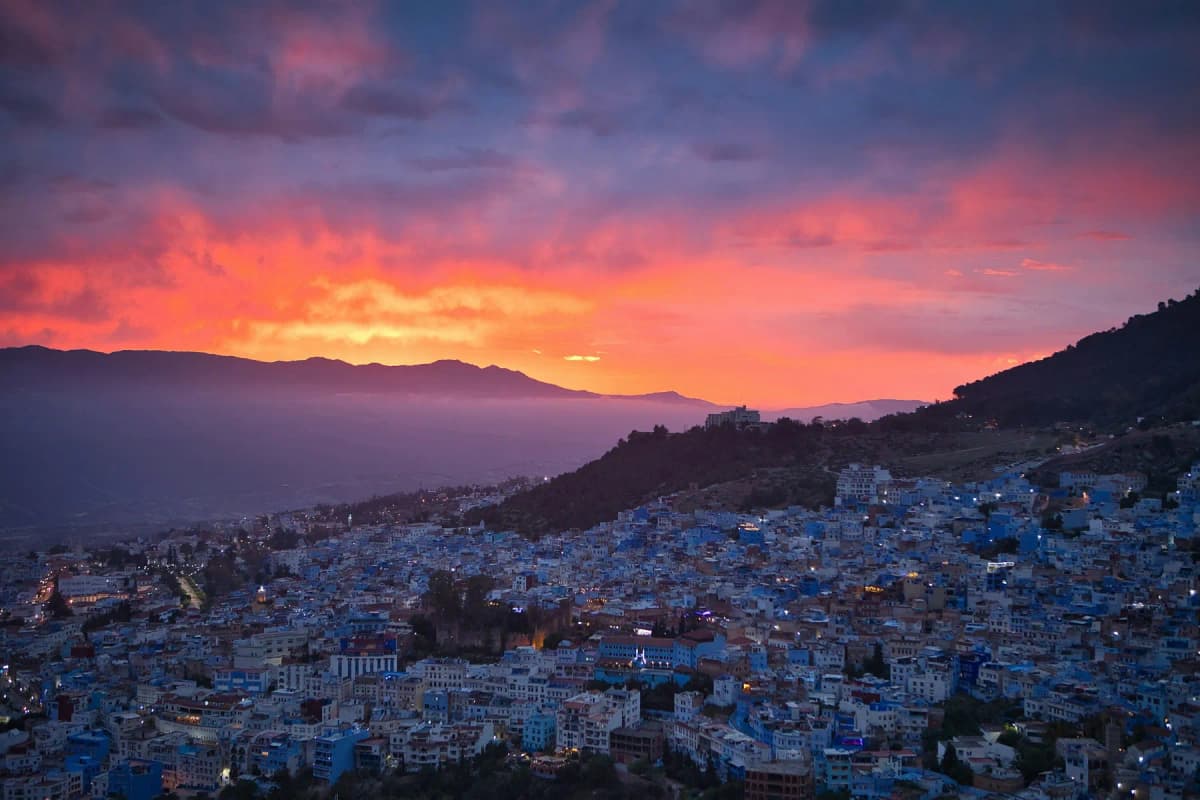
The white mosque on the hill east of town was built by the Spanish in the 1920s and was never used for worship. It is also called the Bouzafer mosque. The reason to go is the view: the whole medina spreads out below, blue against the green and grey of the Rif, and the walls change colour as the sun drops behind the mountains opposite.
- Cost: Free.
- How to get there: Cross the bridge at Ras el-Maa and follow the paved path uphill. It takes 20 to 30 minutes at an easy pace.
- Best time: Arrive 45 minutes before sunset for a place on the wall. Sunrise is far quieter.
- Tip: Bring a torch or a charged phone for the walk down. The path is not lit.
7. Shop for wool blankets, baskets and leather
Chefchaouen has a different craft tradition from Marrakech or Fes. The town is known for woven wool: striped blankets, thick djellabas for the mountain winters and rugs in simple patterns. You will also find palm-leaf baskets, leather bags, and bags of powdered pigment in bright colours. Sellers are calmer than in the big cities, and browsing is easy.
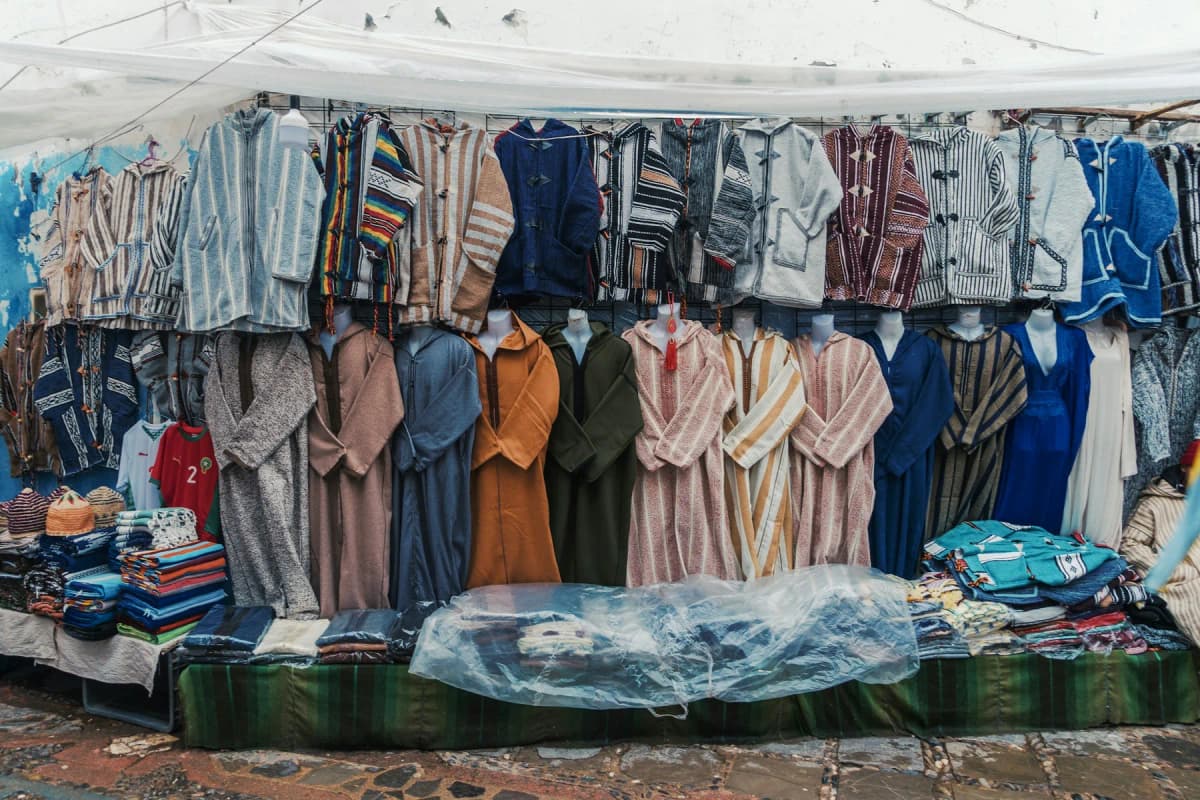
Photo: Youssef Mubarak on Unsplash
- Cost: Free to browse. Bargaining is expected; a first price is usually well above the final one.
- Tip: Some weaving workshops let you watch the looms in use. Ask at the shop if the weaver works on site.
8. Go to the Monday or Thursday market
Twice a week, farmers from villages across the Rif come down to sell in the market area below the medina. Many of the women wear the traditional Jebala dress: a red and white striped cloth tied at the waist and a wide straw hat with wool pom-poms. Stalls sell olives, goat cheese, honey, vegetables and household goods. It is a working market for residents, not a show for visitors.
- Cost: Free to browse.
- Best time: Morning. Most sellers pack up after lunch.
- Tip: Keep your camera down unless you have asked first.
9. Stay for the evening
Most visitors come on a day trip and leave by mid-afternoon. After they go, the medina becomes a different place. Lamps light the blue walls, children play football on the plaza and the café terraces fill with local families. There is no nightlife in the usual sense and very few places serve alcohol. The evening is for a slow dinner on a rooftop and a last walk through quiet lanes.
- Cost: Free, plus dinner.
- Tip: This is the best argument for sleeping here instead of visiting from Fes or Tangier and going back the same day.
10. Try a hammam or a cooking class
A public hammam is the cheapest way to warm up after a cold mountain day. Entry is about 15 to 20 MAD, and you bring or buy your own black soap and scrubbing glove. Hours are usually split between men and women. Several riads and small spas offer a private version with a scrub and massage from about 200 MAD. If you would prefer to cook, a few guesthouses and local cooks run half-day classes where you shop in the market and make a tagine.
- Cost: 15 to 20 MAD for a public hammam; from about 200 MAD for a spa hammam.
- Tip: Ask your accommodation which public hammam is open to women or men at what time. It changes by day.
In the hills around Chefchaouen
11. Hike to the Akchour waterfalls and God's Bridge
Akchour is a river valley about 30 km from Chefchaouen, around 45 minutes by road, inside Talassemtane National Park. From the car park by the small dam, two trails follow different branches of the river. One leads to a small waterfall in 45 minutes to an hour and continues to the Grande Cascade, about two hours each way. The other climbs to God's Bridge, a natural rock arch high above the river, in 45 minutes to an hour and a half each way depending on the route you take.
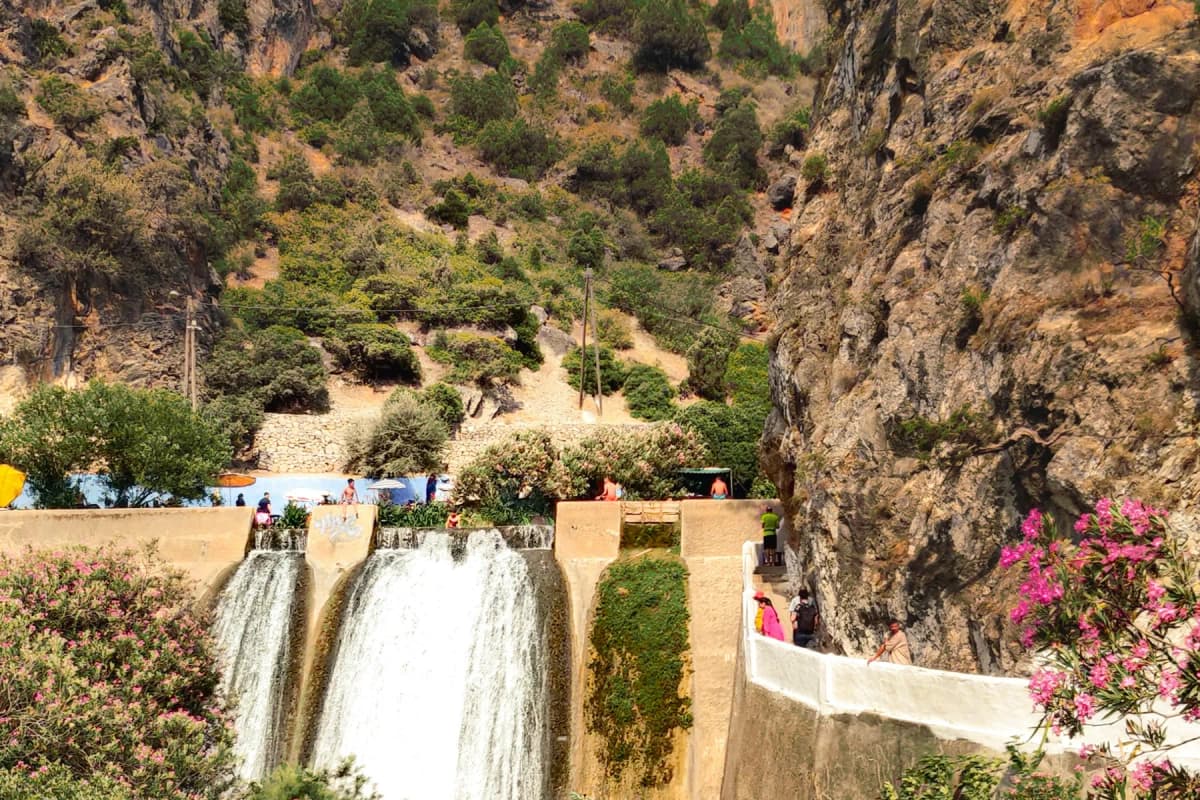
- Cost: Entry is free. A seat in a shared grand taxi from Chefchaouen is about 25 to 30 MAD each way, and parking is about 10 MAD if you drive.
- Time needed: A full day. Doing both trails means five to six hours of walking.
- Best time: April to June for strong water flow and mild weather. July and August weekends are crowded with Moroccan families.
- Tip: Shared taxis back to town thin out late in the day. Be at the car park by about 17:00, and wear shoes you can get wet.
12. Climb Jebel el-Kelaa
The limestone peak directly above town is Jebel el-Kelaa, 1,616 metres high. The trail starts behind the medina near the campsite and climbs about 1,000 metres through pine forest and open rock. The usual out-and-back route is about 13 km, and a longer loop is closer to 16 km. From the top you look down on the blue patch of the medina and, on a clear day, out towards the Mediterranean.
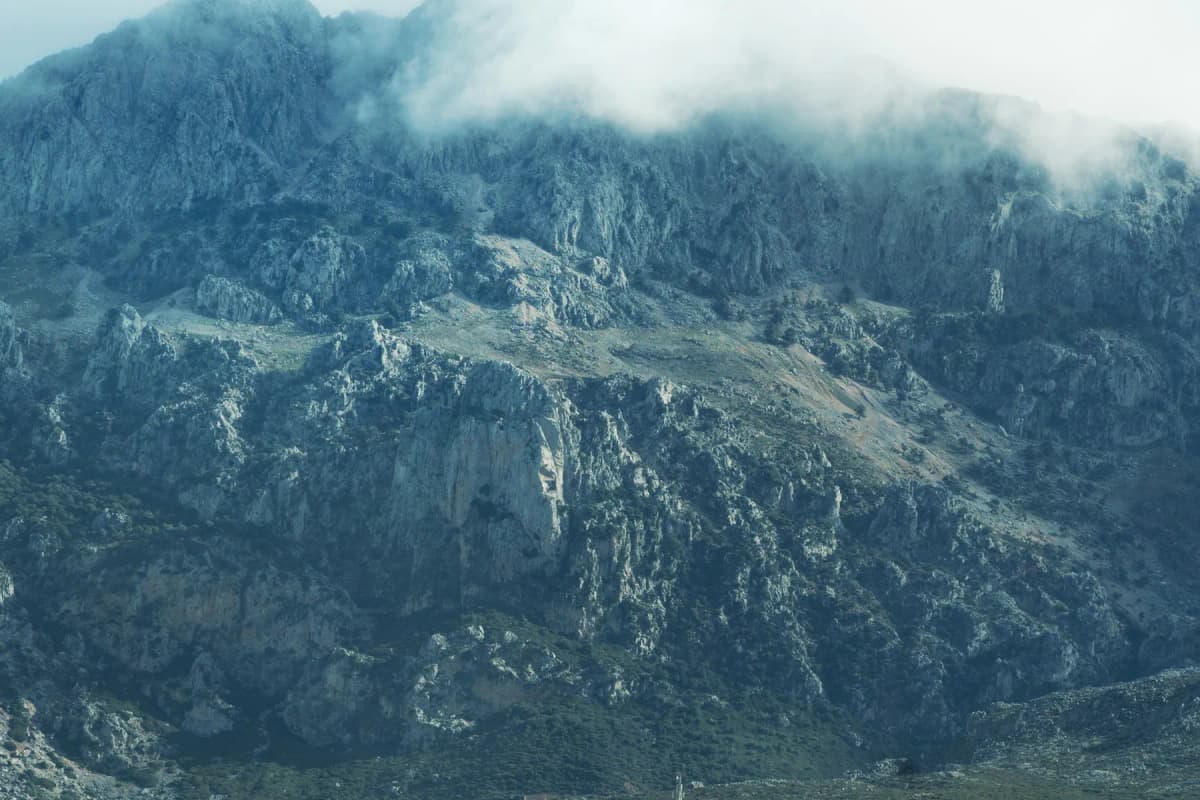
Photo: Youssef Mubarak on Unsplash
- Cost: Free. A local mountain guide costs roughly 300 to 500 MAD for the day.
- Time needed: 4 to 6 hours.
- Tip: The trail is not well marked on the upper section. Download an offline map, start early and carry at least two litres of water.
13. Spend a day in Talassemtane National Park
Akchour is only the edge of Talassemtane, a national park created in October 2004 to protect the last forests of Moroccan fir, a tree that grows nowhere else in the world. Beyond the waterfalls there are multi-day trails between mountain villages, where simple guesthouses offer a bed and dinner. This is a quieter side of the Rif that few day visitors see.
- Cost: No park entry fee. Village guesthouses charge roughly 200 to 300 MAD per person with meals.
- Tip: Parts of the Rif are used to grow cannabis. Stay on marked trails, do not photograph fields, and go with a registered guide if you plan to walk between villages.
Food and day trips
14. Eat the food of the Rif
Chefchaouen is one of the places named in UNESCO's listing of the Mediterranean diet as intangible cultural heritage, and the local cooking is worth your attention. Look for jben, a fresh goat cheese sold wrapped in palm leaves; bissara, a thick broad bean soup served with olive oil and cumin, usually for breakfast; and tagines made with local goat or with anchovies from the nearby coast. Bab Ssour is the restaurant most often recommended for home-style food at fair prices, and Café Clock has a rooftop and runs cooking classes.
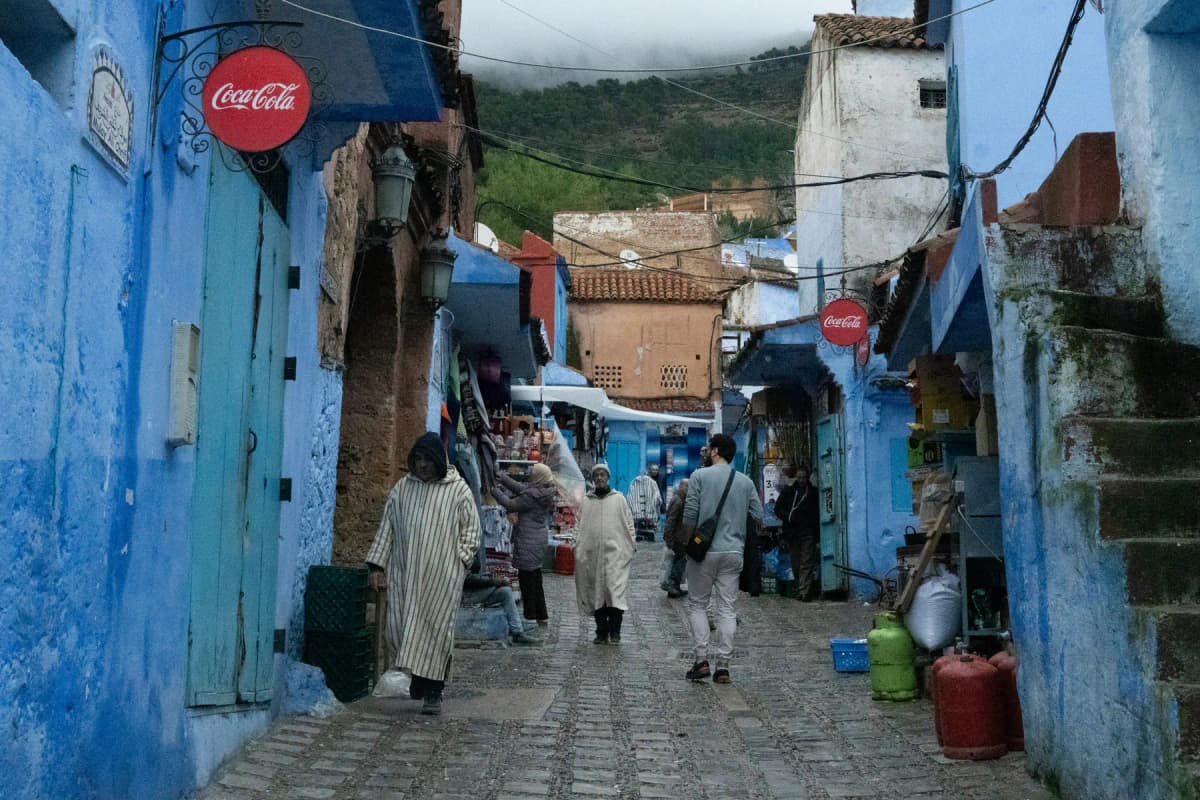
Photo: Youssef Mubarak on Unsplash
- Cost: A bowl of bissara is under 10 MAD. A tagine in a simple restaurant is about 40 to 70 MAD.
- Tip: Popular places fill up between 13:00 and 14:30 when day-trip groups eat. Go earlier or later.
15. Take a day trip to Tetouan
Tetouan is about 60 km north and makes an easy day out if you are staying three nights. Its medina has been a UNESCO World Heritage site since 1997 and is white where Chefchaouen is blue, with strong Andalusian influence and far fewer visitors. CTM buses take about an hour and a quarter.
- Cost: Bus about 30 to 60 MAD each way.
- Tip: If you are travelling on to Tangier, stop in Tetouan on the way north instead of coming back.
Free things to do in Chefchaouen
Most of the best things to do in Chefchaouen cost nothing:
- Walk the blue lanes of the medina and the Mellah
- Sit on Plaza Uta el-Hammam and look at the Grand Mosque's minaret
- Watch daily life at the Ras el-Maa spring
- Climb to the Spanish Mosque for sunset or sunrise
- Browse the Monday and Thursday market
- Hike Jebel el-Kelaa
- Walk the Akchour trails (you only pay for transport)
How to spend 1, 2 or 3 days in Chefchaouen
One day: Arrive the evening before if you can. Walk the medina before 9:00, visit the kasbah when it opens, and have lunch away from the plaza. In the afternoon, shop in the lanes, walk to Ras el-Maa and continue up to the Spanish Mosque for sunset. If you only have a single day and are based in Fes, a small-group day trip from Fes to Chefchaouen saves working out the buses, though it is a long day with about eight hours on the road.
Two days: Spend day one in town as above. On day two, take an early shared taxi to Akchour, hike to God's Bridge or the waterfalls, and be back in time for dinner on a rooftop.
Three days: Add Jebel el-Kelaa or a day trip to Tetouan, and leave time to do nothing on the plaza.
Chefchaouen fits naturally between Tangier and Fes on a longer route. Our 10-day Morocco itinerary shows how to fit it in, and the best places to visit in Morocco guide compares it with the other main stops.
Getting there and around
Chefchaouen has no airport and no train station. You arrive by bus, grand taxi or car.
| From | By bus (approx.) | Fare (approx.) |
|---|---|---|
| Tangier | 2.5 to 3 hours | 45 to 80 MAD |
| Fes | 4 to 5 hours | 80 to 140 MAD |
| Tetouan | 1 to 1.5 hours | 30 to 60 MAD |
| Casablanca or Rabat | 5 to 7 hours | Varies by operator |
CTM is the most reliable bus company on these routes. Seats sell out in spring and summer, so book a day or two ahead. Times and fares above come from operator and route-planner listings checked in October 2026.
The bus station is about 1.5 km downhill from the medina. The walk up is steep with luggage; a petit taxi costs about 15 to 20 MAD. If you are driving, cars cannot enter the medina. Guarded car parks near the gates charge about 20 MAD a night.
If you would rather not deal with buses after a flight, a pre-booked transfer from Tangier or Fes airport takes you straight to the medina gate. Mobile signal is good in town and patchy in the hills, so a Morocco eSIM set up before you land helps with offline maps for the trails. If you plan to hike, check that your travel insurance covers it; EKTA is one option that sells cover online.
Still comparing dates? Check flight prices to Morocco here:
Best time to visit Chefchaouen
April to June and September to October are the best months. Days are warm, the hills are green in spring and the walls have just been repainted. The town sits at about 560 metres, so it is cooler than Fes or Marrakech in summer, but July and August are busy with Moroccan holidaymakers and Akchour gets crowded. Winter is cold and often wet, with occasional snow on the peaks, and many guesthouses have little heating. For the rest of the country, see our month-by-month guide to the best time to visit Morocco.
Tips for visiting Chefchaouen
- Stay at least one night. The town is at its best before 9:00 and after 17:00, when day-trip groups are not there.
- Bring cash. There are ATMs outside the medina walls, but most small shops, taxis and cafés do not take cards.
- Wear shoes with grip. The lanes are steep, stepped and slippery when wet.
- Expect offers of hashish. The Rif is a cannabis-growing region and you may be approached, mostly near the plaza and on the mosque path. Recreational use is illegal in Morocco. A firm "no, thank you" is enough.
- Ask before you photograph people. Many residents, especially older women, do not want to be photographed. Doorways are also people's homes, so keep your voice down early in the morning.
- Dress modestly. This is a conservative mountain town. Covering shoulders and knees is appreciated.
Frequently asked questions
What not to miss in Chefchaouen?
Do not miss the blue medina early in the morning, the kasbah on Plaza Uta el-Hammam, the walk past Ras el-Maa to the Spanish Mosque at sunset and, if you have a second day, the Akchour waterfalls. Those four cover the town's history, its best view and the mountains around it.
How many days do you need in Chefchaouen?
Two nights is the right amount for most travellers. One full day is enough for the medina, the kasbah and the Spanish Mosque, and the second day is for Akchour or Jebel el-Kelaa. One night works if you are short on time; three suits hikers.
Is Chefchaouen, Morocco worth visiting?
Yes, if you are travelling between Tangier and Fes or have a week or more in Morocco. It is small, calm and unlike any other town in the country. It is less worth it as a rushed day trip from Fes, because you spend about eight hours on the road for three or four in town.
Why is Chefchaouen blue?
There is no single confirmed reason. The most common explanations are that Jewish refugees painted their quarter blue in the 1930s, that the colour repels mosquitoes, that it keeps houses cool and that the town extended it from the 1970s because visitors loved it. The walls are repainted every spring.
What is there to do in Chefchaouen at night?
Evenings are quiet. People eat on rooftop terraces, drink mint tea on Plaza Uta el-Hammam and walk the lamp-lit lanes. There are no clubs and very few places serve alcohol.
What can you see in Chefchaouen in one day?
In one day you can walk the medina, visit the kasbah and its museum, see the Ras el-Maa spring, shop for wool and baskets and watch the sunset from the Spanish Mosque. Akchour needs a separate day.
Is Chefchaouen safe for tourists?
Chefchaouen is generally regarded as one of the calmer, lower-pressure towns in Morocco. The main annoyances are offers of hashish and the occasional unofficial guide. On the trails, the risks are the usual ones: heat, slippery rock and getting back late.
Can you do Chefchaouen as a day trip from Fes or Tangier?
You can. From Tangier it is about two and a half hours each way, which leaves a reasonable afternoon in town. From Fes it is four hours or more each way, so an organised trip with a driver is easier than the bus. Staying overnight is better in both cases.
How we researched this guide
This guide is based on desk research, not a personal visit. We checked bus times and fares against CTM and route-planner listings, heritage details against UNESCO's pages, and prices and opening hours against visitor guides updated in 2026. All figures were checked in October 2026 and are approximate; where sources disagreed, we give a range or the higher number. If you find something that has changed, let us know.
For more of the country, start with our Morocco travel guide, then see the best things to do in Morocco and the best things to do in Fes, the usual next stop after Chefchaouen.